



One side of a parallelogram is 2.4 dam and its area is 576 $m^2$. Find its corresponding altitude.
A) 24 m
B) 24 cm
C) 24 dm
D) 24 dam
Answer
 Verified
612.6k+ views
Hint: Area of a parallelogram is given by multiplication of base of a parallelogram and its corresponding altitude. Here from the given value for the area of parallelogram and base of parallelogram we can get the corresponding altitude of parallelogram. Putting the values of area and base of a parallelogram in the Area formula, Area = Base $ \times $ Corresponding altitude, we can obtain the value of altitude.
Complete step-by-step answer:
Parallelogram is a quadrilateral having two opposite sides parallel. Opposite sides are congruent means equal in length. Any side of the parallelogram can be considered as base. Altitude is the perpendicular distance from a vertex of a parallelogram to the opposite side of parallelogram.
Here one sample diagram of a parallelogram is shown.
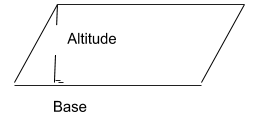
Here for given data for a parallelogram are, area (A) = 576 m2 and one side (base) of parallelogram is 2.4 dam.
Now, dam is a short form of Decameter. Decameter is the unit of length. Decameter unit can be converted in meters as 1 dam = 10 meter.
So, side of parallelogram (base) = 2.4 dam = $2.4 \times 10 = 24$ m
Now for parallelogram Area = Base $ \times $ Corresponding altitude
Putting the value of area and base in above equation in same unit of measurement as meter,
So, $576 = 24 \times $Altitude
Altitude = $\dfrac{{576}}{{24}}$
Altitude = $24$m
So the corresponding altitude of the parallelogram is 24 meter.
So option (A) is the correct answer.
Note: Each diagonal of the parallelogram cut the parallelogram in two equal triangles. So, the area of the parallelogram can also be calculated by adding the area of two triangles. Area of the triangle can be calculated by formula Area = $\dfrac{1}{2} \times $Base $ \times $ Height.
1 dam = 10m. 1m = 10dm. 1dm = 10cm.
Complete step-by-step answer:
Parallelogram is a quadrilateral having two opposite sides parallel. Opposite sides are congruent means equal in length. Any side of the parallelogram can be considered as base. Altitude is the perpendicular distance from a vertex of a parallelogram to the opposite side of parallelogram.
Here one sample diagram of a parallelogram is shown.
Here for given data for a parallelogram are, area (A) = 576 m2 and one side (base) of parallelogram is 2.4 dam.
Now, dam is a short form of Decameter. Decameter is the unit of length. Decameter unit can be converted in meters as 1 dam = 10 meter.
So, side of parallelogram (base) = 2.4 dam = $2.4 \times 10 = 24$ m
Now for parallelogram Area = Base $ \times $ Corresponding altitude
Putting the value of area and base in above equation in same unit of measurement as meter,
So, $576 = 24 \times $Altitude
Altitude = $\dfrac{{576}}{{24}}$
Altitude = $24$m
So the corresponding altitude of the parallelogram is 24 meter.
So option (A) is the correct answer.
Note: Each diagonal of the parallelogram cut the parallelogram in two equal triangles. So, the area of the parallelogram can also be calculated by adding the area of two triangles. Area of the triangle can be calculated by formula Area = $\dfrac{1}{2} \times $Base $ \times $ Height.
1 dam = 10m. 1m = 10dm. 1dm = 10cm.
Recently Updated Pages
Master Class 12 Business Studies: Engaging Questions & Answers for Success

Master Class 12 Biology: Engaging Questions & Answers for Success
Master Class 12 Chemistry: Engaging Questions & Answers for Success
Class 12 Question and Answer - Your Ultimate Solutions Guide
Master Class 11 Social Science: Engaging Questions & Answers for Success
Master Class 11 English: Engaging Questions & Answers for Success
Trending doubts
Find the sum of series 1 + 2 + 3 + 4 + 5 + + 100 class 9 maths CBSE
Fill the blanks with the suitable prepositions 1 The class 9 english CBSE
Difference Between Plant Cell and Animal Cell
How many hours before the closure of election must class 9 social science CBSE
What is pollution? How many types of pollution? Define it
Name 10 Living and Non living things class 9 biology CBSE