



One mole of glycerol is treated with an excess of \[\text{HI}\] to obtain isopropyl iodide. The number of \[\text{HI}\] consumed by one mole of glycerol in this reaction is:
Answer
 Verified
637.8k+ views
Hint: Hydro iodic acid, \[\text{HI}\], is an oxidising agent that reduces glycerol to 1,2,3-tri iodopropane is formed at first which is further reduced to form 1,2-diiodopropane and again reduced to form 2-iodopropane or isopropyl iodide.
Complete step by step answer:
The reactions can be represented by the following diagram:
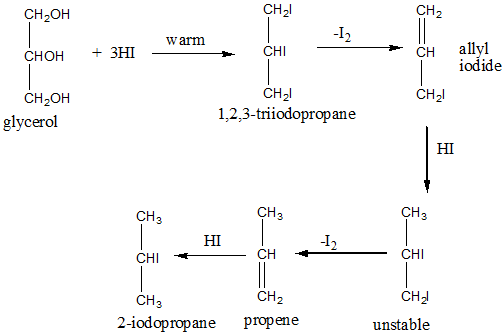
From the above figure it can be seen that a total of 5 moles of Hydrogen Iodide are consumed by 1 mole of glycerol. Three moles of Hydrogen Iodide are consumed in the first reaction when initially 1,2,3-tri iodopropane, which is not much stable and disintegrates quickly to form allyl iodide releasing iodine molecule.
This allyl iodide is further reduced by \[\text{HI}\] to form 1,2-diiodopropane, which is again unstable and dissociates to form propene. Propene is again reduced by \[\text{HI}\] to form 2-iodopropane which is the final product. Hence total 5 moles of \[\text{HI}\] required to reduce 1 mole of glycerol.
Note:
The bond between carbon and iodine is a weak bond due to the difference in their sizes. Hence it dissociates readily to form a stronger bond. The reaction between Glycerol and Hydrogen Iodide takes place in two ways, firstly, when glycerol is warmed with a small amount of Hydrogen Iodide, giving result to allyl iodide and secondly when both glycerol and Hydrogen Iodide are heated, the allyl iodide formed is reduced to propene which is reduced by Hydrogen Iodide again to form 2-propyl iodide or isopropyl iodide.
Complete step by step answer:
The reactions can be represented by the following diagram:
From the above figure it can be seen that a total of 5 moles of Hydrogen Iodide are consumed by 1 mole of glycerol. Three moles of Hydrogen Iodide are consumed in the first reaction when initially 1,2,3-tri iodopropane, which is not much stable and disintegrates quickly to form allyl iodide releasing iodine molecule.
This allyl iodide is further reduced by \[\text{HI}\] to form 1,2-diiodopropane, which is again unstable and dissociates to form propene. Propene is again reduced by \[\text{HI}\] to form 2-iodopropane which is the final product. Hence total 5 moles of \[\text{HI}\] required to reduce 1 mole of glycerol.
Note:
The bond between carbon and iodine is a weak bond due to the difference in their sizes. Hence it dissociates readily to form a stronger bond. The reaction between Glycerol and Hydrogen Iodide takes place in two ways, firstly, when glycerol is warmed with a small amount of Hydrogen Iodide, giving result to allyl iodide and secondly when both glycerol and Hydrogen Iodide are heated, the allyl iodide formed is reduced to propene which is reduced by Hydrogen Iodide again to form 2-propyl iodide or isopropyl iodide.
Recently Updated Pages
Explain the structure of megasporangium class 12 biology CBSE

Why is chloroform kept in dark coloured bottles class 12 chemistry CBSE
Derive the balancing condition of a Wheatstone bri class 12 physics CBSE
Draw VI characteristics of a pn junction diode Explain class 12 physics CBSE
Is it possible to carry pride in ones language too class 12 english CBSE
In a population at Hardy Weinberg equilibrium the allele class 12 biology CBSE
Trending doubts
Draw a labelled sketch of the human eye class 12 physics CBSE
Which are the Top 10 Largest Countries of the World?
Draw ray diagrams each showing i myopic eye and ii class 12 physics CBSE
Which is the correct genotypic ratio of mendel dihybrid class 12 biology CBSE
Differentiate between homogeneous and heterogeneous class 12 chemistry CBSE
Give 10 examples of unisexual and bisexual flowers