




One gram of a radioactive substance takes 50 sec to lose 1 centigram. Find its half-life period.
Answer
 Verified
584.7k+ views
Hint: To solve this question, we need to know the basic theory related to the Radioactive Decay like Radioactive Decay Law or half-life is the time for decaying half of the radioactive material. First, we calculate the rate constant (sometimes called radioactive decay constant) by using the law of radio-activity. And then after calculating half life time of the given radio-active material.
Formula used:
\[{\text{N = }}{{\text{N}}_{\text{0}}}{{\text{e}}^{{{ - \lambda t}}}}\]
Complete step by step answer:
As we know Radioactive decay law states that the number of nuclei undergoing decay per unit time is directly proportional to total number of nuclei in the sample.
Radioactive decay follows first order kinetics.
\[{\text{N = }}{{\text{N}}_{\text{0}}}{{\text{e}}^{{{ - \lambda t}}}}\]
Where,
N = number of nuclei in a sample after t = 1 cg = 0.01 g
${{\text{N}}_{\text{0}}}$ = initial amount = 1 g
$\lambda $= rate constant =?
t= time = 50 sec
Using law of radioactivity,
\[{\text{N = }}{{\text{N}}_{\text{0}}}{{\text{e}}^{{{ - \lambda t}}}}\]
Now, put all values in above equation, we get-
0.01 g = 1g ${{ \times }}{{\text{e}}^{{{ - \lambda \times 50s}}}}$
${{\text{e}}^{{{\lambda \times 50s}}}}$= 100
${{\lambda }}$= 0.09${{\text{s}}^{{\text{ - 1}}}}$
Relation of rate constant and half life
${{\lambda = }}\dfrac{{{\text{0}}{\text{.693}}}}{{{{\text{t}}_{{\text{1/2}}}}}}$
As we calculated, ${{\lambda }}$= 0.09${{\text{s}}^{{\text{ - 1}}}}$
0.09${{\text{s}}^{{\text{ - 1}}}}$= $\dfrac{{{\text{0}}{\text{.693}}}}{{{{\text{t}}_{{\text{1/2}}}}}}$
${{\text{t}}_{{\text{1/2}}}}$ = 7.7 sec
Note:
Radio-activity is the phenomenon shown by the nuclei of an atom as a result of nuclear instability. the first time Henry Becquerel showed this phenomenon. This is a process by which the nucleus of an unstable atom emits radiation and loses its energy.
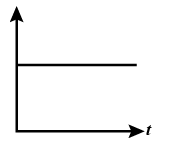
The half-life is the time for decay in which half of the radioactive material decay. Its expression is ${{\text{t}}_{{\text{1/2}}}} = \dfrac{0.693}{{ \lambda }}$ where λ is the decay constant. Thus, it is a constant value. And the graph between the half-life of a radioactive substance as a function of time is constant.
Formula used:
\[{\text{N = }}{{\text{N}}_{\text{0}}}{{\text{e}}^{{{ - \lambda t}}}}\]
Complete step by step answer:
As we know Radioactive decay law states that the number of nuclei undergoing decay per unit time is directly proportional to total number of nuclei in the sample.
Radioactive decay follows first order kinetics.
\[{\text{N = }}{{\text{N}}_{\text{0}}}{{\text{e}}^{{{ - \lambda t}}}}\]
Where,
N = number of nuclei in a sample after t = 1 cg = 0.01 g
${{\text{N}}_{\text{0}}}$ = initial amount = 1 g
$\lambda $= rate constant =?
t= time = 50 sec
Using law of radioactivity,
\[{\text{N = }}{{\text{N}}_{\text{0}}}{{\text{e}}^{{{ - \lambda t}}}}\]
Now, put all values in above equation, we get-
0.01 g = 1g ${{ \times }}{{\text{e}}^{{{ - \lambda \times 50s}}}}$
${{\text{e}}^{{{\lambda \times 50s}}}}$= 100
${{\lambda }}$= 0.09${{\text{s}}^{{\text{ - 1}}}}$
Relation of rate constant and half life
${{\lambda = }}\dfrac{{{\text{0}}{\text{.693}}}}{{{{\text{t}}_{{\text{1/2}}}}}}$
As we calculated, ${{\lambda }}$= 0.09${{\text{s}}^{{\text{ - 1}}}}$
0.09${{\text{s}}^{{\text{ - 1}}}}$= $\dfrac{{{\text{0}}{\text{.693}}}}{{{{\text{t}}_{{\text{1/2}}}}}}$
${{\text{t}}_{{\text{1/2}}}}$ = 7.7 sec
Note:
Radio-activity is the phenomenon shown by the nuclei of an atom as a result of nuclear instability. the first time Henry Becquerel showed this phenomenon. This is a process by which the nucleus of an unstable atom emits radiation and loses its energy.
The half-life is the time for decay in which half of the radioactive material decay. Its expression is ${{\text{t}}_{{\text{1/2}}}} = \dfrac{0.693}{{ \lambda }}$ where λ is the decay constant. Thus, it is a constant value. And the graph between the half-life of a radioactive substance as a function of time is constant.
Recently Updated Pages
Master Class 12 Economics: Engaging Questions & Answers for Success

Master Class 12 Physics: Engaging Questions & Answers for Success
Master Class 12 English: Engaging Questions & Answers for Success
Master Class 12 Social Science: Engaging Questions & Answers for Success
Master Class 12 Maths: Engaging Questions & Answers for Success
Master Class 12 Business Studies: Engaging Questions & Answers for Success
Trending doubts
Which are the Top 10 Largest Countries of the World?
What are the major means of transport Explain each class 12 social science CBSE
Draw a labelled sketch of the human eye class 12 physics CBSE
Why cannot DNA pass through cell membranes class 12 biology CBSE
Differentiate between insitu conservation and exsitu class 12 biology CBSE
Draw a neat and well labeled diagram of TS of ovary class 12 biology CBSE