




One face of the sheet of cork, 3mm thick is placed in contact with one face of a sheet of glass 5mm thick, both sheets being 20 cm square. The outer face of this square composite sheet is maintained at ${{100}^{\circ }}C$and ${{20}^{\circ }}C$, the glass being at the higher mean temperature. Find: (i) The temperature of glass-cork interface and (ii) The rate at which heat is conducted across the sheet neglecting edge effects.
Thermal conductivity of cork: $6.3\times {{10}^{-2}}W{{m}^{-1}}{{K}^{-1}}$
Thermal conductivity of glass: $7.2\times {{10}^{-2}}W{{m}^{-1}}{{K}^{-1}}$
Answer
 Verified
589.8k+ views
Hint: Assume that temperature of glass-cork interface is ${{T}^{\circ }}C$. As we know that, heat current across a layer is given by: $Q=\dfrac{KA}{l}\Delta T$, where Q is heat current, k is thermal conductivity, A is the area, l is the length and $\Delta T$ is the temperature difference. Find the heat current for both the sheets in terms of T and then equate both the equations to get the value of the temperature of the glass-cork interface. Later, substitute the value of T in any of the equations to get the rate of heat conducted.
Complete step by step answer:
We have the following setup of glass and cork sheet:
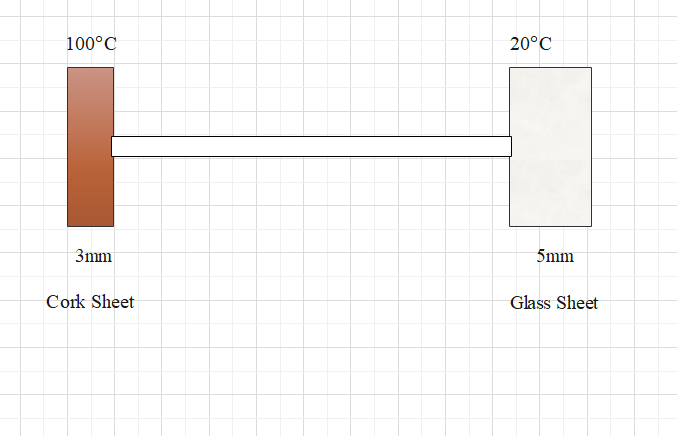
We have:
Thermal conductivity of cork: $6.3\times {{10}^{-2}}W{{m}^{-1}}{{K}^{-1}}$
Thermal conductivity of glass: $7.2\times {{10}^{-2}}W{{m}^{-1}}{{K}^{-1}}$
Length of cork: 3 mm $=3\times {{10}^{-3}}m$
Length of glass: 5 mm $=5\times {{10}^{-3}}m$
Area of glass = Area of cork = $20c{{m}^{2}}=20\times {{10}^{-4}}{{m}^{2}}$
So, by using the formula for heat rate: $Q=\dfrac{KA}{l}\Delta T$, we get:
For cork sheet:
\[{{Q}_{c}}=\dfrac{6.3\times {{10}^{-2}}\times 20\times {{10}^{-4}}}{3\times {{10}^{-3}}}\left( 100-T \right)......(1)\]
For glass sheet:
${{Q}_{g}}=\dfrac{7.2\times {{10}^{-2}}\times 20\times {{10}^{-4}}}{5\times {{10}^{-3}}}\left( T-20 \right)......(2)$
Since, heat released by the cork sheet is equal to heat gained by glass sheet, we get:
\[\begin{align}
& {{Q}_{c}}={{Q}_{g}} \\
& \dfrac{6.3\times {{10}^{-2}}\times 20\times {{10}^{-4}}}{3\times {{10}^{-3}}}\left( 100-T \right)=\dfrac{7.2\times {{10}^{-2}}\times 20\times {{10}^{-4}}}{5\times {{10}^{-3}}}\left( T-20 \right) \\
& 42\times {{10}^{-3}}\left( 100-T \right)={{28.810}^{-2}}\left( T-20 \right) \\
& 1.146T=100+2.92 \\
& T\approx {{90}^{\circ }}C
\end{align}\]
Hence, the temperature of glass-cork interface is \[T\approx {{90}^{\circ }}C\]
Now, put the value of T in any of the equation (say equation (1)), we get: \[\begin{align}
& Q=\dfrac{6.3\times {{10}^{-2}}\times 20\times {{10}^{-4}}}{3\times {{10}^{-3}}}\left( 100-90 \right)......(1) \\
& =2940\times {{10}^{-3}} \\
& =2.94J{{s}^{-1}}
\end{align}\]
Note:
Thermal conductivity refers to the ability of a given material to conduct/transfer heat. It is generally denoted by the symbol 'k'. The reciprocal of this quantity is known as thermal resistivity.
Complete step by step answer:
We have the following setup of glass and cork sheet:
We have:
Thermal conductivity of cork: $6.3\times {{10}^{-2}}W{{m}^{-1}}{{K}^{-1}}$
Thermal conductivity of glass: $7.2\times {{10}^{-2}}W{{m}^{-1}}{{K}^{-1}}$
Length of cork: 3 mm $=3\times {{10}^{-3}}m$
Length of glass: 5 mm $=5\times {{10}^{-3}}m$
Area of glass = Area of cork = $20c{{m}^{2}}=20\times {{10}^{-4}}{{m}^{2}}$
So, by using the formula for heat rate: $Q=\dfrac{KA}{l}\Delta T$, we get:
For cork sheet:
\[{{Q}_{c}}=\dfrac{6.3\times {{10}^{-2}}\times 20\times {{10}^{-4}}}{3\times {{10}^{-3}}}\left( 100-T \right)......(1)\]
For glass sheet:
${{Q}_{g}}=\dfrac{7.2\times {{10}^{-2}}\times 20\times {{10}^{-4}}}{5\times {{10}^{-3}}}\left( T-20 \right)......(2)$
Since, heat released by the cork sheet is equal to heat gained by glass sheet, we get:
\[\begin{align}
& {{Q}_{c}}={{Q}_{g}} \\
& \dfrac{6.3\times {{10}^{-2}}\times 20\times {{10}^{-4}}}{3\times {{10}^{-3}}}\left( 100-T \right)=\dfrac{7.2\times {{10}^{-2}}\times 20\times {{10}^{-4}}}{5\times {{10}^{-3}}}\left( T-20 \right) \\
& 42\times {{10}^{-3}}\left( 100-T \right)={{28.810}^{-2}}\left( T-20 \right) \\
& 1.146T=100+2.92 \\
& T\approx {{90}^{\circ }}C
\end{align}\]
Hence, the temperature of glass-cork interface is \[T\approx {{90}^{\circ }}C\]
Now, put the value of T in any of the equation (say equation (1)), we get: \[\begin{align}
& Q=\dfrac{6.3\times {{10}^{-2}}\times 20\times {{10}^{-4}}}{3\times {{10}^{-3}}}\left( 100-90 \right)......(1) \\
& =2940\times {{10}^{-3}} \\
& =2.94J{{s}^{-1}}
\end{align}\]
Note:
Thermal conductivity refers to the ability of a given material to conduct/transfer heat. It is generally denoted by the symbol 'k'. The reciprocal of this quantity is known as thermal resistivity.
Recently Updated Pages
Basicity of sulphurous acid and sulphuric acid are

Master Class 12 English: Engaging Questions & Answers for Success
Master Class 12 Social Science: Engaging Questions & Answers for Success
Master Class 12 Maths: Engaging Questions & Answers for Success
Master Class 12 Economics: Engaging Questions & Answers for Success
Master Class 12 Physics: Engaging Questions & Answers for Success
Trending doubts
Which are the Top 10 Largest Countries of the World?
Draw a labelled sketch of the human eye class 12 physics CBSE
Which country did Danny Casey play for class 12 english CBSE
Give 10 examples of unisexual and bisexual flowers
Coming together federation is practiced in A India class 12 social science CBSE
Write the formula to find the shortest distance between class 12 maths CBSE