




On the axis of any parabola \[{{y}^{2}}=4ax\]there is a certain point K on the x-axis which has the property that, if a chord PQ of the parabola be drawn through it, then $ \dfrac{1}{{{(PK)}^{2}}}+\dfrac{1}{{{(QK)}^{2}}} $ is same for all position of chord. Find the coordinate of K.
A.(4a,0)
B.(2a,0)
C.(a,0)
D.None of these
Answer
 Verified
663.9k+ views
Hint: First we will draw a parabola whose vertex is on origin and opens on the right side. Then draw a cord which intersects the x-axis at a point K (0, d) (assume it). Now we will have a line PQ, Find the coordinate of P and Q and try to find the coordinate of K.
Complete step-by-step answer:
Draw the given parabola \[{{y}^{2}}=4ax\] and also draw a chord PQ which is passing through point K having an angle $ \theta $ with x axis which is basically line’s slope.
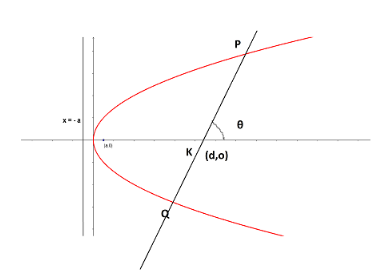
Equation of line PQ which is passing through K and having slope $ \theta $ and equal distance from both axis ‘r’.
$ \dfrac{x-d}{\cos \theta }=\dfrac{y-0}{\sin \theta }=r $
Now we can find the coordinates of P and Q.
$ \begin{align}
& P=[PK\cos \theta +d,PK\sin \theta ], \\
& Q=[-QK\cos \theta +d,-QK\sin \theta ] \\
\end{align} $ $ (given:PK=QK=r) $
P and Q lies on parabola so it must satisfy the equation of parabola.
$ \begin{align}
& {{(PK)}^{2}}{{\sin }^{2}}\theta =4a(PK\cos \theta +d) \\
& {{(PK)}^{2}}{{\sin }^{2}}\theta -PK.4a\cos \theta -4ad \\
\end{align} $
……………….. (1)
$ \begin{align}
& {{(QK)}^{2}}{{\sin }^{2}}\theta =4a(-QK\cos \theta +d) \\
& {{(QK)}^{2}}{{\sin }^{2}}\theta +QK.4a\cos \theta -4ad=0 \\
\end{align} $
………………. (2)
Equation 1 and equation 2 is an quadratic equation,
$ PK=\dfrac{4a\cos \theta +\sqrt{16{{a}^{2}}{{\cos }^{2}}\theta +16ad{{\sin }^{2}}\theta }}{2{{\sin }^{2}}\theta } $
We will ignore the negative value.
\[QK=\dfrac{-4a\cos \theta +\sqrt{16{{a}^{2}}{{\cos }^{2}}\theta +16ad{{\sin }^{2}}\theta }}{2{{\sin }^{2}}\theta }\]
We will ignore the negative value.
Now, we will have,
$ \dfrac{1}{{{(PK)}^{2}}}+\dfrac{1}{{{(QK)}^{2}}}=\dfrac{2a{{\cos }^{2}}\theta +d{{\sin }^{2}}\theta }{2a{{d}^{2}}} $
It is given that the value of $ \dfrac{1}{{{(PK)}^{2}}}+\dfrac{1}{{{(QK)}^{2}}} $ is same.
It should be independent from $ \theta $ . To make it independent from $ \theta $ , substitute $ d=2a $ .
$ \dfrac{1}{{{(PK)}^{2}}}+\dfrac{1}{{{(QK)}^{2}}}=\dfrac{2a{{\cos }^{2}}\theta +2a{{\sin }^{2}}\theta }{2a{{(2a)}^{2}}}=\dfrac{1}{4{{a}^{2}}} $
Hence the coordinate of K is (2a,0).
Option (B) is correct.
Note: Recall the equation of lines which two coordinate or one point and slope etc. are given. The parabola is defined as the locus of a point which moves so that it is always the same distance from a fixed point (called the focus) and a given line (called the directrix).
Complete step-by-step answer:
Draw the given parabola \[{{y}^{2}}=4ax\] and also draw a chord PQ which is passing through point K having an angle $ \theta $ with x axis which is basically line’s slope.
Equation of line PQ which is passing through K and having slope $ \theta $ and equal distance from both axis ‘r’.
$ \dfrac{x-d}{\cos \theta }=\dfrac{y-0}{\sin \theta }=r $
Now we can find the coordinates of P and Q.
$ \begin{align}
& P=[PK\cos \theta +d,PK\sin \theta ], \\
& Q=[-QK\cos \theta +d,-QK\sin \theta ] \\
\end{align} $ $ (given:PK=QK=r) $
P and Q lies on parabola so it must satisfy the equation of parabola.
$ \begin{align}
& {{(PK)}^{2}}{{\sin }^{2}}\theta =4a(PK\cos \theta +d) \\
& {{(PK)}^{2}}{{\sin }^{2}}\theta -PK.4a\cos \theta -4ad \\
\end{align} $
……………….. (1)
$ \begin{align}
& {{(QK)}^{2}}{{\sin }^{2}}\theta =4a(-QK\cos \theta +d) \\
& {{(QK)}^{2}}{{\sin }^{2}}\theta +QK.4a\cos \theta -4ad=0 \\
\end{align} $
………………. (2)
Equation 1 and equation 2 is an quadratic equation,
$ PK=\dfrac{4a\cos \theta +\sqrt{16{{a}^{2}}{{\cos }^{2}}\theta +16ad{{\sin }^{2}}\theta }}{2{{\sin }^{2}}\theta } $
We will ignore the negative value.
\[QK=\dfrac{-4a\cos \theta +\sqrt{16{{a}^{2}}{{\cos }^{2}}\theta +16ad{{\sin }^{2}}\theta }}{2{{\sin }^{2}}\theta }\]
We will ignore the negative value.
Now, we will have,
$ \dfrac{1}{{{(PK)}^{2}}}+\dfrac{1}{{{(QK)}^{2}}}=\dfrac{2a{{\cos }^{2}}\theta +d{{\sin }^{2}}\theta }{2a{{d}^{2}}} $
It is given that the value of $ \dfrac{1}{{{(PK)}^{2}}}+\dfrac{1}{{{(QK)}^{2}}} $ is same.
It should be independent from $ \theta $ . To make it independent from $ \theta $ , substitute $ d=2a $ .
$ \dfrac{1}{{{(PK)}^{2}}}+\dfrac{1}{{{(QK)}^{2}}}=\dfrac{2a{{\cos }^{2}}\theta +2a{{\sin }^{2}}\theta }{2a{{(2a)}^{2}}}=\dfrac{1}{4{{a}^{2}}} $
Hence the coordinate of K is (2a,0).
Option (B) is correct.
Note: Recall the equation of lines which two coordinate or one point and slope etc. are given. The parabola is defined as the locus of a point which moves so that it is always the same distance from a fixed point (called the focus) and a given line (called the directrix).
Recently Updated Pages
Which of the following graphs shows the variation of class 12 physics CBSE

Draw a labelled diagram of the human male reproductive class 12 biology CBSE
Describe the experiment to compare the emf of two cells class 12 physics CBSE
What is standard hydrogen electrode
What is conventional current and electric current class 12 physics CBSE
2Bromopentane is treated with an alcoholic KOH solution class 12 chemistry CBSE
Trending doubts
Draw a labelled sketch of the human eye class 12 physics CBSE
Which are the Top 10 Largest Countries of the World?
A member of Simon commission later became Prime Minister class 12 social science CBSE
Differentiate between homogeneous and heterogeneous class 12 chemistry CBSE
Draw ray diagrams each showing i myopic eye and ii class 12 physics CBSE
Which is the correct genotypic ratio of mendel dihybrid class 12 biology CBSE