




On heating glycerol with excess amount of ${\rm{HI}}$, the product formed is:
A. Allyl iodide
B. Isopropyl iodide
C. Propylene
D. $1,2,3 - {\rm{tri iodopropane}}$
Answer
 Verified
626.4k+ views
Hint: Glycerol has three hydroxyl groups that take part in the reaction and the final product is formed after going through some intermediates. These intermediates decide which type of reaction is going to happen.
Step by step answer: We know that one method of preparing halogenated alkanes is the reaction of alcohols with suitable hydrogen halide. However, we have to take into account the reactant’s properties and reaction conditions as well while deducing the final product. Here, we are given a reaction of heating glycerol with an excess amount of ${\rm{HI}}$. Let’s look at our reactant, first of all which has the following structure:
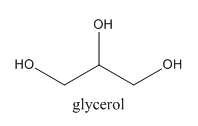
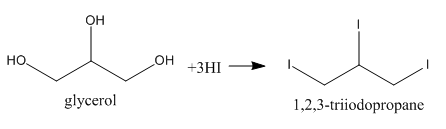
As we can see, three $ - {\rm{OH}}$ groups are present at each of the three carbon atoms. We can write its proper name to be ${\rm{Propane}} - {\rm{1, 2, 3}} - {\rm{triol}}$. Now, upon reacting with excess of ${\rm{HI}}$, we can say that all of the three $ - {\rm{OH}}$ groups would be replaced by iodides as in any normal reaction but here, this product is not stable but an intermediate one. We can show the reaction as follows:
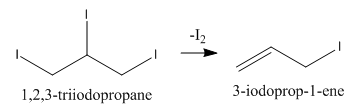
We can write the next step of the reaction in which $1,2,3 - {\rm{triiodopropane}}$ loses a molecule of iodine as follows:
We know that \[{\rm{3 - iodoprop - 1 - ene}}\] is also known as allyl iodide and it can add one molecule of ${\rm{HI}}$ as follows:
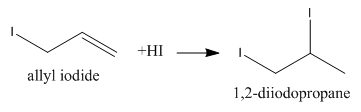
As we can see that this addition product, \[{\rm{1,2 - diiodopropane}}\] can also eliminate one iodine molecule as follows:
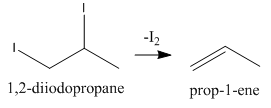
Now, again we have an alkene that can add one molecule of ${\rm{HI}}$ to give the final product as follows:
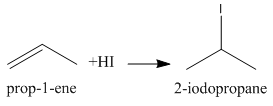
We know that \[{\rm{2 - iodopropane}}\] is also known as Isopropyl iodide.
Hence, the correct option is B.
Note: Here, we have used both the common names as well as IUPAC names for the compounds so it is necessary to know both systems. We have to look for the reaction condition very carefully because the above reaction is possible only when we have an excess amount of ${\rm{HI}}$.
Step by step answer: We know that one method of preparing halogenated alkanes is the reaction of alcohols with suitable hydrogen halide. However, we have to take into account the reactant’s properties and reaction conditions as well while deducing the final product. Here, we are given a reaction of heating glycerol with an excess amount of ${\rm{HI}}$. Let’s look at our reactant, first of all which has the following structure:
As we can see, three $ - {\rm{OH}}$ groups are present at each of the three carbon atoms. We can write its proper name to be ${\rm{Propane}} - {\rm{1, 2, 3}} - {\rm{triol}}$. Now, upon reacting with excess of ${\rm{HI}}$, we can say that all of the three $ - {\rm{OH}}$ groups would be replaced by iodides as in any normal reaction but here, this product is not stable but an intermediate one. We can show the reaction as follows:
We can write the next step of the reaction in which $1,2,3 - {\rm{triiodopropane}}$ loses a molecule of iodine as follows:
We know that \[{\rm{3 - iodoprop - 1 - ene}}\] is also known as allyl iodide and it can add one molecule of ${\rm{HI}}$ as follows:
As we can see that this addition product, \[{\rm{1,2 - diiodopropane}}\] can also eliminate one iodine molecule as follows:
Now, again we have an alkene that can add one molecule of ${\rm{HI}}$ to give the final product as follows:
We know that \[{\rm{2 - iodopropane}}\] is also known as Isopropyl iodide.
Hence, the correct option is B.
Note: Here, we have used both the common names as well as IUPAC names for the compounds so it is necessary to know both systems. We have to look for the reaction condition very carefully because the above reaction is possible only when we have an excess amount of ${\rm{HI}}$.
Recently Updated Pages
Explain the structure of megasporangium class 12 biology CBSE

Why is chloroform kept in dark coloured bottles class 12 chemistry CBSE
Derive the balancing condition of a Wheatstone bri class 12 physics CBSE
Draw VI characteristics of a pn junction diode Explain class 12 physics CBSE
Is it possible to carry pride in ones language too class 12 english CBSE
In a population at Hardy Weinberg equilibrium the allele class 12 biology CBSE
Trending doubts
Draw a labelled sketch of the human eye class 12 physics CBSE
Which are the Top 10 Largest Countries of the World?
Draw ray diagrams each showing i myopic eye and ii class 12 physics CBSE
Which is the correct genotypic ratio of mendel dihybrid class 12 biology CBSE
Differentiate between homogeneous and heterogeneous class 12 chemistry CBSE
Which animal never drinks water in its entire life class 12 biology CBSE