




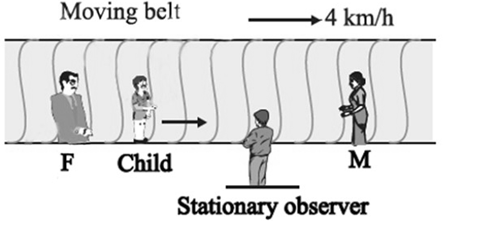
: On a long horizontally moving belt (Fig), a child runs to and fro with speed 9km/h ( with respect to the belt) between his father and mother located 50m apart on the moving belt. The belt moves with a speed of 4km/h. For an observer on a stationary platform outside, what is the
a) Speed of the child running in the direction of the belt.
b) Speed of child running opposite in the direction of motion of the belt.
c) Time is taken by the child (a) and (b).
Answer
 Verified
593.1k+ views
Hint:-The relative velocity of an object A with respect to another object B is the time rate at which the object A changes its position with respect to the object B. To solve this problem, we used the relative velocity formula to calculate the speed of the child in the direction and opposite to the direction of motion of the belt.
Formula used: For the same direction ${{\rm{V}}_{{\rm{BA}}}}\; = \;({{\rm{V}}_{\rm{B}}}\; - {{\rm{V}}_{\rm{A}}})$
Also for opposite direction ${{\rm{V}}_{{\rm{BA}}\;}} = (\; - {{\rm{V}}_{\rm{B}}}\; - {{\rm{V}}_{\rm{A}}})$
Complete step-by-step solution:i) According to given data,
Speed of the belt $ = \;4km{h^{ - 1}}$
Speed of the child with respect to belt $\left( {{{\rm{V}}_{{\rm{cb}}}}} \right)$$ = \;9km{h^{ - 1}}$
$ \Rightarrow \;{{\rm{V}}_{{\rm{cb}}}}\; = \,{{\rm{V}}_{\rm{c}}}\; - \;{{\rm{V}}_{\rm{b}}}$
$ \Rightarrow 9km{h^{ - 1}}\; = \;{{\rm{V}}_{\rm{c}}} - \;4km{h^{ - 1}}$
$ \Rightarrow \;{{\rm{V}}_{\rm{c}}}\; = \,(9 + 4)km{h^{ - 1}}\, = 13km{h^{ - 1}}$
Therefore the speed of child running in the direction of motion of the belt $ = 13km{h^{ - 1}}$
ii) Now, the child runs in the opposite direction.
The speed of the belt $ = 4km{h^{ - 1}}$
Speed of the child with respect to belt $\left( {{{\rm{V}}_{{\rm{cb}}}}} \right)$$ = \; - 9km{h^{ - 1}}$
(Here negative sign indicates that child run in opposite direction)
$ \Rightarrow \;{{\rm{V}}_{{\rm{cb}}}}\; = \,{{\rm{V}}_{\rm{c}}}\; - \;{{\rm{V}}_{\rm{b}}}$
$ \Rightarrow - 9km{h^{ - 1}}\; = \;{{\rm{V}}_{\rm{c}}} - \;4km{h^{ - 1}}$
$ \Rightarrow \;{{\rm{V}}_{\rm{c}}}\; = \,( - 9 + 4)km{h^{ - 1}}\, = - 5km{h^{ - 1}}$
Therefore the speed of child running in the opposite direction of motion of the belt $ = - 5km{h^{ - 1}}$
iii) The speed of the child observed by the stationary observers (i.e. mother and father) both presents on the same belt. When a child runs there is only change in direction; it becomes positive in the same direction and negative in the opposite direction.
So the time taken by the child in both cases, ${\rm{Time = }}\dfrac{{{\rm{Distance}}}}{{{\rm{Speed}}}}$ ………(1)
Given distance $ = 50m$
Also the speed of the child given in forward and backward direction $ = \;9km{h^{ - 1}} = 9 \times \dfrac{5}{{18}} = 2.5m/s$
Now, substitute the value in equation (1) we get,
${\rm{Time = }}\dfrac{{50m}}{{2.5m/s}}\; = \;\dfrac{{50 \times 10}}{{25}} = 20\sec $
Therefore the time taken by the child in case of (a) and (b) $ = 20\sec $
Note:- In the above question two different frames are involved i.e. an inertial frame and a stationary frame. It depends on the observer on which he is standing and the motion of the object seen by the observer on each of these frames will be different.
Formula used: For the same direction ${{\rm{V}}_{{\rm{BA}}}}\; = \;({{\rm{V}}_{\rm{B}}}\; - {{\rm{V}}_{\rm{A}}})$
Also for opposite direction ${{\rm{V}}_{{\rm{BA}}\;}} = (\; - {{\rm{V}}_{\rm{B}}}\; - {{\rm{V}}_{\rm{A}}})$
Complete step-by-step solution:i) According to given data,
Speed of the belt $ = \;4km{h^{ - 1}}$
Speed of the child with respect to belt $\left( {{{\rm{V}}_{{\rm{cb}}}}} \right)$$ = \;9km{h^{ - 1}}$
$ \Rightarrow \;{{\rm{V}}_{{\rm{cb}}}}\; = \,{{\rm{V}}_{\rm{c}}}\; - \;{{\rm{V}}_{\rm{b}}}$
$ \Rightarrow 9km{h^{ - 1}}\; = \;{{\rm{V}}_{\rm{c}}} - \;4km{h^{ - 1}}$
$ \Rightarrow \;{{\rm{V}}_{\rm{c}}}\; = \,(9 + 4)km{h^{ - 1}}\, = 13km{h^{ - 1}}$
Therefore the speed of child running in the direction of motion of the belt $ = 13km{h^{ - 1}}$
ii) Now, the child runs in the opposite direction.
The speed of the belt $ = 4km{h^{ - 1}}$
Speed of the child with respect to belt $\left( {{{\rm{V}}_{{\rm{cb}}}}} \right)$$ = \; - 9km{h^{ - 1}}$
(Here negative sign indicates that child run in opposite direction)
$ \Rightarrow \;{{\rm{V}}_{{\rm{cb}}}}\; = \,{{\rm{V}}_{\rm{c}}}\; - \;{{\rm{V}}_{\rm{b}}}$
$ \Rightarrow - 9km{h^{ - 1}}\; = \;{{\rm{V}}_{\rm{c}}} - \;4km{h^{ - 1}}$
$ \Rightarrow \;{{\rm{V}}_{\rm{c}}}\; = \,( - 9 + 4)km{h^{ - 1}}\, = - 5km{h^{ - 1}}$
Therefore the speed of child running in the opposite direction of motion of the belt $ = - 5km{h^{ - 1}}$
iii) The speed of the child observed by the stationary observers (i.e. mother and father) both presents on the same belt. When a child runs there is only change in direction; it becomes positive in the same direction and negative in the opposite direction.
So the time taken by the child in both cases, ${\rm{Time = }}\dfrac{{{\rm{Distance}}}}{{{\rm{Speed}}}}$ ………(1)
Given distance $ = 50m$
Also the speed of the child given in forward and backward direction $ = \;9km{h^{ - 1}} = 9 \times \dfrac{5}{{18}} = 2.5m/s$
Now, substitute the value in equation (1) we get,
${\rm{Time = }}\dfrac{{50m}}{{2.5m/s}}\; = \;\dfrac{{50 \times 10}}{{25}} = 20\sec $
Therefore the time taken by the child in case of (a) and (b) $ = 20\sec $
Note:- In the above question two different frames are involved i.e. an inertial frame and a stationary frame. It depends on the observer on which he is standing and the motion of the object seen by the observer on each of these frames will be different.
Recently Updated Pages
Basicity of sulphurous acid and sulphuric acid are

Master Class 12 English: Engaging Questions & Answers for Success
Master Class 12 Social Science: Engaging Questions & Answers for Success
Master Class 12 Maths: Engaging Questions & Answers for Success
Master Class 12 Economics: Engaging Questions & Answers for Success
Master Class 12 Physics: Engaging Questions & Answers for Success
Trending doubts
Which are the Top 10 Largest Countries of the World?
Draw a labelled sketch of the human eye class 12 physics CBSE
Which country did Danny Casey play for class 12 english CBSE
Give 10 examples of unisexual and bisexual flowers
Coming together federation is practiced in A India class 12 social science CBSE
Write the formula to find the shortest distance between class 12 maths CBSE