




Of \[{\text{P}}{{\text{H}}_3}\] and \[{{\text{H}}_{\text{2}}}{\text{S}}\] which is more acidic and why?
Answer
 Verified
630.9k+ views
Hint: The acidity of a molecule depends upon the polarity of the bond. More polar bonds cause the more acidity of the molecule. Electronegativity is defined as the power of an atom to attract the bonded electrons toward itself.
Complete answer:
Acidity is defined as the strength of acid to donate a proton. More acidity means more is the power to release protons.
If an atom has more electronegative it will attract the electrons towards itself, so it will get a negative charge and another bonded atom will get a positive charge. So, on increasing electronegativity difference the polarity of bond increases.
If another atom is hydrogen then the hydrogen will release in the form of a proton when the bond will break.
So, as the polarity increases the acidity of the acid increases.
In phosphorus hydride, the central atom is phosphorous and in hydrogen sulphide, the central atom is sulphur.
The structure of the phosphorus hydride and hydrogen sulphide is as follows:
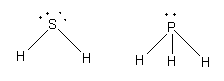
The electronegative of phosphorus is 2.2 and sulphur is 2.6. So, the electronegativity of sulphur is more than phosphorus and thus sulphur-hydrogen bond is more polar than phosphorus-hydrogen bond.
So, the acidity of hydrogen sulphide is more than the acidity of phosphorus hydride.
Therefore, \[{{\text{H}}_{\text{2}}}{\text{S}}\] is more acidic due to a more polar sulphur-hydrogen bond.
Note: In a period of p-block, the electronegativity increases from right to left thus, the polarity of non-metal and hydrogen bonds increases, so the acidity of non-metal hydride increases from right to left in a period.
Complete answer:
Acidity is defined as the strength of acid to donate a proton. More acidity means more is the power to release protons.
If an atom has more electronegative it will attract the electrons towards itself, so it will get a negative charge and another bonded atom will get a positive charge. So, on increasing electronegativity difference the polarity of bond increases.
If another atom is hydrogen then the hydrogen will release in the form of a proton when the bond will break.
So, as the polarity increases the acidity of the acid increases.
In phosphorus hydride, the central atom is phosphorous and in hydrogen sulphide, the central atom is sulphur.
The structure of the phosphorus hydride and hydrogen sulphide is as follows:
The electronegative of phosphorus is 2.2 and sulphur is 2.6. So, the electronegativity of sulphur is more than phosphorus and thus sulphur-hydrogen bond is more polar than phosphorus-hydrogen bond.
So, the acidity of hydrogen sulphide is more than the acidity of phosphorus hydride.
Therefore, \[{{\text{H}}_{\text{2}}}{\text{S}}\] is more acidic due to a more polar sulphur-hydrogen bond.
Note: In a period of p-block, the electronegativity increases from right to left thus, the polarity of non-metal and hydrogen bonds increases, so the acidity of non-metal hydride increases from right to left in a period.
Recently Updated Pages
Basicity of sulphurous acid and sulphuric acid are

Master Class 12 Economics: Engaging Questions & Answers for Success
Master Class 12 Biology: Engaging Questions & Answers for Success
Master Class 11 English: Engaging Questions & Answers for Success
Master Class 11 Physics: Engaging Questions & Answers for Success
Master Class 11 Computer Science: Engaging Questions & Answers for Success
Trending doubts
Draw a labelled sketch of the human eye class 12 physics CBSE
The chemical formula of tear gas is A CO Cl 2 B C 10 class 12 chemistry CBSE
Draw ray diagrams each showing i myopic eye and ii class 12 physics CBSE
Which are the Top 10 Largest Countries of the World?
Differentiate between homogeneous and heterogeneous class 12 chemistry CBSE
Which is the correct genotypic ratio of mendel dihybrid class 12 biology CBSE