




Obtain the formula for the electric field due to a long thin wire of uniform linear charge density $\lambda $ without using gauss’s law.
Answer
 Verified
543k+ views
Hint: Coulomb's law which deals with charges if the polarities of charges are same then a repulsive force is created if the charges have different polarity then attractive forces are created. Coulomb’s law is an inverse square law; this law is analogous to Isaac Newton's inverse-square law of universal gravitation.
Complete step-by-step solution:
Coulomb’s law states that the magnitude of electrostatic force between two point charges is directly proportional to the product of the magnitudes of charges and inversely proportional to the square of the distance between them
$\left| F \right|=k\dfrac{\left| {{q}_{1}}{{q}_{2}} \right|}{{{d}^{2}}}$
Where coulomb’s constant $(k)=\dfrac{1}{4\pi {{\varepsilon }_{0}}}$
Charge density $(\lambda )=\dfrac{\text{Total charge}}{\text{Length}}$
Electric field due to a long thin wire of uniform linear charge density$\lambda $
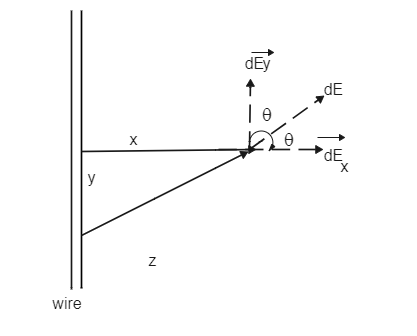
Consider a long thin wire with charges inside the wire the distance from the point A to the middle of the wire is X and we are going to calculate the electric field at point A a distance from the middle of a very long thin wire of positive charge.
Electric field due to $dQ$
$d\overrightarrow{E}=\dfrac{dQ}{4\pi {{\varepsilon }_{0}}{{z}^{2}}}=\dfrac{dQ}{4\pi {{\varepsilon }_{0}}({{x}^{2}}+{{y}^{2}})}$
By the symmetry of the setup, for all $d\overrightarrow{{{E}_{Y}}}$ below the x-axis, there will be a $-d\overrightarrow{{{E}_{Y}}}$ above the axis
${{E}_{y}}=\int{d{{E}_{y}}=0}$
\[{{E}_{set}}={{E}_{x}}=\int{d{{E}_{x}}=\int{\cos \theta dE=\int{\cos \theta \dfrac{dQ}{4\pi {{\varepsilon }_{0}}({{x}^{2}}+{{y}^{2}})}}}}\]
$dQ=\lambda dy$
$\Rightarrow \int{\dfrac{\cos \theta \times \lambda dy}{4\pi {{\varepsilon }_{0}}({{x}^{2}}+{{y}^{2}})}}$
$dQ=\dfrac{\lambda }{4\pi {{\varepsilon }_{0}}}\int{\dfrac{\cos \theta }{{{x}^{2}}+{{y}^{2}}}}dy$
Represent y as function of $\theta $ :
$y=x\tan \theta $
$\Rightarrow dy=\dfrac{xd\theta }{{{\cos }^{2}}\theta }$
where
$\begin{align}
& \cos \theta =\dfrac{x}{z}=\dfrac{x}{{{({{x}^{2}}+{{y}^{2}})}^{\dfrac{1}{2}}}} \\
&\Rightarrow \dfrac{1}{{{x}^{2}}+{{y}^{2}}}=\dfrac{{{\cos }^{2}}\theta }{{{x}^{2}}} \\
\end{align}$
\[\begin{align}
& \Rightarrow E = \dfrac{\lambda }{4\pi {{\varepsilon }_{0}}}\int{\cos \theta (\dfrac{xd\theta }{{{\cos }^{2}}\theta })\times \dfrac{{{\cos }^{2}}\theta }{{{x}^{2}}}} \\
& \Rightarrow E = \dfrac{\lambda }{4\pi {{\varepsilon }_{0}}x}\int\limits_{\dfrac{-\pi }{2}}^{\dfrac{\pi }{2}}{\cos \theta d\theta } \\
& \Rightarrow E = \dfrac{\lambda }{4\pi {{\varepsilon }_{0}}}(\sin \theta )_{\dfrac{-\pi }{2}}^{\dfrac{\pi }{2}} \\
& \Rightarrow E = \dfrac{\lambda }{4\pi {{\varepsilon }_{_{0}}}x}\times 2 \\
\end{align}\]
$\Rightarrow E=\dfrac{\lambda }{2\pi {{\varepsilon }_{0}}x}$
The electric field due to a long thin wire of uniform linear charge density $\lambda $ is$E=\dfrac{\lambda }{2\pi {{\varepsilon }_{0}}x}$
Note: Student’s gravitational forces are always attractive while the electrostatic forces are both attractive or repulsive force .The magnitude of electric field is obtained by coulomb’s law and in case of a unit stationary point charge coulomb’s law derivation formula is similar to gauss law derivation. Electrons flow direction is in the opposite direction of current.
Complete step-by-step solution:
Coulomb’s law states that the magnitude of electrostatic force between two point charges is directly proportional to the product of the magnitudes of charges and inversely proportional to the square of the distance between them
$\left| F \right|=k\dfrac{\left| {{q}_{1}}{{q}_{2}} \right|}{{{d}^{2}}}$
Where coulomb’s constant $(k)=\dfrac{1}{4\pi {{\varepsilon }_{0}}}$
Charge density $(\lambda )=\dfrac{\text{Total charge}}{\text{Length}}$
Electric field due to a long thin wire of uniform linear charge density$\lambda $
Consider a long thin wire with charges inside the wire the distance from the point A to the middle of the wire is X and we are going to calculate the electric field at point A a distance from the middle of a very long thin wire of positive charge.
Electric field due to $dQ$
$d\overrightarrow{E}=\dfrac{dQ}{4\pi {{\varepsilon }_{0}}{{z}^{2}}}=\dfrac{dQ}{4\pi {{\varepsilon }_{0}}({{x}^{2}}+{{y}^{2}})}$
By the symmetry of the setup, for all $d\overrightarrow{{{E}_{Y}}}$ below the x-axis, there will be a $-d\overrightarrow{{{E}_{Y}}}$ above the axis
${{E}_{y}}=\int{d{{E}_{y}}=0}$
\[{{E}_{set}}={{E}_{x}}=\int{d{{E}_{x}}=\int{\cos \theta dE=\int{\cos \theta \dfrac{dQ}{4\pi {{\varepsilon }_{0}}({{x}^{2}}+{{y}^{2}})}}}}\]
$dQ=\lambda dy$
$\Rightarrow \int{\dfrac{\cos \theta \times \lambda dy}{4\pi {{\varepsilon }_{0}}({{x}^{2}}+{{y}^{2}})}}$
$dQ=\dfrac{\lambda }{4\pi {{\varepsilon }_{0}}}\int{\dfrac{\cos \theta }{{{x}^{2}}+{{y}^{2}}}}dy$
Represent y as function of $\theta $ :
$y=x\tan \theta $
$\Rightarrow dy=\dfrac{xd\theta }{{{\cos }^{2}}\theta }$
where
$\begin{align}
& \cos \theta =\dfrac{x}{z}=\dfrac{x}{{{({{x}^{2}}+{{y}^{2}})}^{\dfrac{1}{2}}}} \\
&\Rightarrow \dfrac{1}{{{x}^{2}}+{{y}^{2}}}=\dfrac{{{\cos }^{2}}\theta }{{{x}^{2}}} \\
\end{align}$
\[\begin{align}
& \Rightarrow E = \dfrac{\lambda }{4\pi {{\varepsilon }_{0}}}\int{\cos \theta (\dfrac{xd\theta }{{{\cos }^{2}}\theta })\times \dfrac{{{\cos }^{2}}\theta }{{{x}^{2}}}} \\
& \Rightarrow E = \dfrac{\lambda }{4\pi {{\varepsilon }_{0}}x}\int\limits_{\dfrac{-\pi }{2}}^{\dfrac{\pi }{2}}{\cos \theta d\theta } \\
& \Rightarrow E = \dfrac{\lambda }{4\pi {{\varepsilon }_{0}}}(\sin \theta )_{\dfrac{-\pi }{2}}^{\dfrac{\pi }{2}} \\
& \Rightarrow E = \dfrac{\lambda }{4\pi {{\varepsilon }_{_{0}}}x}\times 2 \\
\end{align}\]
$\Rightarrow E=\dfrac{\lambda }{2\pi {{\varepsilon }_{0}}x}$
The electric field due to a long thin wire of uniform linear charge density $\lambda $ is$E=\dfrac{\lambda }{2\pi {{\varepsilon }_{0}}x}$
Note: Student’s gravitational forces are always attractive while the electrostatic forces are both attractive or repulsive force .The magnitude of electric field is obtained by coulomb’s law and in case of a unit stationary point charge coulomb’s law derivation formula is similar to gauss law derivation. Electrons flow direction is in the opposite direction of current.
Recently Updated Pages
Basicity of sulphurous acid and sulphuric acid are

Master Class 12 English: Engaging Questions & Answers for Success
Master Class 12 Social Science: Engaging Questions & Answers for Success
Master Class 12 Maths: Engaging Questions & Answers for Success
Master Class 12 Economics: Engaging Questions & Answers for Success
Master Class 12 Physics: Engaging Questions & Answers for Success
Trending doubts
Which are the Top 10 Largest Countries of the World?
Draw a labelled sketch of the human eye class 12 physics CBSE
Which state in the country is at the forefront in controlling class 12 social science CBSE
Where is the largest hydroelectric power station located class 12 biology CBSE
Which country did Danny Casey play for class 12 english CBSE
Coming together federation is practiced in A India class 12 social science CBSE