




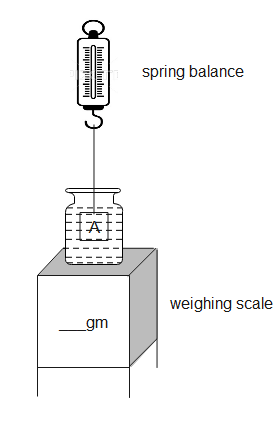
Object A is completely immersed in water. True weight of object A is ${{W}_{A}}$, weight of water with beaker is ${{W}_{B}}$. Let $B$ be the buoyant force. ${{W}_{1}}$ and ${{W}_{2}}$ are scale readings of spring balance and weighing scale respectively, then
(A). ${{W}_{1}}={{W}_{A}}$
(B). ${{W}_{1}}={{W}_{A}}+B$
(C). ${{W}_{2}}={{W}_{B}}$
(D). ${{W}_{2}}={{W}_{B}}+B$
Answer
 Verified
584.1k+ views
Hint: The weight of the water beaker and block system is measured by spring balance and weighing scale. The spring balance measures the weight of block A immersed in water and the weighing scale measures the weight of beaker and water. The buoyant force acts opposite to the weight and hence decreases the weight of the block, the reaction force of buoyant increases the weight of the water beaker system.
Complete step-by-step solution:
Given, a block is immersed in water and weighed by a spring balance. The weight of water and block is weighed by the weighing scale.
Buoyant force is the force exerted by a fluid on the objects immersed in it. It is due to the pressure applied by the water on the objects. Buoyant force is responsible for objects floating in liquid.
The forces acting on block will be-
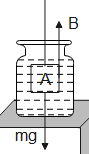
$F=mg-B$
Here, $mg$ is the true weight of block A
Therefore,
$mg={{W}_{A}}$
Since the buoyant force and weight are acting in different directions, the reading of spring balance will decrease. Therefore,
${{W}_{1}}={{W}_{A}}-B$
The forces acting on the water, beaker and block system are-
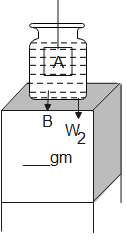
The weighing scale will weigh the water, beaker and block A. Therefore,
${{W}_{2}}={{W}_{B}}+B$
When water exerts a buoyant force on the block A, according to Newton’s third law, it exerts equal and opposite force on water.
Therefore, the reading of the weighing scale is ${{W}_{2}}={{W}_{B}}+B$. Hence, the correct option is (D).
Note:
The spring balance measures the resultant weight of an object. The buoyant force cancels the weight of block A. According to the Archimedes principle, the buoyant force acting on an object is equivalent to the amount of fluid displaced by it. The third law of Newton states that every action has an equal and opposite reaction.
Complete step-by-step solution:
Given, a block is immersed in water and weighed by a spring balance. The weight of water and block is weighed by the weighing scale.
Buoyant force is the force exerted by a fluid on the objects immersed in it. It is due to the pressure applied by the water on the objects. Buoyant force is responsible for objects floating in liquid.
The forces acting on block will be-
$F=mg-B$
Here, $mg$ is the true weight of block A
Therefore,
$mg={{W}_{A}}$
Since the buoyant force and weight are acting in different directions, the reading of spring balance will decrease. Therefore,
${{W}_{1}}={{W}_{A}}-B$
The forces acting on the water, beaker and block system are-
The weighing scale will weigh the water, beaker and block A. Therefore,
${{W}_{2}}={{W}_{B}}+B$
When water exerts a buoyant force on the block A, according to Newton’s third law, it exerts equal and opposite force on water.
Therefore, the reading of the weighing scale is ${{W}_{2}}={{W}_{B}}+B$. Hence, the correct option is (D).
Note:
The spring balance measures the resultant weight of an object. The buoyant force cancels the weight of block A. According to the Archimedes principle, the buoyant force acting on an object is equivalent to the amount of fluid displaced by it. The third law of Newton states that every action has an equal and opposite reaction.
Recently Updated Pages
Master Class 12 Business Studies: Engaging Questions & Answers for Success

Master Class 12 Biology: Engaging Questions & Answers for Success
Master Class 12 Chemistry: Engaging Questions & Answers for Success
Class 12 Question and Answer - Your Ultimate Solutions Guide
Master Class 11 Social Science: Engaging Questions & Answers for Success
Master Class 11 English: Engaging Questions & Answers for Success
Trending doubts
Which is more stable and why class 12 chemistry CBSE
Which are the Top 10 Largest Countries of the World?
Draw a labelled sketch of the human eye class 12 physics CBSE
Differentiate between homogeneous and heterogeneous class 12 chemistry CBSE
What are the major means of transport Explain each class 12 social science CBSE
Sulphuric acid is known as the king of acids State class 12 chemistry CBSE