



Number of unit cells in $4g$ of $X$(atomic mass $ = 40$), which crystallises in the bcc pattern is: (${N_A}$ is Avogadro’s number)
A. $0.1{N_A}$
B. $2 \times 0.1{N_A}$
C. $\dfrac{{0.1 \times {N_A}}}{2}$
D. $2 \times {N_A}$
Answer
 Verified
574.5k+ views
Hint: In BCC lattice, the atoms are present at each corner and at the centre of the cubic crystal. For the given question, first find the number of atoms in the given mass of $X$ and the number of atoms comprises one unit cell of the bcc lattice. Then by comparing values, we will get the number of unit cells for a given mass of $X$.
Complete answer:
As we know, for BCC lattice, the atoms are present at each corner and at the centre of the cubic crystal as shown in the figure below:
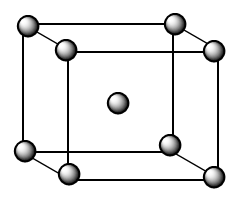
The contribution of each atom present at the corner $ = \dfrac{1}{8}$
The contribution of the atom present at the centre $ = 1$
Therefore, the number of atoms which comprises one unit cell of bcc lattice $ = 8 \times \dfrac{1}{8} + 1 \Rightarrow 2$
Now as per question, the given mass of $X = 4g$
Atomic mass of $X = 40g$
So, the number of moles of $X = \dfrac{{{\text{given mass}}}}{{{\text{atomic mass}}}}$
$ \Rightarrow n = \dfrac{4}{{40}}$
$ \Rightarrow n = 0.1$
Therefore, the number of atoms of $X = n \times {N_A} \Rightarrow 0.1 \times {N_A}$
For BCC unit lattice:
$\because $ 2 atoms comprise to form $ \Rightarrow $1 unit cell
$\therefore 0.1 \times {N_A}$ atoms will comprise to form $ \Rightarrow \dfrac{{0.1 \times {N_A}}}{2}$ unit cells.
Hence for a bcc unit lattice, the number of unit cells in $4g$ of $X$ is $\dfrac{{0.1 \times {N_A}}}{2}$.
So, option (C) is the correct answer.
Note:
Remember that atoms in BCC unit lattice are much more efficiently packed as compared to simple cubic structure, occupying about $68\% $ of the total volume. The coordination number i.e., the number of nearest neighbour atoms in a bcc lattice is eight.
Complete answer:
As we know, for BCC lattice, the atoms are present at each corner and at the centre of the cubic crystal as shown in the figure below:
The contribution of each atom present at the corner $ = \dfrac{1}{8}$
The contribution of the atom present at the centre $ = 1$
Therefore, the number of atoms which comprises one unit cell of bcc lattice $ = 8 \times \dfrac{1}{8} + 1 \Rightarrow 2$
Now as per question, the given mass of $X = 4g$
Atomic mass of $X = 40g$
So, the number of moles of $X = \dfrac{{{\text{given mass}}}}{{{\text{atomic mass}}}}$
$ \Rightarrow n = \dfrac{4}{{40}}$
$ \Rightarrow n = 0.1$
Therefore, the number of atoms of $X = n \times {N_A} \Rightarrow 0.1 \times {N_A}$
For BCC unit lattice:
$\because $ 2 atoms comprise to form $ \Rightarrow $1 unit cell
$\therefore 0.1 \times {N_A}$ atoms will comprise to form $ \Rightarrow \dfrac{{0.1 \times {N_A}}}{2}$ unit cells.
Hence for a bcc unit lattice, the number of unit cells in $4g$ of $X$ is $\dfrac{{0.1 \times {N_A}}}{2}$.
So, option (C) is the correct answer.
Note:
Remember that atoms in BCC unit lattice are much more efficiently packed as compared to simple cubic structure, occupying about $68\% $ of the total volume. The coordination number i.e., the number of nearest neighbour atoms in a bcc lattice is eight.
Recently Updated Pages
Explain the structure of megasporangium class 12 biology CBSE

Why is chloroform kept in dark coloured bottles class 12 chemistry CBSE
Derive the balancing condition of a Wheatstone bri class 12 physics CBSE
Draw VI characteristics of a pn junction diode Explain class 12 physics CBSE
Is it possible to carry pride in ones language too class 12 english CBSE
In a population at Hardy Weinberg equilibrium the allele class 12 biology CBSE
Trending doubts
Draw a labelled sketch of the human eye class 12 physics CBSE
Which are the Top 10 Largest Countries of the World?
Draw ray diagrams each showing i myopic eye and ii class 12 physics CBSE
One megawatt is equal to how many units of electri class 12 physics CBSE
Which is the correct genotypic ratio of mendel dihybrid class 12 biology CBSE
Give 10 examples of unisexual and bisexual flowers