




Number of triangles formed by joining the vertices of an n sided polygon which has no side in common with that of the polygon.
(a) $\dfrac{n\left( n-3 \right)}{2}$
(b) $\dfrac{\left( n-4 \right)\left( n-5 \right)}{3!}$
(c) $\dfrac{n\left( n-4 \right)\left( n-5 \right)}{3!}$
(d) None of these
Answer
 Verified
611.7k+ views
Hint: We have to find the number of triangles formed from the vertices of an n sided polygon which has no side in common with that of the polygon which we will find by writing the total number of triangles formed from the n vertices then we are going to subtract the number of triangles formed in which on side common and two sides common.
Complete step-by-step answer:
In the below diagram, we have drawn an n sided polygon we don’t know the value of n so we have left the polygon open.
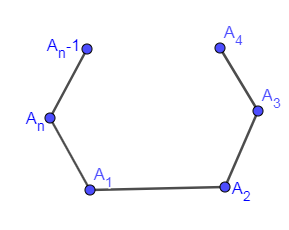
The total number of triangles that can be formed from these n vertices without any constraint is as follows:
${}^{n}{{C}_{3}}$
Now, we are going to subtract the number of triangles in which one of the sides of the triangle is coinciding with the side of the polygon and also number of triangles in which two of the sides of the triangle are coinciding with the two sides of the polygon from the total number of triangles formed from n vertices without any constraint.
Number of triangles formed from n vertices in such a way that one of the sides of the triangle is coinciding with the side of the polygon.
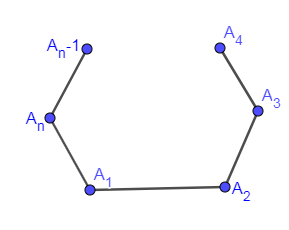
If you see the above figure, there are n sides possible which could be common with the triangle. We have selected two points but we need one more point to construct a triangle. So, let us suppose that we have taken side ${{A}_{1}}{{A}_{2}}$ then two points ${{A}_{1}}$ and ${{A}_{2}}$ are gone from n points and also ${{A}_{3}}$ and ${{A}_{n}}$ could not be possible because only one side is common if we would have taken any pint from ${{A}_{3}}$ and ${{A}_{n}}$ then two sides will be common. Now, we are left with n – 4 points. Hence, the final answer is the multiplication of n and n – 4.
$n\left( n-4 \right)$
Now, number of triangles that could be possible in which two sides of the triangles are common with n sided polygon is n and the reason is shown below:
Now, we are taking three vertices of the triangle in the following way:
${{A}_{1}}{{A}_{2}}{{A}_{3}},{{A}_{2}}{{A}_{3}}{{A}_{4}},..........{{A}_{n}}{{A}_{1}}{{A}_{2}}$
As you can see that there are n sets of three vertices possible.
Now, subtracting $n\left( n-4 \right)$ and n from ${}^{n}{{C}_{3}}$ we get,
$\begin{align}
& {}^{n}{{C}_{3}}-n\left( n-4 \right)-n \\
& =\dfrac{n!}{3!\left( n-3 \right)!}-n\left( n-4 \right)-n \\
& =\dfrac{n\left( n-1 \right)\left( n-2 \right)\left( n-3 \right)!}{3!\left( n-3 \right)!}-n\left( n-4 \right)-n \\
\end{align}$
In the above expression $\left( n-3 \right)!$ will be cancelled out from the numerator and the denominator and we get,
$\begin{align}
& \dfrac{n\left( n-1 \right)\left( n-2 \right)}{3.2.1}-n\left( n-4 \right)-n \\
& =\dfrac{n\left( n-1 \right)\left( n-2 \right)}{6}-\left( {{n}^{2}}-4n \right)-n \\
& =\dfrac{n\left( n-1 \right)\left( n-2 \right)}{6}-{{n}^{2}}+4n-n \\
& =\dfrac{n\left( n-1 \right)\left( n-2 \right)-6{{n}^{2}}+18n}{6} \\
& =\dfrac{n\left( n-1 \right)\left( n-2 \right)-6n\left( n-3 \right)}{6} \\
\end{align}$
Taking n as common from the above expression we get,
$\begin{align}
& \dfrac{n\left( \left( n-1 \right)\left( n-2 \right)-6n+18 \right)}{6} \\
& =\dfrac{n\left( {{n}^{2}}+2-3n-6n+18 \right)}{6} \\
& =\dfrac{n\left( {{n}^{2}}-9n+20 \right)}{6} \\
\end{align}$
Factoring the quadratic expression written in the numerator we get,
$\begin{align}
& \dfrac{n\left( {{n}^{2}}-4n-5n+20 \right)}{6} \\
& =\dfrac{n\left( n\left( n-4 \right)-5\left( n-4 \right) \right)}{6} \\
& =\dfrac{n\left( n-4 \right)\left( n-5 \right)}{6} \\
\end{align}$
In the above expression, we can write 6 as $3!$ and we get,
$\dfrac{n\left( n-4 \right)\left( n-5 \right)}{3!}$
So, the correct answer is “Option (c)”.
Note: The mistake that could possible in this problem is that in writing the number of triangles whose one of the sides is coinciding with n sided polygon you might forget to multiply n by $\left( n-4 \right)$ because you might think that there are n sides which will be common so answer is n but this is wrong approach because here there are triangles possible in which two sides are common between triangle and n sided polygon. Make sure not to repeat this mistake.
Complete step-by-step answer:
In the below diagram, we have drawn an n sided polygon we don’t know the value of n so we have left the polygon open.
The total number of triangles that can be formed from these n vertices without any constraint is as follows:
${}^{n}{{C}_{3}}$
Now, we are going to subtract the number of triangles in which one of the sides of the triangle is coinciding with the side of the polygon and also number of triangles in which two of the sides of the triangle are coinciding with the two sides of the polygon from the total number of triangles formed from n vertices without any constraint.
Number of triangles formed from n vertices in such a way that one of the sides of the triangle is coinciding with the side of the polygon.
If you see the above figure, there are n sides possible which could be common with the triangle. We have selected two points but we need one more point to construct a triangle. So, let us suppose that we have taken side ${{A}_{1}}{{A}_{2}}$ then two points ${{A}_{1}}$ and ${{A}_{2}}$ are gone from n points and also ${{A}_{3}}$ and ${{A}_{n}}$ could not be possible because only one side is common if we would have taken any pint from ${{A}_{3}}$ and ${{A}_{n}}$ then two sides will be common. Now, we are left with n – 4 points. Hence, the final answer is the multiplication of n and n – 4.
$n\left( n-4 \right)$
Now, number of triangles that could be possible in which two sides of the triangles are common with n sided polygon is n and the reason is shown below:
Now, we are taking three vertices of the triangle in the following way:
${{A}_{1}}{{A}_{2}}{{A}_{3}},{{A}_{2}}{{A}_{3}}{{A}_{4}},..........{{A}_{n}}{{A}_{1}}{{A}_{2}}$
As you can see that there are n sets of three vertices possible.
Now, subtracting $n\left( n-4 \right)$ and n from ${}^{n}{{C}_{3}}$ we get,
$\begin{align}
& {}^{n}{{C}_{3}}-n\left( n-4 \right)-n \\
& =\dfrac{n!}{3!\left( n-3 \right)!}-n\left( n-4 \right)-n \\
& =\dfrac{n\left( n-1 \right)\left( n-2 \right)\left( n-3 \right)!}{3!\left( n-3 \right)!}-n\left( n-4 \right)-n \\
\end{align}$
In the above expression $\left( n-3 \right)!$ will be cancelled out from the numerator and the denominator and we get,
$\begin{align}
& \dfrac{n\left( n-1 \right)\left( n-2 \right)}{3.2.1}-n\left( n-4 \right)-n \\
& =\dfrac{n\left( n-1 \right)\left( n-2 \right)}{6}-\left( {{n}^{2}}-4n \right)-n \\
& =\dfrac{n\left( n-1 \right)\left( n-2 \right)}{6}-{{n}^{2}}+4n-n \\
& =\dfrac{n\left( n-1 \right)\left( n-2 \right)-6{{n}^{2}}+18n}{6} \\
& =\dfrac{n\left( n-1 \right)\left( n-2 \right)-6n\left( n-3 \right)}{6} \\
\end{align}$
Taking n as common from the above expression we get,
$\begin{align}
& \dfrac{n\left( \left( n-1 \right)\left( n-2 \right)-6n+18 \right)}{6} \\
& =\dfrac{n\left( {{n}^{2}}+2-3n-6n+18 \right)}{6} \\
& =\dfrac{n\left( {{n}^{2}}-9n+20 \right)}{6} \\
\end{align}$
Factoring the quadratic expression written in the numerator we get,
$\begin{align}
& \dfrac{n\left( {{n}^{2}}-4n-5n+20 \right)}{6} \\
& =\dfrac{n\left( n\left( n-4 \right)-5\left( n-4 \right) \right)}{6} \\
& =\dfrac{n\left( n-4 \right)\left( n-5 \right)}{6} \\
\end{align}$
In the above expression, we can write 6 as $3!$ and we get,
$\dfrac{n\left( n-4 \right)\left( n-5 \right)}{3!}$
So, the correct answer is “Option (c)”.
Note: The mistake that could possible in this problem is that in writing the number of triangles whose one of the sides is coinciding with n sided polygon you might forget to multiply n by $\left( n-4 \right)$ because you might think that there are n sides which will be common so answer is n but this is wrong approach because here there are triangles possible in which two sides are common between triangle and n sided polygon. Make sure not to repeat this mistake.
Recently Updated Pages
Master Class 12 Economics: Engaging Questions & Answers for Success

Master Class 12 English: Engaging Questions & Answers for Success
Master Class 12 Social Science: Engaging Questions & Answers for Success
Master Class 12 Maths: Engaging Questions & Answers for Success
Master Class 12 Physics: Engaging Questions & Answers for Success
Master Class 9 General Knowledge: Engaging Questions & Answers for Success
Trending doubts
Which are the Top 10 Largest Countries of the World?
Draw a labelled sketch of the human eye class 12 physics CBSE
Differentiate between homogeneous and heterogeneous class 12 chemistry CBSE
Why is the cell called the structural and functional class 12 biology CBSE
Draw ray diagrams each showing i myopic eye and ii class 12 physics CBSE
Which is the correct genotypic ratio of mendel dihybrid class 12 biology CBSE