




Number of testicular lobules in testes is
A. 250
B. 500
C. 750
D. 200-300
Answer
 Verified
452.4k+ views
Hint: This question is from Human Reproduction. Here, in this question, first we need to understand about testicular lobules and their number. The testis glandular structure is made up of numerous lobules.
Complete step-by-step answer:
The testis gland varies in size depending on their position, with those in the centre of the gland being larger and longer. The lobules are conical in shape, with the base pointing toward the organ's circumference and the apex pointing toward the mediastinum testis.
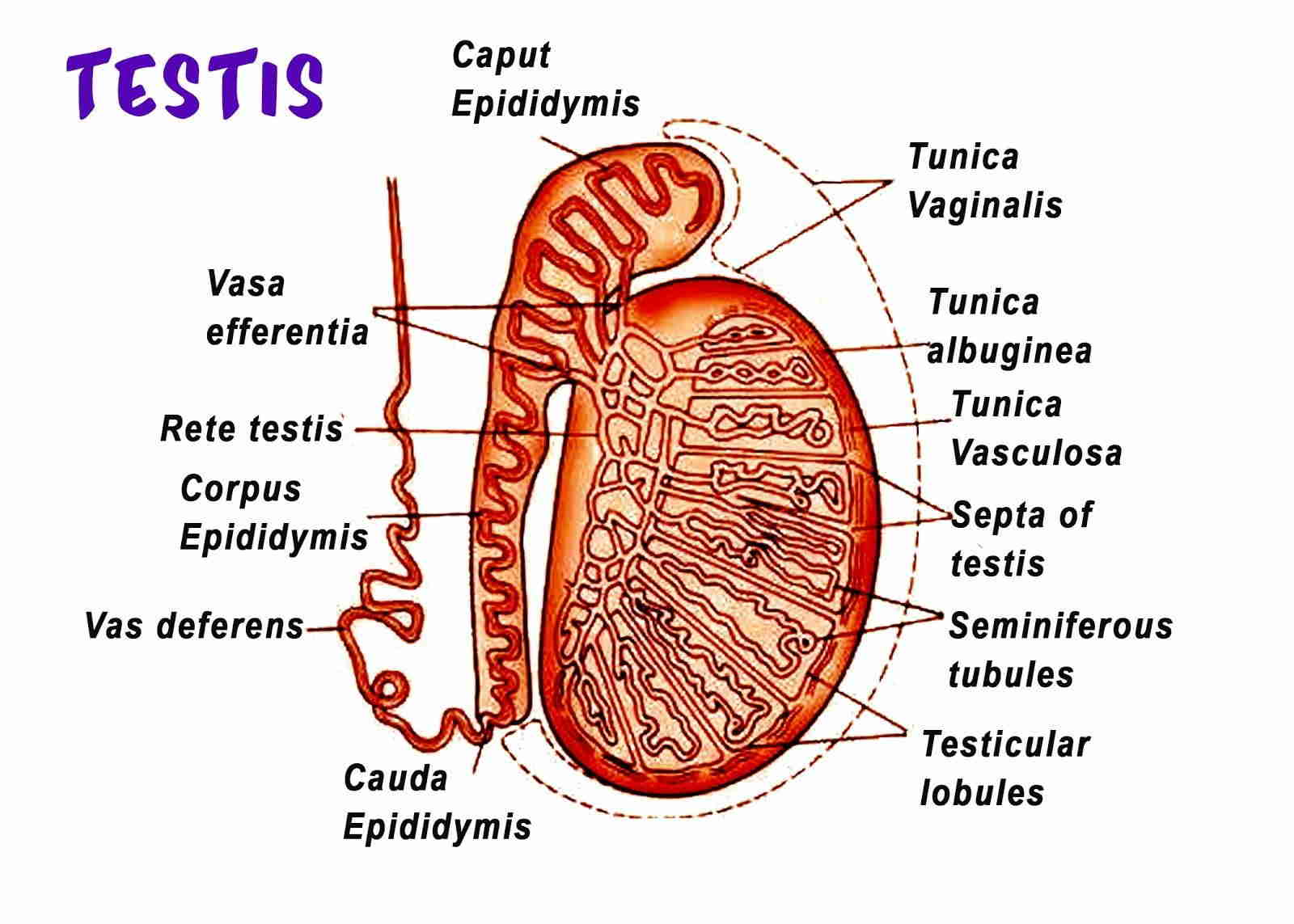
Image: Parts of the testis and the epididymis
Each lobule is contained within one of the intervals between the fibrous septa that extend between the mediastinum testis and the tunica albuginea, and is made up of one to three, or more, minute convoluted tubes called tubuli seminiferi. The tunica is a tough, fibrous layer of tissue that covers each testicle. The tunica vaginalis is the outer layer, and the tunica albuginea is the inner layer.
The testicle is divided into sections known as lobules. Seminiferous tubules are tiny U-shaped tubes found in each lobule. Each testicle contains approximately 800 seminiferous tubules that are tightly coiled.
The seminiferous tubules open into the rete testis, a network of uncoiled, interconnected channels. Ducts or tubes connect the rete testis to the epididymis, a tightly coiled tube. The epididymis connects to the vas deferens, a long, large duct.
Each testis (singular) contains 250 compartments known as testicular lobules. So, there are 500 testicular lobules in a testes (plural).
So, option B is the correct answer.
Note: For this question candidate must be aware of the human reproduction system and its terms. Testicular lobules are one of them.
Complete step-by-step answer:
The testis gland varies in size depending on their position, with those in the centre of the gland being larger and longer. The lobules are conical in shape, with the base pointing toward the organ's circumference and the apex pointing toward the mediastinum testis.
Image: Parts of the testis and the epididymis
Each lobule is contained within one of the intervals between the fibrous septa that extend between the mediastinum testis and the tunica albuginea, and is made up of one to three, or more, minute convoluted tubes called tubuli seminiferi. The tunica is a tough, fibrous layer of tissue that covers each testicle. The tunica vaginalis is the outer layer, and the tunica albuginea is the inner layer.
The testicle is divided into sections known as lobules. Seminiferous tubules are tiny U-shaped tubes found in each lobule. Each testicle contains approximately 800 seminiferous tubules that are tightly coiled.
The seminiferous tubules open into the rete testis, a network of uncoiled, interconnected channels. Ducts or tubes connect the rete testis to the epididymis, a tightly coiled tube. The epididymis connects to the vas deferens, a long, large duct.
Each testis (singular) contains 250 compartments known as testicular lobules. So, there are 500 testicular lobules in a testes (plural).
So, option B is the correct answer.
Note: For this question candidate must be aware of the human reproduction system and its terms. Testicular lobules are one of them.
Recently Updated Pages
Match columnI with columnII and choose the correct class 12 biology NEET_UG

Which will be the least stable resonating structure class 11 chemistry CBSE
Explain the structure of megasporangium class 12 biology CBSE
Differentiate between voluntary action and reflex class 10 biology CBSE
How many 5 digit telephone numbers can be construc-class-11-maths-CBSE
How do you find the angle of the resultant vector class 11 physics CBSE
Trending doubts
How many sides does a circle have a 10 sides b 20 sides class 8 maths CBSE
The common name of Rheo leaf is A Oyster plant B Boat class 9 biology CBSE
What is BLO What is the full form of BLO class 8 social science CBSE
Explain the Treaty of Vienna of 1815 class 10 social science CBSE
Draw a labelled sketch of the human eye class 12 physics CBSE
Which are the Top 10 Largest Countries of the World?