




What is the number of points on the line 3x + 4y = 5, which are at a distance of \[{\sec ^2}\theta + 2{\text{cose}}{{\text{c}}^2}\theta ,\theta \in R\] from the point (1, 3)?
(a). 1
(b). 2
(c). 3
(d). Infinite
Answer
 Verified
626.4k+ views
Hint: Find the shortest distance of the point (1, 3) from the line 3x + 4y = 5 using the formula \[\dfrac{{|a{x_0} + b{y_0} + c|}}{{\sqrt {{a^2} + {b^2}} }}\]. Then find if the distance \[{\sec ^2}\theta + 2{\text{cose}}{{\text{c}}^2}\theta ,\theta \in R\] is smaller than, equal to, or greater than this distance and conclude the answer.
Complete step-by-step answer:
We need to find the number of points on the line 3x + 4y = 5, which are at a distance of \[{\sec ^2}\theta + 2{\text{cose}}{{\text{c}}^2}\theta ,\theta \in R\] from the point (1, 3).
For this, we first find the shortest distance between the point (1, 3) and 3x + 4y = 5.
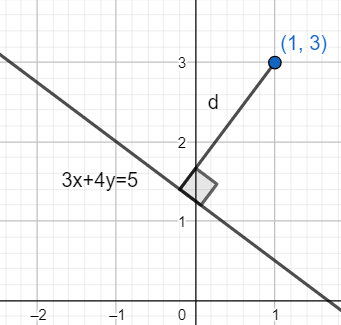
The shortest distance of a point \[({x_0},{y_0})\] from a line \[ax + by + c = 0\] is given as follows:
\[d = \dfrac{{|a{x_0} + b{y_0} + c|}}{{\sqrt {{a^2} + {b^2}} }}\]
The standard form of the line 3x +4y = 5 is given as follows:
\[3x + 4y - 5 = 0\]
Now, the distance of the point (1, 3) from this line is given as follows:
\[d = \dfrac{{|3(1) + 4(3) - 5|}}{{\sqrt {{3^2} + {4^2}} }}\]
Simplifying, we have:
\[d = \dfrac{{|3 + 12 - 5|}}{{\sqrt {9 + 16} }}\]
\[d = \dfrac{{|10|}}{{\sqrt {25} }}\]
\[d = \dfrac{{10}}{5}\]
\[d = 2..............(1)\]
Now, we find the value of \[{\sec ^2}\theta + 2{\text{cose}}{{\text{c}}^2}\theta \].
We know that \[{\sec ^2}\theta = 1 + {\tan ^2}\theta \] and also, we know that \[{\text{cose}}{{\text{c}}^2}\theta = 1 + {\cot ^2}\theta \], hence, we have:
\[{\sec ^2}\theta + 2{\text{cose}}{{\text{c}}^2}\theta = 1 + {\tan ^2}\theta + 2(1 + {\cot ^2}\theta )\]
Simplifying, we have:
\[{\sec ^2}\theta + 2{\text{cose}}{{\text{c}}^2}\theta = 1 + {\tan ^2}\theta + 2 + 2{\cot ^2}\theta \]
\[{\sec ^2}\theta + 2{\text{cose}}{{\text{c}}^2}\theta = 3 + {\tan ^2}\theta + 2{\cot ^2}\theta \]
The squares of tangent and cotangent functions are positive and hence, we have:
\[{\sec ^2}\theta + 2{\text{cose}}{{\text{c}}^2}\theta \geqslant 3\]
Hence, we observe that the distance of \[{\sec ^2}\theta + 2{\text{cose}}{{\text{c}}^2}\theta \] is greater than the shortest distance between the point (1, 3) and the line 3x + 4y = 5, hence, there are two points on either side of the shortest distance, that equals the distance of \[{\sec ^2}\theta + 2{\text{cose}}{{\text{c}}^2}\theta \].
Hence, the correct answer is option (b).
Note: You can also express the point on the line 3x + 4y = 5 as \[\left( {x,\dfrac{{5 - 3x}}{4}} \right)\] and equate the distance between two points as \[\sqrt {{{({x_1},{y_1})}^2} + {{({y_2} - {y_1})}^2}} \] to find the number of values of x.
Complete step-by-step answer:
We need to find the number of points on the line 3x + 4y = 5, which are at a distance of \[{\sec ^2}\theta + 2{\text{cose}}{{\text{c}}^2}\theta ,\theta \in R\] from the point (1, 3).
For this, we first find the shortest distance between the point (1, 3) and 3x + 4y = 5.
The shortest distance of a point \[({x_0},{y_0})\] from a line \[ax + by + c = 0\] is given as follows:
\[d = \dfrac{{|a{x_0} + b{y_0} + c|}}{{\sqrt {{a^2} + {b^2}} }}\]
The standard form of the line 3x +4y = 5 is given as follows:
\[3x + 4y - 5 = 0\]
Now, the distance of the point (1, 3) from this line is given as follows:
\[d = \dfrac{{|3(1) + 4(3) - 5|}}{{\sqrt {{3^2} + {4^2}} }}\]
Simplifying, we have:
\[d = \dfrac{{|3 + 12 - 5|}}{{\sqrt {9 + 16} }}\]
\[d = \dfrac{{|10|}}{{\sqrt {25} }}\]
\[d = \dfrac{{10}}{5}\]
\[d = 2..............(1)\]
Now, we find the value of \[{\sec ^2}\theta + 2{\text{cose}}{{\text{c}}^2}\theta \].
We know that \[{\sec ^2}\theta = 1 + {\tan ^2}\theta \] and also, we know that \[{\text{cose}}{{\text{c}}^2}\theta = 1 + {\cot ^2}\theta \], hence, we have:
\[{\sec ^2}\theta + 2{\text{cose}}{{\text{c}}^2}\theta = 1 + {\tan ^2}\theta + 2(1 + {\cot ^2}\theta )\]
Simplifying, we have:
\[{\sec ^2}\theta + 2{\text{cose}}{{\text{c}}^2}\theta = 1 + {\tan ^2}\theta + 2 + 2{\cot ^2}\theta \]
\[{\sec ^2}\theta + 2{\text{cose}}{{\text{c}}^2}\theta = 3 + {\tan ^2}\theta + 2{\cot ^2}\theta \]
The squares of tangent and cotangent functions are positive and hence, we have:
\[{\sec ^2}\theta + 2{\text{cose}}{{\text{c}}^2}\theta \geqslant 3\]
Hence, we observe that the distance of \[{\sec ^2}\theta + 2{\text{cose}}{{\text{c}}^2}\theta \] is greater than the shortest distance between the point (1, 3) and the line 3x + 4y = 5, hence, there are two points on either side of the shortest distance, that equals the distance of \[{\sec ^2}\theta + 2{\text{cose}}{{\text{c}}^2}\theta \].
Hence, the correct answer is option (b).
Note: You can also express the point on the line 3x + 4y = 5 as \[\left( {x,\dfrac{{5 - 3x}}{4}} \right)\] and equate the distance between two points as \[\sqrt {{{({x_1},{y_1})}^2} + {{({y_2} - {y_1})}^2}} \] to find the number of values of x.
Recently Updated Pages
In a plane electromagnetic wave the electric field class 12 physics CBSE

A plane electromagnetic wave travels in vacuum along class 12 physics CBSE
Basicity of sulphurous acid and sulphuric acid are
The magnetic field in a plane electromagnetic wave class 11 physics CBSE
Master Class 12 English: Engaging Questions & Answers for Success
Master Class 12 Social Science: Engaging Questions & Answers for Success
Trending doubts
Which are the Top 10 Largest Countries of the World?
Draw a labelled sketch of the human eye class 12 physics CBSE
Which state in the country is at the forefront in controlling class 12 social science CBSE
Mention the role of cyanobacteria as a biofertiliz class 12 biology ICSE
Where is the largest hydroelectric power station located class 12 biology CBSE
Which country did Danny Casey play for class 12 english CBSE