




Number of \[dibromo\] derivatives produced when \[bromine\] is added to \[\left( {3S} \right) - 3 - Methyl{\text{ }}Cyclohexene\] in \[1,2 - dichloroethane\] are:
A.\[2\]
B.\[3\]
C.\[4\]
D.\[6\]
Answer
 Verified
576.6k+ views
Hint: \[dibromo\] derivatives as the name suggests contains two \[bromine\] groups in the molecule. These reactions are carried out depending upon the amount of \[bromine\] and thus bromination takes place with or without the help of catalysts.
Complete answer:
\[\left( {3S} \right) - 3 - Methyl{\text{ }}Cyclohexene\] is an organic compound consisting \[Methyl\] as a functional group, an unsaturated carbon bond and a ring. The number on the structure represents the placement of these functional groups in the compound. The alphabet \[S\] represents the type of configuration. For that we must know the enantiomers. Enantiomers are non-imposable mirror images. The absolute configuration refers to the spatial arrangement of the atoms of a chiral molecular entity. The \[S\] and \[R\] configuration indicates the relative spatial orientation of each atom in a molecule with a non-superimposable mirror image. Here \[S\] means the spatial isomer that has its relative direction of priority order in an anticlockwise direction whereas \[R\] means in clockwise direction.
For that one must be familiar with the bromination process. As one can predict from the name that it involves the \[bromine\] element. Therefore bromination is the process or reaction in which \[bromine\] is introduced into a molecule and no other elements are introduced into a molecule. In a \[benzene\] ring bromination takes place by electrophilic aromatic substitution.
Now let's find out the reaction of \[\left( {3S} \right) - 3 - Methyl{\text{ }}Cyclohexene\] in \[1,2 - dichloroethane\] to find out the number of \[dibromo\] derivatives it produced.
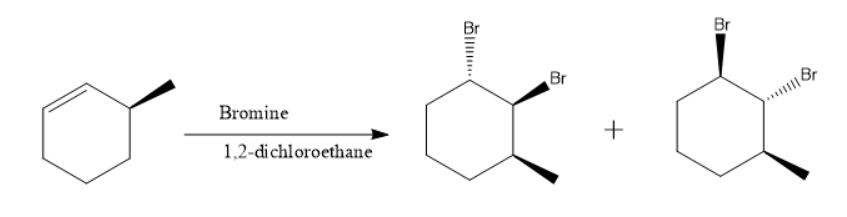
When \[bromine\] is added to \[\left( {3S} \right) - 3 - Methyl{\text{ }}Cyclohexene\] in \[1,2 - dichloroethane\] the number of \[dibromo\] derivatives formed are 2.
They are \[\left( {1S,2S,3S} \right) - 1,2 - dibromo - 3 - methylcyclohexane\] and \[\left( {1R,2R,3S} \right) - 1,2 - dibromo - 3 - methylcyclohexane\]
The reaction and their structure are as follow-
Note:
The products formed from the above reaction are similar, it is only the spatial orientation that differs. Also the knowledge of halogenation and electrophilic aromatic reaction will help you predict the product of the reaction of the reactants provided for such type of question.
Complete answer:
\[\left( {3S} \right) - 3 - Methyl{\text{ }}Cyclohexene\] is an organic compound consisting \[Methyl\] as a functional group, an unsaturated carbon bond and a ring. The number on the structure represents the placement of these functional groups in the compound. The alphabet \[S\] represents the type of configuration. For that we must know the enantiomers. Enantiomers are non-imposable mirror images. The absolute configuration refers to the spatial arrangement of the atoms of a chiral molecular entity. The \[S\] and \[R\] configuration indicates the relative spatial orientation of each atom in a molecule with a non-superimposable mirror image. Here \[S\] means the spatial isomer that has its relative direction of priority order in an anticlockwise direction whereas \[R\] means in clockwise direction.
For that one must be familiar with the bromination process. As one can predict from the name that it involves the \[bromine\] element. Therefore bromination is the process or reaction in which \[bromine\] is introduced into a molecule and no other elements are introduced into a molecule. In a \[benzene\] ring bromination takes place by electrophilic aromatic substitution.
Now let's find out the reaction of \[\left( {3S} \right) - 3 - Methyl{\text{ }}Cyclohexene\] in \[1,2 - dichloroethane\] to find out the number of \[dibromo\] derivatives it produced.
When \[bromine\] is added to \[\left( {3S} \right) - 3 - Methyl{\text{ }}Cyclohexene\] in \[1,2 - dichloroethane\] the number of \[dibromo\] derivatives formed are 2.
They are \[\left( {1S,2S,3S} \right) - 1,2 - dibromo - 3 - methylcyclohexane\] and \[\left( {1R,2R,3S} \right) - 1,2 - dibromo - 3 - methylcyclohexane\]
The reaction and their structure are as follow-
Note:
The products formed from the above reaction are similar, it is only the spatial orientation that differs. Also the knowledge of halogenation and electrophilic aromatic reaction will help you predict the product of the reaction of the reactants provided for such type of question.
Recently Updated Pages
Which of the following graphs shows the variation of class 12 physics CBSE

Draw a labelled diagram of the human male reproductive class 12 biology CBSE
Describe the experiment to compare the emf of two cells class 12 physics CBSE
What is standard hydrogen electrode
What is conventional current and electric current class 12 physics CBSE
2Bromopentane is treated with an alcoholic KOH solution class 12 chemistry CBSE
Trending doubts
Draw a labelled sketch of the human eye class 12 physics CBSE
Which are the Top 10 Largest Countries of the World?
Differentiate between homogeneous and heterogeneous class 12 chemistry CBSE
Draw ray diagrams each showing i myopic eye and ii class 12 physics CBSE
Which is the correct genotypic ratio of mendel dihybrid class 12 biology CBSE
What is the Full Form of PVC, PET, HDPE, LDPE, PP and PS ?