



Number of biosphere reserves in India in May $2002$ was
(A) $9$
(B) $11$
(C) $13$
(D) $15$
Answer
 Verified
638.1k+ views
Hint: Biosphere reserves are the protected areas by the government that draws attention to the connections and improves the compatibility between the people and nature. These are used for multipurpose. It includes terrestrial, aquatic and marines’ areas.
Complete Answer:
In India, there are about $18$ biosphere reserves established till now that protects and preserves the large area of natural habitat and resources. These protect the natural habitat that was protected under the national parks and wildlife sanctuaries. These reserves also contain some buffer zones that are used for some economic uses. Except the areas under the buffer zone, other areas must be protected and no other activities are allowed in that area. The main aim to promote these biosphere reserves is to protect the natural resources and use them in a useful way.
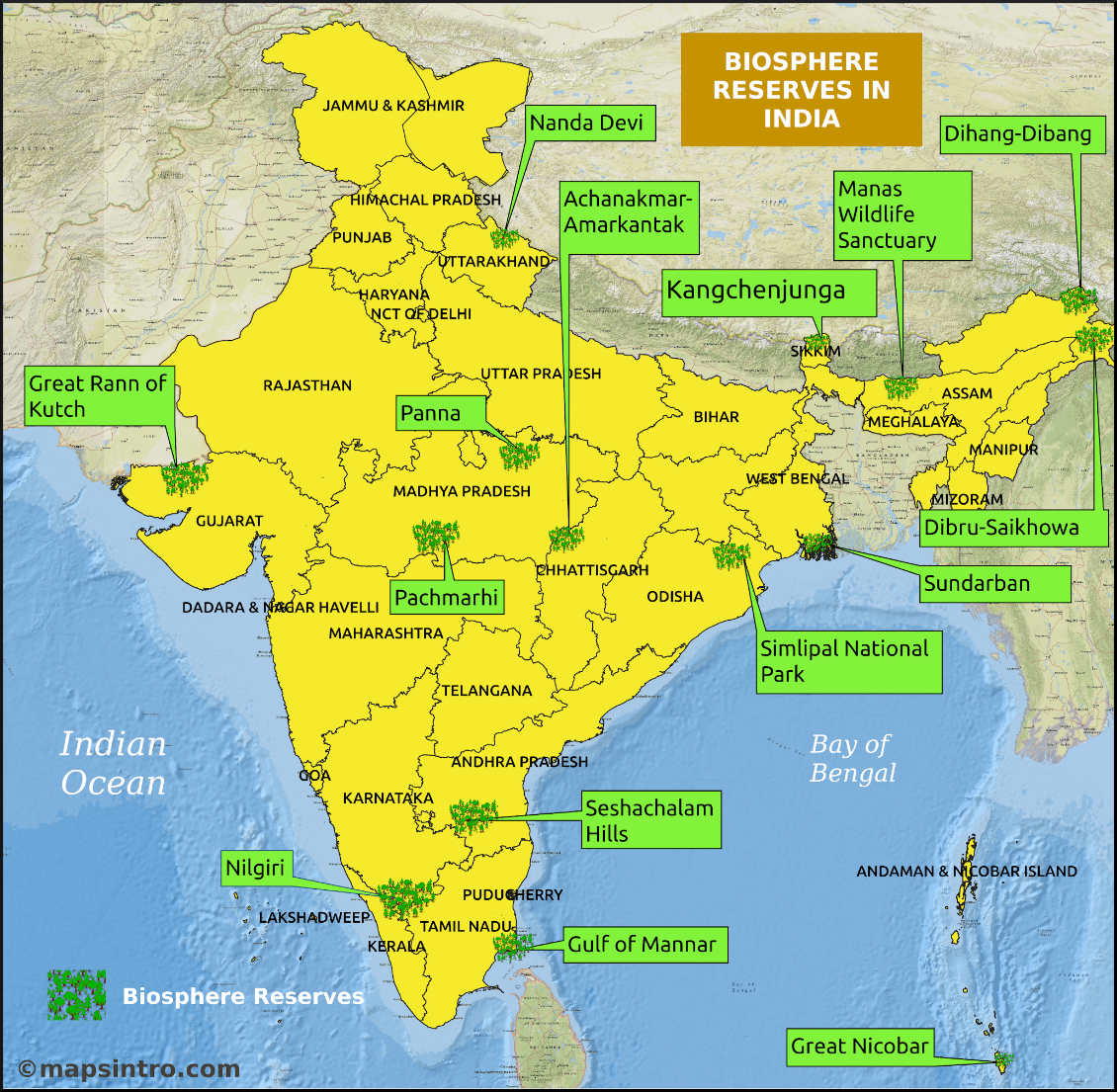
Up to $2002$ the biosphere reserves in India includes
Up to May $2002$, the above-mentioned biosphere reserves only originated. Hence the number of biosphere reserves in India in May $2002$ was $13$.
Thus, the option (C) is correct.
Note: Biosphere reserves help in the economic, social, environmental, socio economic sustainability by using the natural resources of the particular region wisely without any wastage. It also helps in protecting biological diversity. They not only help in the conservation of the soil but also preserve water, wildlife plants and animals.
Complete Answer:
In India, there are about $18$ biosphere reserves established till now that protects and preserves the large area of natural habitat and resources. These protect the natural habitat that was protected under the national parks and wildlife sanctuaries. These reserves also contain some buffer zones that are used for some economic uses. Except the areas under the buffer zone, other areas must be protected and no other activities are allowed in that area. The main aim to promote these biosphere reserves is to protect the natural resources and use them in a useful way.
Up to $2002$ the biosphere reserves in India includes
| Year when biosphere reserve started | Biosphere reserve |
| $1986$ | Nilgiri |
| $1988$ | Nanda Devi |
| $1989$ | Gulf of Mannar |
| $1988$ | Nokrek |
| $1989$ | Sundarbans |
| $1989$ | Great Nicobar |
| $1989$ | Manas |
| $1994$ | Simlipal |
| $1997$ | Dibru- Saikhowa |
| $1998$ | Dihang Dibang |
| $1999$ | Pachmarhi |
| $2000$ | khangchendzonga |
| $2001$ | Agasthyamalai |
Up to May $2002$, the above-mentioned biosphere reserves only originated. Hence the number of biosphere reserves in India in May $2002$ was $13$.
Thus, the option (C) is correct.
Note: Biosphere reserves help in the economic, social, environmental, socio economic sustainability by using the natural resources of the particular region wisely without any wastage. It also helps in protecting biological diversity. They not only help in the conservation of the soil but also preserve water, wildlife plants and animals.
Recently Updated Pages
Basicity of sulphurous acid and sulphuric acid are

Master Class 12 Economics: Engaging Questions & Answers for Success
Master Class 12 Biology: Engaging Questions & Answers for Success
Master Class 11 English: Engaging Questions & Answers for Success
Master Class 11 Physics: Engaging Questions & Answers for Success
Master Class 11 Computer Science: Engaging Questions & Answers for Success
Trending doubts
Difference Between Plant Cell and Animal Cell
Fill the blanks with the suitable prepositions 1 The class 9 english CBSE
What is pollution? How many types of pollution? Define it
What is the full form of pH?
What is the Full Form of ICSE, CBSE and SSC
Name 10 Living and Non living things class 9 biology CBSE