




Non-living part of the plant cell is
(a) Nucleus
(b) Cytoplasm
(c) Mitochondrion
(d) Cell wall
Answer
 Verified
554.6k+ views
Hint: Non-living parts lack protoplasm and thus no metabolic activities are performed in such parts. Also, these parts do not take part in the chemical reactions that occur in the cytoplasm of the cells.
Complete answer:
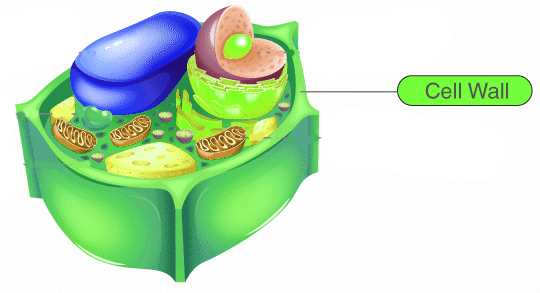
In a plant cell, the cell wall is the only part that is non-living because it is an extracellular product and exists outside the living boundary of the cell i.e. the plasma membrane and protects the cell besides providing it a definite shape.
A cell wall can be seen in the diagram below –
Additional information: In the plant cell walls, three layers can be present –
1. Primary cell wall – this layer is a generally flexible and thin layer formed while the cell is growing and is composed of cellulose, hemicellulose, and pectin.
2. Secondary cell wall – this is a thick layer that is formed inside the primary cell wall after the cell is fully grown and is found in some cells only like the conducting cells in xylem. It may contain polymers like cellulose, xylan, lignin, etc.
3. Middle lamella – this layer rich in pectins and is the outermost layer. It forms the interface between adjacent plant cells.
So, the correct answer is ‘Cell wall’.
Note:
1. Nucleus, cytoplasm, and mitochondria are the living parts of the cell because they are the components of the protoplast of the cell and help in carrying out various cellular metabolic activities.
2. The cytoplasm hosts many organelles and molecules and is a site for the chemical reactions occurring in a cell.
3. The nucleus contains the DNA and thus regulates the reproduction and division related activities. It also controls other metabolic activities by synthesizing appropriate enzymes with the help of DNA.
4. Mitochondria fulfill the energy demands of the cell as it synthesizes the ATP and thus acts as a powerhouse for the cell.
Complete answer:
In a plant cell, the cell wall is the only part that is non-living because it is an extracellular product and exists outside the living boundary of the cell i.e. the plasma membrane and protects the cell besides providing it a definite shape.
A cell wall can be seen in the diagram below –
Additional information: In the plant cell walls, three layers can be present –
1. Primary cell wall – this layer is a generally flexible and thin layer formed while the cell is growing and is composed of cellulose, hemicellulose, and pectin.
2. Secondary cell wall – this is a thick layer that is formed inside the primary cell wall after the cell is fully grown and is found in some cells only like the conducting cells in xylem. It may contain polymers like cellulose, xylan, lignin, etc.
3. Middle lamella – this layer rich in pectins and is the outermost layer. It forms the interface between adjacent plant cells.
So, the correct answer is ‘Cell wall’.
Note:
1. Nucleus, cytoplasm, and mitochondria are the living parts of the cell because they are the components of the protoplast of the cell and help in carrying out various cellular metabolic activities.
2. The cytoplasm hosts many organelles and molecules and is a site for the chemical reactions occurring in a cell.
3. The nucleus contains the DNA and thus regulates the reproduction and division related activities. It also controls other metabolic activities by synthesizing appropriate enzymes with the help of DNA.
4. Mitochondria fulfill the energy demands of the cell as it synthesizes the ATP and thus acts as a powerhouse for the cell.
Recently Updated Pages
Master Class 12 Economics: Engaging Questions & Answers for Success

Master Class 12 English: Engaging Questions & Answers for Success
Master Class 12 Social Science: Engaging Questions & Answers for Success
Master Class 12 Maths: Engaging Questions & Answers for Success
Master Class 12 Physics: Engaging Questions & Answers for Success
Master Class 9 General Knowledge: Engaging Questions & Answers for Success
Trending doubts
Difference Between Plant Cell and Animal Cell
Find the sum of series 1 + 2 + 3 + 4 + 5 + + 100 class 9 maths CBSE
Fill the blanks with the suitable prepositions 1 The class 9 english CBSE
What is pollution? How many types of pollution? Define it
Name 10 Living and Non living things class 9 biology CBSE
What is the full form of pH?