




Noncellular layer is
(A)Theca is interna
(B)Membrana granulosa
(C)Corona Radiata
(D)Zona pellucida
Answer
 Verified
594.9k+ views
Hint: Noncellular layer is present in the layer which is surrounding the plasma membrane of mammalian oocytes made up of glycoprotein. It also helps in species-specific fertilization and also prevents polyspermy. This layer is not divided into cells.
Complete answer:
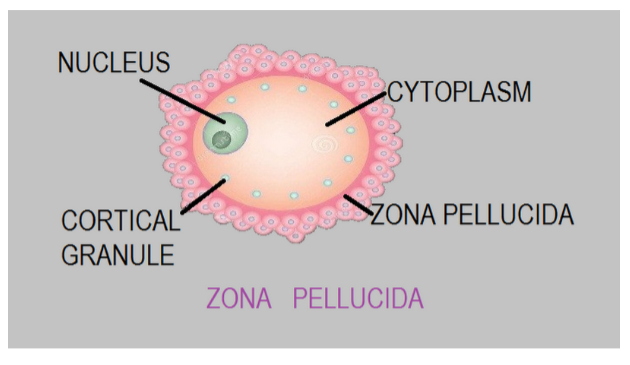
Zeno pellucid is a vital part of the oocyte. It is a noncellular layer present outside the ovum of the mammals.
Additional Information: The zone (ZP) is a specialized extracellular matrix surrounding the developing oocyte (egg, ovum) within each follicle within the ovary. This thick matrix is formed by secretions from the oocyte and therefore the follicle granulosa cells and in human oocytes consist of 4 sorts of zone glycoproteins that have different roles in fertilization. Zona pellucida is a translucent matrix.
It also enables the acrosome reaction. This reaction must occur before the sperm reaches the zona pellucida. Digestion of zona pellucida and membrane of oocyte takes place. Digesting enzymes help in the breakdown of the outer membrane. Theca interna is the internal layer of the cells surrounding the primary oocyte within the tertiary follicle present within the ovary.
There are many abnormalities of Zona pellucida. One of them is mentioned below:-
Empty Follicle syndrome- In this condition, no oocytes are retrieved from the mature follicle after ovulation.
So, the correct answer is ‘Zona pellucida’
Note: In human beings, the blastocyst performs zona hatching after five days have been completed to the fertilization process, in which the zona pellucida degenerates and decomposes, and also gets replaced by the underlying layer of trophoblastic cells. The zona pellucida is important for oocyte growth and fertilization.
Complete answer:
Zeno pellucid is a vital part of the oocyte. It is a noncellular layer present outside the ovum of the mammals.
Additional Information: The zone (ZP) is a specialized extracellular matrix surrounding the developing oocyte (egg, ovum) within each follicle within the ovary. This thick matrix is formed by secretions from the oocyte and therefore the follicle granulosa cells and in human oocytes consist of 4 sorts of zone glycoproteins that have different roles in fertilization. Zona pellucida is a translucent matrix.
It also enables the acrosome reaction. This reaction must occur before the sperm reaches the zona pellucida. Digestion of zona pellucida and membrane of oocyte takes place. Digesting enzymes help in the breakdown of the outer membrane. Theca interna is the internal layer of the cells surrounding the primary oocyte within the tertiary follicle present within the ovary.
There are many abnormalities of Zona pellucida. One of them is mentioned below:-
Empty Follicle syndrome- In this condition, no oocytes are retrieved from the mature follicle after ovulation.
So, the correct answer is ‘Zona pellucida’
Note: In human beings, the blastocyst performs zona hatching after five days have been completed to the fertilization process, in which the zona pellucida degenerates and decomposes, and also gets replaced by the underlying layer of trophoblastic cells. The zona pellucida is important for oocyte growth and fertilization.
Recently Updated Pages
Master Class 12 Social Science: Engaging Questions & Answers for Success

Master Class 12 Physics: Engaging Questions & Answers for Success
Master Class 12 Maths: Engaging Questions & Answers for Success
Master Class 12 Economics: Engaging Questions & Answers for Success
Master Class 12 Chemistry: Engaging Questions & Answers for Success
Master Class 12 Business Studies: Engaging Questions & Answers for Success
Trending doubts
What are the major means of transport Explain each class 12 social science CBSE
How many chromosomes are found in human ovum a 46 b class 12 biology CBSE
The diagram of the section of a maize grain is given class 12 biology CBSE
Differentiate between homogeneous and heterogeneous class 12 chemistry CBSE
No of 5 membered ring in left Caleft EDTA right right2 class 12 chemistry CBSE
Sulphuric acid is known as the king of acids State class 12 chemistry CBSE