




What is the net force if two forces are acting in opposite directions on an object ?
Answer
 Verified
547.5k+ views
Hint :In physics, a force is any influence that, when unopposed, causes an object to change its velocity. A force can cause a mass item to change its velocity (which includes starting to move from a standstill), i.e. accelerate. Intuitively, force may be characterised as a push or a pull. A force is a vector quantity since it has both magnitude and direction. The SI unit of Newton is used to measure it (N). The letter F is used to signify force.
Complete Step By Step Answer:
Newton's laws of motion are three laws that define the connection between an object's motion and the forces acting on it in classical mechanics.
The third law says that when one item exerts a force on another, the second object exerts a force on the first object that is equal in magnitude but opposite in direction. According to the third law, all forces between two things are equal in size and opposite in direction: if one object A exerts a force $ {F_A} $ on another item B, then B simultaneously exerts a force $ {F_B} $ on A, and the two forces are opposite in direction:
$\vec{F}_{net} = \vec{F}_A - \vec{F}_B $
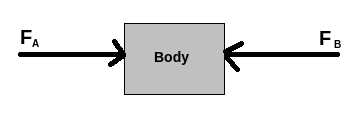
According to the third rule, all forces are interactions between distinct bodies or various regions within one body, and hence no force exists that is not accompanied by an equal and opposing force. In some cases, one of the two bodies, say Body A, determines the magnitude and direction of the forces fully; the force exerted by Body A on Body B is termed the "action," and the force exerted by Body B on Body A is called the "reaction."
The net force on an item is zero if two forces of equal magnitude but opposing diversity operate on it (null vector).
Note :
The law of conservation of momentum was derived from Newton's third law; however, conservation of momentum is the more fundamental idea (derived from Galilean invariance via Noether's theorem), and holds in cases where Newton's third law appears to fail, such as when force fields as well as particles carry momentum, and in quantum mechanics.
Complete Step By Step Answer:
Newton's laws of motion are three laws that define the connection between an object's motion and the forces acting on it in classical mechanics.
The third law says that when one item exerts a force on another, the second object exerts a force on the first object that is equal in magnitude but opposite in direction. According to the third law, all forces between two things are equal in size and opposite in direction: if one object A exerts a force $ {F_A} $ on another item B, then B simultaneously exerts a force $ {F_B} $ on A, and the two forces are opposite in direction:
$\vec{F}_{net} = \vec{F}_A - \vec{F}_B $
According to the third rule, all forces are interactions between distinct bodies or various regions within one body, and hence no force exists that is not accompanied by an equal and opposing force. In some cases, one of the two bodies, say Body A, determines the magnitude and direction of the forces fully; the force exerted by Body A on Body B is termed the "action," and the force exerted by Body B on Body A is called the "reaction."
The net force on an item is zero if two forces of equal magnitude but opposing diversity operate on it (null vector).
Note :
The law of conservation of momentum was derived from Newton's third law; however, conservation of momentum is the more fundamental idea (derived from Galilean invariance via Noether's theorem), and holds in cases where Newton's third law appears to fail, such as when force fields as well as particles carry momentum, and in quantum mechanics.
Recently Updated Pages
Master Class 11 English: Engaging Questions & Answers for Success

Master Class 11 Physics: Engaging Questions & Answers for Success
Master Class 11 Computer Science: Engaging Questions & Answers for Success
Master Class 11 Chemistry: Engaging Questions & Answers for Success
Master Class 11 Social Science: Engaging Questions & Answers for Success
Master Class 11 Accountancy: Engaging Questions & Answers for Success
Trending doubts
Difference Between Prokaryotic Cells and Eukaryotic Cells
Two of the body parts which do not appear in MRI are class 11 biology CBSE
One Metric ton is equal to kg A 10000 B 1000 C 100 class 11 physics CBSE
10 examples of friction in our daily life
Draw a diagram of nephron and explain its structur class 11 biology CBSE
Draw a diagram of a plant cell and label at least eight class 11 biology CBSE