




What is the nature of the image formed on the retina of the human eye of an object?
A. Virtual and erect
B. Virtual and inverted
C. Real and erect
D. Real and inverted
Answer
 Verified
638.4k+ views
Hint: The lens of a human eye is convex in nature that focuses the light rays that pass through it in order to create an image.
Complete answer:
The cornea and lens of an eye together form the real image on the retina. When light passes into the eye, it passes first from the cornea. Since the cornea has a curved surface and acts as a convex lens, it begins to focus on the light rays. The light then passes over the pupil and hits the lens of the eye. The lens which is also convex further focuses the light so that it will hit the retina at the back of the eyeball to form the image. The image formed on the retina is real and inverted. The retina comprises specialized cells that are sensitive to light, known as rod and cone cells. These cells get stimulated and send signals to the brain which turns them into erect images that allow us to see.
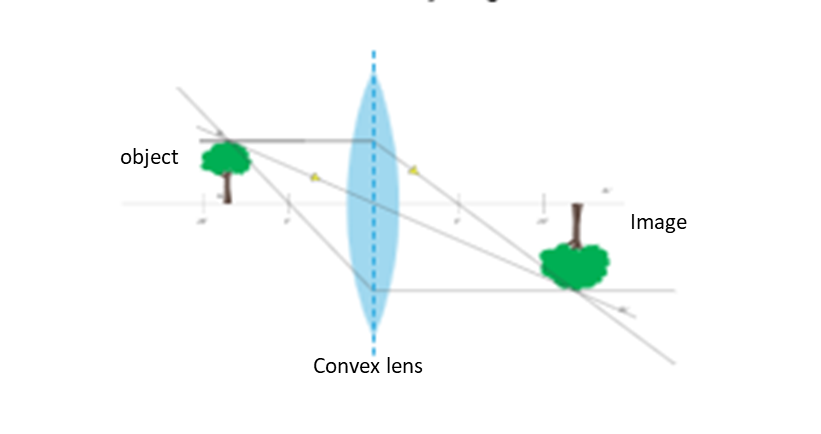
So, the correct answer is ‘real and inverted’.
Note: Nearsightedness is a common vision condition that occurs when the focus of the image is in front of the retina and is commonly known as myopia. In this defect, close objects are seen clear but distant objects are blurry.
Farsightedness is a vision defect that occurs when the focus of the image is behind the retina and commonly referred to as hyperopia. In this defect, distant objects are seen fine, but closer objects appear blurry.
Complete answer:
The cornea and lens of an eye together form the real image on the retina. When light passes into the eye, it passes first from the cornea. Since the cornea has a curved surface and acts as a convex lens, it begins to focus on the light rays. The light then passes over the pupil and hits the lens of the eye. The lens which is also convex further focuses the light so that it will hit the retina at the back of the eyeball to form the image. The image formed on the retina is real and inverted. The retina comprises specialized cells that are sensitive to light, known as rod and cone cells. These cells get stimulated and send signals to the brain which turns them into erect images that allow us to see.
So, the correct answer is ‘real and inverted’.
Note: Nearsightedness is a common vision condition that occurs when the focus of the image is in front of the retina and is commonly known as myopia. In this defect, close objects are seen clear but distant objects are blurry.
Farsightedness is a vision defect that occurs when the focus of the image is behind the retina and commonly referred to as hyperopia. In this defect, distant objects are seen fine, but closer objects appear blurry.
Recently Updated Pages
Master Class 12 Business Studies: Engaging Questions & Answers for Success

Master Class 12 Chemistry: Engaging Questions & Answers for Success
Master Class 12 Biology: Engaging Questions & Answers for Success
Class 12 Question and Answer - Your Ultimate Solutions Guide
Master Class 9 General Knowledge: Engaging Questions & Answers for Success
Master Class 9 Maths: Engaging Questions & Answers for Success
Trending doubts
Which are the Top 10 Largest Countries of the World?
Draw a labelled sketch of the human eye class 12 physics CBSE
Differentiate between homogeneous and heterogeneous class 12 chemistry CBSE
Sulphuric acid is known as the king of acids State class 12 chemistry CBSE
Why is the cell called the structural and functional class 12 biology CBSE
A dentist uses a small mirror that gives a magnification class 12 physics CBSE