




Nature of shear stress is
A. Positive
B. Negative
C. Positive as well as negative
D. Is always less than 0.5
Answer
 Verified
666.3k+ views
Hint: Shearing is the process of parallel layers sliding past each other. While cutting vegetables there is a direct stress acting on the vegetable and also while shaving our face, we apply a shear stress. The force needed per unit area for this kind of deformation is called the shear stress.
Complete step by step answer:
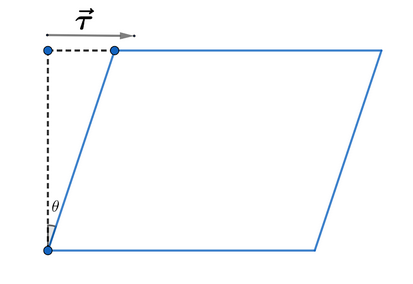
We know that when an external force acts on an object, it undergoes deformation. If the direction of the force is parallel to the plane of the object, the deformation will be along that plane. Here the stress experienced by the object is the tangential stress or the shear stress.
Shear stress is denoted by the symbol $\tau $. The SI unit of shear stress is the same as that of pressure which is Pascal (Pa). It can be denoted mathematically as, $\tau =\dfrac{F}{A}$.
The shear stress can be both positive or negative, depending on the coordinate system we are choosing. If the deformation is along the negative axis, the shear stress is said to be negative, and if the deformation is along the positive axis, then the shear stress is positive shear stress.
So, the answer to the question is option (C)- Positive as well as negative.
Note: Shear stress is found in both solids and liquids. Shear stress is an important stress in nature, being very closely related to the downward slope movement of earth materials and to earthquakes.
Stress is the force acting on a unit area of the material. Effect of stress on a body is named as strain. There are mainly two types of stress, 1) Normal stress, 2) The shearing stress.
The normal stress can be subdivided into two stresses,
Longitudinal Stress- A normal stress that leads to the change in the dimensions of a body.
Volumetric Stress- A normal stress that leads to the change in the volume of the body.
The strain which is produced by stress is defined as the ratio of change in dimension of the body to the original dimension of the body.
Complete step by step answer:
We know that when an external force acts on an object, it undergoes deformation. If the direction of the force is parallel to the plane of the object, the deformation will be along that plane. Here the stress experienced by the object is the tangential stress or the shear stress.
Shear stress is denoted by the symbol $\tau $. The SI unit of shear stress is the same as that of pressure which is Pascal (Pa). It can be denoted mathematically as, $\tau =\dfrac{F}{A}$.
The shear stress can be both positive or negative, depending on the coordinate system we are choosing. If the deformation is along the negative axis, the shear stress is said to be negative, and if the deformation is along the positive axis, then the shear stress is positive shear stress.
So, the answer to the question is option (C)- Positive as well as negative.
Note: Shear stress is found in both solids and liquids. Shear stress is an important stress in nature, being very closely related to the downward slope movement of earth materials and to earthquakes.
Stress is the force acting on a unit area of the material. Effect of stress on a body is named as strain. There are mainly two types of stress, 1) Normal stress, 2) The shearing stress.
The normal stress can be subdivided into two stresses,
Longitudinal Stress- A normal stress that leads to the change in the dimensions of a body.
Volumetric Stress- A normal stress that leads to the change in the volume of the body.
The strain which is produced by stress is defined as the ratio of change in dimension of the body to the original dimension of the body.
Recently Updated Pages
If x a + bt + ct2 where x is in meters and t is in class 11 physics CBSE

A car covers the first half distance between two places class 11 physics CBSE
The resultant of two vectors overrightarrow P and overrightarrow class 11 physics CBSE
Find the value of cos 135 class 11 maths CBSE
A mass M is held in place by an applied force F and class 11 physics CBSE
A solution of glucose in water is labelled as 10 dfracwv class 11 chemistry CBSE
Trending doubts
One Metric ton is equal to kg A 10000 B 1000 C 100 class 11 physics CBSE
Find the value of the expression given below sin 30circ class 11 maths CBSE
What do you mean by retardation What is its SI uni class 11 physics CBSE
Draw a diagram of nephron and explain its structur class 11 biology CBSE
10 examples of friction in our daily life
Difference between physical and chemical change class 11 chemistry CBSE