




Natural rubber is obtained as ‘latex’, which is a milky white fluid from rubber trees. Latex is a:
A. Mixture of rubber and gum.
B. Colloidal dispersion of rubber in water.
C. solution of rubber in water.
D. paste of rubber, clay and water.
Answer
 Verified
609.3k+ views
Hint: In metal reactivity series, it is known that reactivity decreases as we move down the group.
Complete step by step answer:
Natural rubber is an example of natural polymer. The formula of natural rubber is ${\left( {{{\rm{C}}_{\rm{5}}}{{\rm{H}}_{\rm{8}}}} \right)_{\rm{n}}}$. The natural rubber is a polymer comprising the monomer ${{\rm{C}}_{\rm{5}}}{{\rm{H}}_{\rm{8}}}$which is known as 2-methylbut-1,3-diene. This monomer is also commonly known as isoprene which is an alkene.
It is formed by the polymerisation of isoprene.
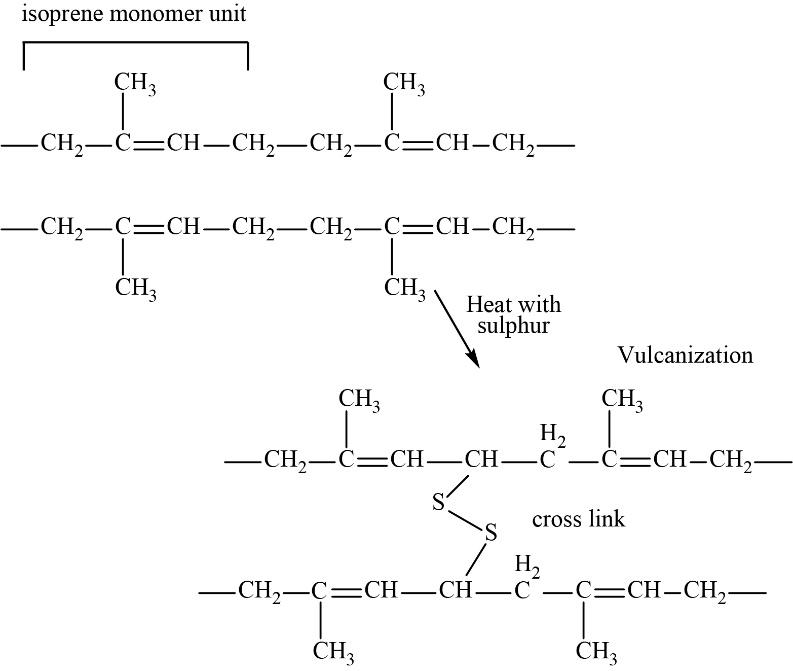
Natural rubber is achieved as ‘latex’. Latex is a milky white fluid which is obtained from rubber trees. Actually latex is a colloidal dispersion of rubber in water. Latex is negatively charged. In other words, we can say that latex is a colloidal mixture of rubber and water. Each rubber particle is made up of negatively charged protein membranes. The natural rubber is obtained by the coagulation of latex. But the latex does not coagulate on its own. Acid is added to the latex to promote coagulation. As we know the acid consists of ${{\rm{H}}^ + }$ ion, due to this the negatively charged protein membrane gets neutralized. Thus, as the similar negative charge on the particles gets neutralized, all the rubber particles stop repelling each other and collide with each other. In this way, the coagulation of latex is promoted and as a result the rubber molecule clumps together and the rubber is finally obtained.
So, the correct answer is “Option A”.
Note:
Thus, natural rubber which is a natural polymer is obtained from the latex. Latex is a milky white fluid obtained from the rubber tree. The latex is negatively charged. So it is coagulated by adding acid to it.
Complete step by step answer:
Natural rubber is an example of natural polymer. The formula of natural rubber is ${\left( {{{\rm{C}}_{\rm{5}}}{{\rm{H}}_{\rm{8}}}} \right)_{\rm{n}}}$. The natural rubber is a polymer comprising the monomer ${{\rm{C}}_{\rm{5}}}{{\rm{H}}_{\rm{8}}}$which is known as 2-methylbut-1,3-diene. This monomer is also commonly known as isoprene which is an alkene.
It is formed by the polymerisation of isoprene.
Natural rubber is achieved as ‘latex’. Latex is a milky white fluid which is obtained from rubber trees. Actually latex is a colloidal dispersion of rubber in water. Latex is negatively charged. In other words, we can say that latex is a colloidal mixture of rubber and water. Each rubber particle is made up of negatively charged protein membranes. The natural rubber is obtained by the coagulation of latex. But the latex does not coagulate on its own. Acid is added to the latex to promote coagulation. As we know the acid consists of ${{\rm{H}}^ + }$ ion, due to this the negatively charged protein membrane gets neutralized. Thus, as the similar negative charge on the particles gets neutralized, all the rubber particles stop repelling each other and collide with each other. In this way, the coagulation of latex is promoted and as a result the rubber molecule clumps together and the rubber is finally obtained.
So, the correct answer is “Option A”.
Note:
Thus, natural rubber which is a natural polymer is obtained from the latex. Latex is a milky white fluid obtained from the rubber tree. The latex is negatively charged. So it is coagulated by adding acid to it.
Recently Updated Pages
Master Class 12 Business Studies: Engaging Questions & Answers for Success

Master Class 12 Biology: Engaging Questions & Answers for Success
Master Class 12 Chemistry: Engaging Questions & Answers for Success
Class 12 Question and Answer - Your Ultimate Solutions Guide
Master Class 11 Social Science: Engaging Questions & Answers for Success
Master Class 11 English: Engaging Questions & Answers for Success
Trending doubts
Which are the Top 10 Largest Countries of the World?
Draw a labelled sketch of the human eye class 12 physics CBSE
Name the crygenes that control cotton bollworm and class 12 biology CBSE
Differentiate between homogeneous and heterogeneous class 12 chemistry CBSE
Ribosomal RNA is actively synthesised in A Nucleoplasm class 12 biology CBSE
How many molecules of ATP and NADPH are required information class 12 biology CBSE