




Name two reagents used for acylation of benzene.
Answer
 Verified
650.4k+ views
Hint: Acylation is the substitution of an acyl group into an organic compound. In case of benzene, the acyl group is substituted into the benzene ring. This reaction is also known as Friedel-Crafts acylation of Benzene.
Complete step by step answer:
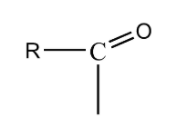
Acylation involves the substitution of an acyl group into an organic compound. The acyl group is an alkyl group that possesses a carbon-oxygen double bond. The general formula of an acyl group is \[RCO - \] where R is an alkyl group. \[C{H_3}CO - \] is the most commonly used acyl group. It is also known as ethanoyl group. In the acylation of benzene, \[C{H_3}CO - \] is getting substituted into the ring.
\[C{H_3}COCl\] is the most reactive substance that contains an acyl group. It is commonly known as acyl chloride or acid chloride.
Benzene ring is reacted with a mixture of ethanoyl chloride \[C{H_3}COCl\] and \[AlC{l_3}\] (aluminium chloride) that acts as a catalyst. The product formed is a ketone called phenylethanone.
The reaction is as follows:
\[{C_6}{H_6} + C{H_3}COCl \to {C_6}{H_5}COCl + HCl\]
Or
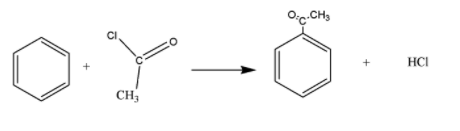
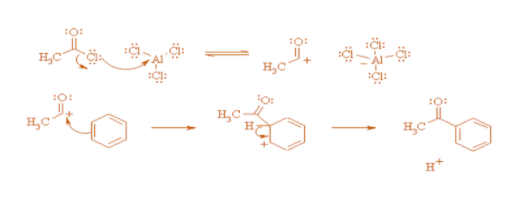
This reaction is an example of an electrophilic substitution reaction. The electrophile is \[C{H_3}C{O^ + }\] that is produced by the reaction of ethanoyl chloride and aluminium chloride.
The reaction is as follows:
\[C{H_3}COCl + AlC{l_3} \to C{H_3}C{O^ + } + AlC{l_4}^ - \]
The electrophilic substitution mechanism is:
Hence, the two reagents used in the acylation of benzene is ethanoyl chloride \[C{H_3}COCl\] and aluminium chloride \[AlC{l_3}\]
Note: A student can get confused between acylation and alkylation. Alkylation is the transfer of an alkyl group from one compound to another. A student can also get confused between electrophilic substitution and nucleophilic substitution. Electrophilic substitution involves the displacement of a functional group by an electrophile, i.e., hydrogen whereas nucleophilic substitution involves the attack of a positively charged atom by a nucleophile.
Complete step by step answer:
Acylation involves the substitution of an acyl group into an organic compound. The acyl group is an alkyl group that possesses a carbon-oxygen double bond. The general formula of an acyl group is \[RCO - \] where R is an alkyl group. \[C{H_3}CO - \] is the most commonly used acyl group. It is also known as ethanoyl group. In the acylation of benzene, \[C{H_3}CO - \] is getting substituted into the ring.
\[C{H_3}COCl\] is the most reactive substance that contains an acyl group. It is commonly known as acyl chloride or acid chloride.
Benzene ring is reacted with a mixture of ethanoyl chloride \[C{H_3}COCl\] and \[AlC{l_3}\] (aluminium chloride) that acts as a catalyst. The product formed is a ketone called phenylethanone.
The reaction is as follows:
\[{C_6}{H_6} + C{H_3}COCl \to {C_6}{H_5}COCl + HCl\]
Or
This reaction is an example of an electrophilic substitution reaction. The electrophile is \[C{H_3}C{O^ + }\] that is produced by the reaction of ethanoyl chloride and aluminium chloride.
The reaction is as follows:
\[C{H_3}COCl + AlC{l_3} \to C{H_3}C{O^ + } + AlC{l_4}^ - \]
The electrophilic substitution mechanism is:
Hence, the two reagents used in the acylation of benzene is ethanoyl chloride \[C{H_3}COCl\] and aluminium chloride \[AlC{l_3}\]
Note: A student can get confused between acylation and alkylation. Alkylation is the transfer of an alkyl group from one compound to another. A student can also get confused between electrophilic substitution and nucleophilic substitution. Electrophilic substitution involves the displacement of a functional group by an electrophile, i.e., hydrogen whereas nucleophilic substitution involves the attack of a positively charged atom by a nucleophile.
Recently Updated Pages
Write structures of the following compounds i 2 Chloro3methylpentane class 11 chemistry CBSE

What is BLO What is the full form of BLO class 8 social science CBSE
Explain the Treaty of Vienna of 1815 class 10 social science CBSE
A Paragraph on Pollution in about 100-150 Words
XIX+XXX A 49 B 51 C 55 D 44 class 5 maths CBSE
If x a + bt + ct2 where x is in meters and t is in class 11 physics CBSE
Trending doubts
One Metric ton is equal to kg A 10000 B 1000 C 100 class 11 physics CBSE
Find the value of the expression given below sin 30circ class 11 maths CBSE
What do you mean by retardation What is its SI uni class 11 physics CBSE
Draw a diagram of nephron and explain its structur class 11 biology CBSE
10 examples of friction in our daily life
Difference between physical and chemical change class 11 chemistry CBSE