




Name the tissue where cells are living, thin-walled, isodiametric with intercellular spaces
(a) Prosenchyma
(b) Aerenchyma
(C) Parenchyma
(d) Collenchyma
Answer
 Verified
645.3k+ views
Hint: The tissues are of two types based on their dividing capabilities. The ones which cannot divide are further of three types based on the type of material deposited in their cell wall. The tissue which is living and thin-walled can be found in the softer parts of leaves, the pulp of fruits, etc.
Complete answer:
Meristematic tissues can divide to form new cells. They are not restricted to perform any particular set of functions. On the other hand, permanent cells are the mature cells that have lost the ability to divide as they have attained their destined shape, size, and function. They can be parenchymatous, collenchymatous, or sclerenchymatous.
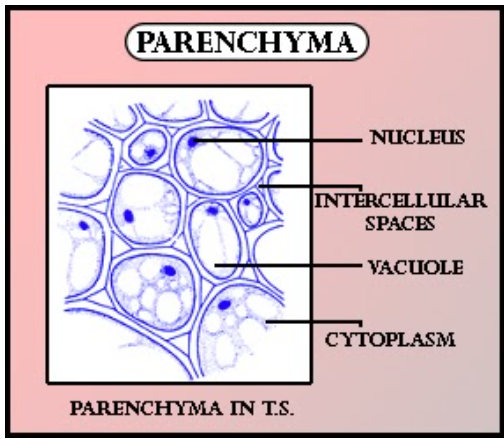
Parenchyma is made up of simple, thin-walled, closely packed isodiametric cells, with little intercellular spaces between them. They are living cells and are the most abundant in plants. Their cell wall contains cellulose with uniform thickening around its periphery. They are located in the cortex of stems and roots, the pulp of fruits, and mesophyll of leaves.
Additional Information:
- Collenchyma is a simple permanent tissue with irregular thickenings of pecto cellulose in specific areas of their walls. They can be only observed in the aerial parts of the plant like petioles, leaves, and stems of dicots. Collenchyma provides mechanical strength coupled with flexibility.
- Parenchyma may be modified to chlorenchyma, aerenchyma, and prosenchyma.
- Aerenchyma is abundant in aquatic plants where the need for floatation is fulfilled by the storage of gases in the air cavities of aerenchyma. Chlorenchyma, as the name suggests, contains chloroplast and thus takes part in the manufacture of food.
-Prosenchyma is a special type of parenchyma found exclusively in vascular tissues for short-distance transport of solutes.
So, the correct answer is ‘Parenchyma.’
Note: -Sclerenchymatous tissue is a type of simple permanent tissues with highly thickened walls and extremely narrow cavities. Little or negligible protoplasm may be present. They are supportive in function. They are of two types - sclereids and fibers.
-Sclereids are found in the grits of guava and pear and in the fruit walls of nuts.
-Sclerenchymatous fibers are elongated and narrow whose ends are interlocked with each other. E.g Jute fibers.
Complete answer:
Meristematic tissues can divide to form new cells. They are not restricted to perform any particular set of functions. On the other hand, permanent cells are the mature cells that have lost the ability to divide as they have attained their destined shape, size, and function. They can be parenchymatous, collenchymatous, or sclerenchymatous.
Parenchyma is made up of simple, thin-walled, closely packed isodiametric cells, with little intercellular spaces between them. They are living cells and are the most abundant in plants. Their cell wall contains cellulose with uniform thickening around its periphery. They are located in the cortex of stems and roots, the pulp of fruits, and mesophyll of leaves.
Additional Information:
- Collenchyma is a simple permanent tissue with irregular thickenings of pecto cellulose in specific areas of their walls. They can be only observed in the aerial parts of the plant like petioles, leaves, and stems of dicots. Collenchyma provides mechanical strength coupled with flexibility.
- Parenchyma may be modified to chlorenchyma, aerenchyma, and prosenchyma.
- Aerenchyma is abundant in aquatic plants where the need for floatation is fulfilled by the storage of gases in the air cavities of aerenchyma. Chlorenchyma, as the name suggests, contains chloroplast and thus takes part in the manufacture of food.
-Prosenchyma is a special type of parenchyma found exclusively in vascular tissues for short-distance transport of solutes.
So, the correct answer is ‘Parenchyma.’
Note: -Sclerenchymatous tissue is a type of simple permanent tissues with highly thickened walls and extremely narrow cavities. Little or negligible protoplasm may be present. They are supportive in function. They are of two types - sclereids and fibers.
-Sclereids are found in the grits of guava and pear and in the fruit walls of nuts.
-Sclerenchymatous fibers are elongated and narrow whose ends are interlocked with each other. E.g Jute fibers.
Recently Updated Pages
If x a + bt + ct2 where x is in meters and t is in class 11 physics CBSE

A car covers the first half distance between two places class 11 physics CBSE
The resultant of two vectors overrightarrow P and overrightarrow class 11 physics CBSE
Find the value of cos 135 class 11 maths CBSE
A mass M is held in place by an applied force F and class 11 physics CBSE
A solution of glucose in water is labelled as 10 dfracwv class 11 chemistry CBSE
Trending doubts
One Metric ton is equal to kg A 10000 B 1000 C 100 class 11 physics CBSE
Find the value of the expression given below sin 30circ class 11 maths CBSE
What do you mean by retardation What is its SI uni class 11 physics CBSE
Draw a diagram of nephron and explain its structur class 11 biology CBSE
10 examples of friction in our daily life
Difference between physical and chemical change class 11 chemistry CBSE