




Name the lens which produces a virtual, magnified image. Draw ray diagrams to the image formation.
Answer
 Verified
620.1k+ views
Hint: Recall the properties of concave lens and convex lens. The magnification of the lens is the ratio of image height to the object height. The lens produces virtual images when the image is formed on the same side of the object.
Complete step by step answer:We know that the virtual image is the opposite of the real image, that is it cannot be seen on the screen. The image formed by the concave lens is always virtual, because the image is formed on the same side of the object from the lens. The convex lens produces a virtual image when the object is placed between the pole of the lens and first principle focus.
The image formed by a concave lens is never magnified. The convex lens produces magnified images when the object is placed between the first principal focus and pole of the lens.
Therefore, the image formed by the convex lens is virtual and magnified if it satisfies the above condition.
The following figure shows image formation by the convex lens.
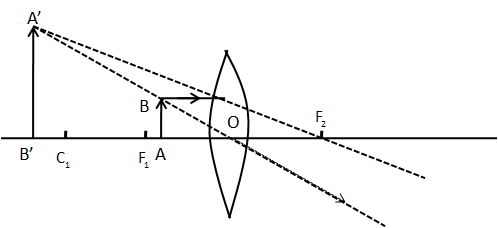
In the above ray diagram, AB is the height of object and A’B’ is the height of image, \[{F_1}\] is the first principal focus, \[{{\text{C}}_{\text{1}}}\] is the curvature of the lens and \[{{\text{F}}_2}\] is the second principal focus.
From the above ray diagram, we can say that the image is magnified and since it is formed on the same side of the object, we can say the image is virtual.
Note:Students should remember that the convex lens produces a real image if the object is placed beyond the first principle focus on the opposite side of the lens. It produces a virtual image if the object is at the right of the principal focus. The magnification of the lens is the ratio of image height to the object height. Since the image height is greater than the object height, the image will be magnified.
Complete step by step answer:We know that the virtual image is the opposite of the real image, that is it cannot be seen on the screen. The image formed by the concave lens is always virtual, because the image is formed on the same side of the object from the lens. The convex lens produces a virtual image when the object is placed between the pole of the lens and first principle focus.
The image formed by a concave lens is never magnified. The convex lens produces magnified images when the object is placed between the first principal focus and pole of the lens.
Therefore, the image formed by the convex lens is virtual and magnified if it satisfies the above condition.
The following figure shows image formation by the convex lens.
In the above ray diagram, AB is the height of object and A’B’ is the height of image, \[{F_1}\] is the first principal focus, \[{{\text{C}}_{\text{1}}}\] is the curvature of the lens and \[{{\text{F}}_2}\] is the second principal focus.
From the above ray diagram, we can say that the image is magnified and since it is formed on the same side of the object, we can say the image is virtual.
Note:Students should remember that the convex lens produces a real image if the object is placed beyond the first principle focus on the opposite side of the lens. It produces a virtual image if the object is at the right of the principal focus. The magnification of the lens is the ratio of image height to the object height. Since the image height is greater than the object height, the image will be magnified.
Recently Updated Pages
Master Class 5 English: Engaging Questions & Answers for Success

Master Class 5 Maths: Engaging Questions & Answers for Success
Master Class 5 Social Science: Engaging Questions & Answers for Success
Master Class 5 Science: Engaging Questions & Answers for Success
Class 5 Question and Answer - Your Ultimate Solutions Guide
Master Class 9 General Knowledge: Engaging Questions & Answers for Success
Trending doubts
Which are the Top 10 Largest Countries of the World?
The total number of vertebrae in man is a30 b31 c32 class 12 biology CBSE
Draw a labelled sketch of the human eye class 12 physics CBSE
The number of cranial nerves in a frog is A 10 pairs class 12 biology CBSE
Differentiate between homogeneous and heterogeneous class 12 chemistry CBSE
Differentiate between Pyramid of energy and pyramid class 12 biology CBSE