




Name the heaviest and longest bone in the human body.
Answer
 Verified
618.6k+ views
Hint: The heaviest and the longest bone in the human body is the bone of the thigh or of the hindlimb, forming the joint at the hip and the knee found in the pelvic region.
Complete answer:
The heaviest and longest bone in the human body is the femur. The head of the femur makes a joint with the acetabulum within the pelvic bone forming the hip, while the distal part of the femur articulates with the tibia and kneecap, forming the knee. By most measures, both left and right femurs are the strongest bones of the body.
Additional Information: The femur is the only bone within the upper leg. The angle of convergence of the femora may be a major think about determining the femoral-tibial angle. Human females have wider pelvic bones, causing their femora to converge quite in males.
The femur is the longest and, by some measures, the strongest bone within the physical body. This relies on the sort of measurement taken to calculate strength. The femur length on the average is 26.74% of an individual's height, a ratio found in both men and ladies and most ethnic groups with only restricted variation, and is beneficial in anthropology because it offers a basis for an inexpensive estimate of a subject's height from an incomplete skeleton.
Note: In the condition which is known as genu valgum or the knock knee, the femurs converge so much that the knees touch one another. The opposite extreme is genu varum (bow-leggedness). The angle of the femoral-tibial is found to be around 175 degrees in the normal population of people where both of the conditions i.e genu valgum or genu varum are absent.
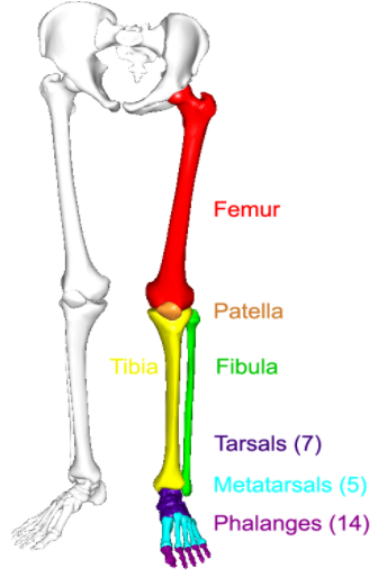
Complete answer:
The heaviest and longest bone in the human body is the femur. The head of the femur makes a joint with the acetabulum within the pelvic bone forming the hip, while the distal part of the femur articulates with the tibia and kneecap, forming the knee. By most measures, both left and right femurs are the strongest bones of the body.
Additional Information: The femur is the only bone within the upper leg. The angle of convergence of the femora may be a major think about determining the femoral-tibial angle. Human females have wider pelvic bones, causing their femora to converge quite in males.
The femur is the longest and, by some measures, the strongest bone within the physical body. This relies on the sort of measurement taken to calculate strength. The femur length on the average is 26.74% of an individual's height, a ratio found in both men and ladies and most ethnic groups with only restricted variation, and is beneficial in anthropology because it offers a basis for an inexpensive estimate of a subject's height from an incomplete skeleton.
Note: In the condition which is known as genu valgum or the knock knee, the femurs converge so much that the knees touch one another. The opposite extreme is genu varum (bow-leggedness). The angle of the femoral-tibial is found to be around 175 degrees in the normal population of people where both of the conditions i.e genu valgum or genu varum are absent.
Recently Updated Pages
Master Class 12 Business Studies: Engaging Questions & Answers for Success

Master Class 12 Chemistry: Engaging Questions & Answers for Success
Master Class 12 Biology: Engaging Questions & Answers for Success
Class 12 Question and Answer - Your Ultimate Solutions Guide
Master Class 11 English: Engaging Questions & Answers for Success
Master Class 11 Social Science: Engaging Questions & Answers for Success
Trending doubts
Which are the Top 10 Largest Countries of the World?
Draw a labelled sketch of the human eye class 12 physics CBSE
Differentiate between homogeneous and heterogeneous class 12 chemistry CBSE
Differentiate between Pyramid of energy and pyramid class 12 biology CBSE
Why is the cell called the structural and functional class 12 biology CBSE
Draw the diagram of the pyramid of energy Explain In class 12 biology CBSE