




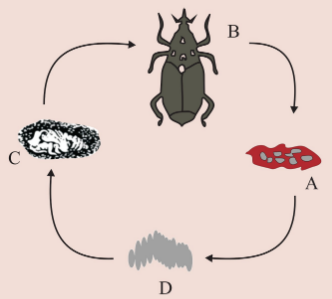
Name the four stages of the life cycle given in the diagram.
(a) ${ Eggs }\longrightarrow { Pupa }\longrightarrow { Larva }\longrightarrow { Adult }$
(b) ${ Pupa }\longrightarrow { Eggs }\longrightarrow { Larva }\longrightarrow { Adult }$
(c) ${ Adult }\longrightarrow { Eggs }\longrightarrow { Pupa }\longrightarrow { Larva }$
(d) ${ Adult }\longrightarrow { Eggs }\longrightarrow { Larva }\longrightarrow { Pupa }$
Answer
 Verified
533.7k+ views
Hint: Metamorphosis is the process where the physical development occurs after the birth or hatching of the egg of an organism. This process will lead to the changes in the body of an organism and its structure through differentiation and division.
Complete answer:
The life cycle process of an insect in which it undergoes a transformation from the larva into an adult, this process is known as metamorphosis. This process will result in the bodily changes of the larva. It is of two types complete and incomplete metamorphosis and depends upon the functioning of the hormones. This process commonly occurs in the case of the insects, moths, butterflies, etc. The four stages of the life cyc;e mainly includes eggs, larvae, pupa, and then adults.
-The complete metamorphosis constitutes four stages which start with the hatching of eggs as shown in the figure A.
-The eggs then develop and convert into a larva that is worm-shaped as shown in the figure D.
-Later in the figure C shows that the larva after eating and growing a hard shell around it will develop into a pupa.
-Then lastly in figure B it is shown that the larva eventually grows and develops into a complete adult.
-The two types of metamorphosis are:
1) Ametabolous metamorphosis - Here no metamorphosis occurs which takes place in an insect in which the size of their body increases slowly.
2) Hemimetabolous metamorphosis - It occurs in various insects where distinct stages occur that include egg, nymph, and the adult stage or images while the pupa stage may be absent. It is also called the paurometabolous or incomplete metamorphosis.
So, the correct answer is ‘${ Adult }\longrightarrow { Eggs }\longrightarrow { Pupa }\longrightarrow { Larva }$’.
Note:
In human’s metamorphosis is not seen because as we grow our body grows too but it does not transform into some new complex structure. In the case of humans, their body structure remains the same from their birth till their death. So, the process of metamorphosis is absent in humans.
Complete answer:
The life cycle process of an insect in which it undergoes a transformation from the larva into an adult, this process is known as metamorphosis. This process will result in the bodily changes of the larva. It is of two types complete and incomplete metamorphosis and depends upon the functioning of the hormones. This process commonly occurs in the case of the insects, moths, butterflies, etc. The four stages of the life cyc;e mainly includes eggs, larvae, pupa, and then adults.
-The complete metamorphosis constitutes four stages which start with the hatching of eggs as shown in the figure A.
-The eggs then develop and convert into a larva that is worm-shaped as shown in the figure D.
-Later in the figure C shows that the larva after eating and growing a hard shell around it will develop into a pupa.
-Then lastly in figure B it is shown that the larva eventually grows and develops into a complete adult.
-The two types of metamorphosis are:
1) Ametabolous metamorphosis - Here no metamorphosis occurs which takes place in an insect in which the size of their body increases slowly.
2) Hemimetabolous metamorphosis - It occurs in various insects where distinct stages occur that include egg, nymph, and the adult stage or images while the pupa stage may be absent. It is also called the paurometabolous or incomplete metamorphosis.
So, the correct answer is ‘${ Adult }\longrightarrow { Eggs }\longrightarrow { Pupa }\longrightarrow { Larva }$’.
Note:
In human’s metamorphosis is not seen because as we grow our body grows too but it does not transform into some new complex structure. In the case of humans, their body structure remains the same from their birth till their death. So, the process of metamorphosis is absent in humans.
Recently Updated Pages
Master Class 12 Economics: Engaging Questions & Answers for Success

Master Class 12 Physics: Engaging Questions & Answers for Success
Master Class 12 English: Engaging Questions & Answers for Success
Master Class 12 Social Science: Engaging Questions & Answers for Success
Master Class 12 Maths: Engaging Questions & Answers for Success
Master Class 12 Business Studies: Engaging Questions & Answers for Success
Trending doubts
Which are the Top 10 Largest Countries of the World?
What are the major means of transport Explain each class 12 social science CBSE
Draw a labelled sketch of the human eye class 12 physics CBSE
Why cannot DNA pass through cell membranes class 12 biology CBSE
Differentiate between insitu conservation and exsitu class 12 biology CBSE
Draw a neat and well labeled diagram of TS of ovary class 12 biology CBSE