




Name the following: Tissue that forms the inner lining of our mouth
Answer
 Verified
606.6k+ views
Hint: Tissues that shape the inner lining of our mouth have cells that appear as small, flat plates that, when viewed from above, may look polygonal. Their name comes from the Latin word which means scale that appears on fish or snake skin. In tissues, the cells fit tightly together, creating a smooth, low-friction surface over which fluids can easily travel.
Complete step by step answer:
The squamous epithelium has cells (flat and scale- like) that are wider than their height. This is found in the lining of the mouth, the esophagus, and in the alveoli of the lungs, including blood vessels.
Simple squamous epithelia are tissues that line surfaces, formed from one layer of squamous cells. Squamous cells have a rounded nucleus and are wide, thin, and smooth. They have polarity, like other epithelial cells, and contain a distinct apical surface with specialized membrane proteins.
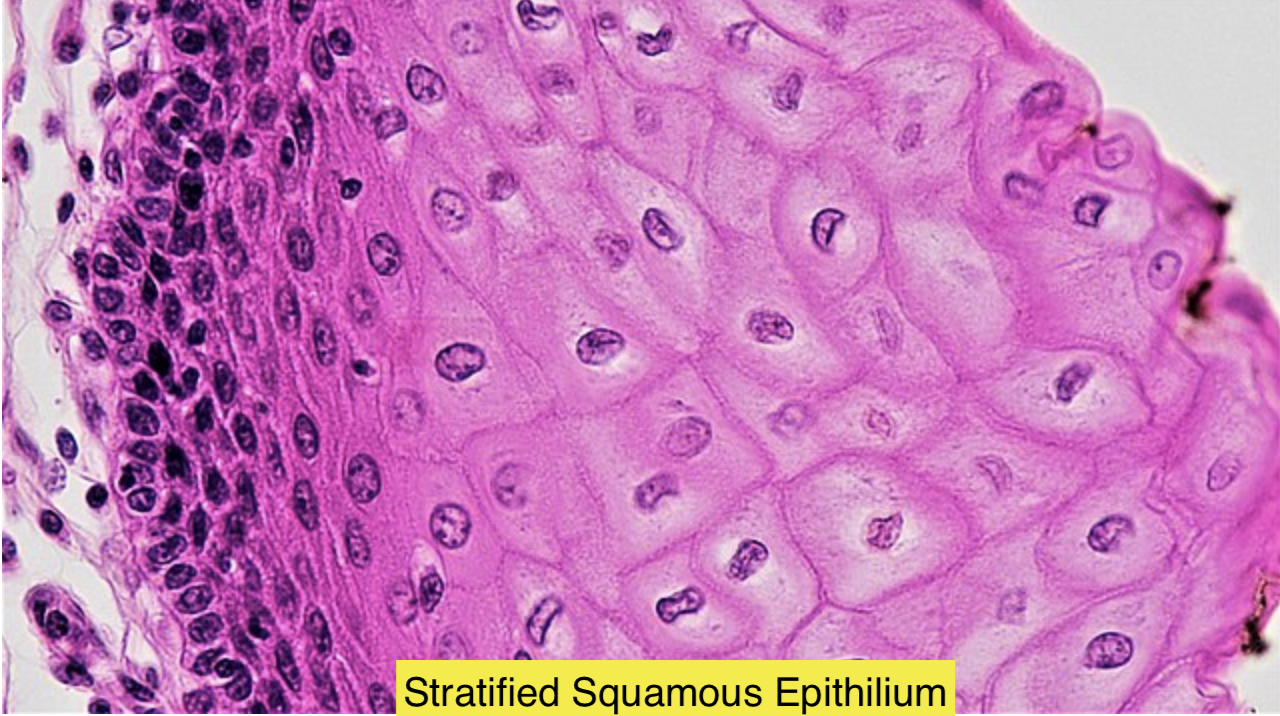
Squamous Epithelium functions
- These epithelia are popular where it is necessary to absorb or transport materials.
- Diffusion, osmosis, and filtration also play a part. This makes them essential in the kidneys, in the lungs' alveoli, and in the capillary walls.
- It is the perfect medium for selective transmembrane transport since this epithelium is made of a single layer of thin cells that are tightly packed together. Some items, such as oxygen from the lungs, pass more toward the blood along their concentration gradient. Using membrane-bound carrier proteins, some are effectively transported.
So, the correct answer is, ‘Squamous epithelial tissue’.
Note: In addition to connective tissue, muscle tissue, and nervous tissue, the epithelium is one of the four essential kinds of animal tissue. It is a thin, continuous layer of cells that is defensive. In several internal organs, epithelial tissues line the outer surfaces of organs and blood vessels throughout the body, as well as the inner surfaces of cavities. The epidermis, the skin's outermost layer, is an example.
Complete step by step answer:
The squamous epithelium has cells (flat and scale- like) that are wider than their height. This is found in the lining of the mouth, the esophagus, and in the alveoli of the lungs, including blood vessels.
Simple squamous epithelia are tissues that line surfaces, formed from one layer of squamous cells. Squamous cells have a rounded nucleus and are wide, thin, and smooth. They have polarity, like other epithelial cells, and contain a distinct apical surface with specialized membrane proteins.
Squamous Epithelium functions
- These epithelia are popular where it is necessary to absorb or transport materials.
- Diffusion, osmosis, and filtration also play a part. This makes them essential in the kidneys, in the lungs' alveoli, and in the capillary walls.
- It is the perfect medium for selective transmembrane transport since this epithelium is made of a single layer of thin cells that are tightly packed together. Some items, such as oxygen from the lungs, pass more toward the blood along their concentration gradient. Using membrane-bound carrier proteins, some are effectively transported.
So, the correct answer is, ‘Squamous epithelial tissue’.
Note: In addition to connective tissue, muscle tissue, and nervous tissue, the epithelium is one of the four essential kinds of animal tissue. It is a thin, continuous layer of cells that is defensive. In several internal organs, epithelial tissues line the outer surfaces of organs and blood vessels throughout the body, as well as the inner surfaces of cavities. The epidermis, the skin's outermost layer, is an example.
Recently Updated Pages
Master Class 11 English: Engaging Questions & Answers for Success

Master Class 11 Maths: Engaging Questions & Answers for Success
Class 11 Question and Answer - Your Ultimate Solutions Guide
Master Class 11 Biology: Engaging Questions & Answers for Success
Master Class 11 Physics: Engaging Questions & Answers for Success
Master Class 11 Accountancy: Engaging Questions & Answers for Success
Trending doubts
Differentiate between an exothermic and an endothermic class 11 chemistry CBSE
One Metric ton is equal to kg A 10000 B 1000 C 100 class 11 physics CBSE
Difference Between Prokaryotic Cells and Eukaryotic Cells
There are 720 permutations of the digits 1 2 3 4 5 class 11 maths CBSE
Draw a diagram of a plant cell and label at least eight class 11 biology CBSE
1 Quintal is equal to a 110 kg b 10 kg c 100kg d 1000 class 11 physics CBSE