



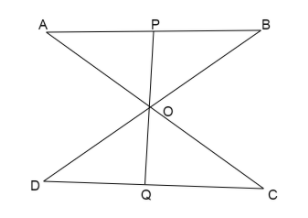
Name all pairs of vertically opposite angles in the following figure.
Answer
 Verified
629.1k+ views
Hint: Here we look for all the angles in the diagram which fit into the definition of vertically opposite angles which is the angles which lie on the exact opposite side of each other when two lines cross at a point. So we look at every point which is formed by crossing two lines carefully.
Complete step-by-step answer:
We have three sets of intersecting lines \[AC,BD\], \[AC,PQ\] and \[BD,PQ\].
Also, note that all the lines are intersecting at the same point of intersection \[O\].
First we see the intersection of lines \[AC,BD\] at the point \[O\]
If we see the figure only with two lines \[AC,BD\] intersecting at the point \[O\], then the set of opposite angles formed is \[\angle AOB,\angle COD\]
Now we see the intersection of lines \[AC,PQ\] at the point \[O\]
If we see the figure only with two lines \[AC,PQ\] intersecting at the point \[O\], then the set of opposite angles formed is \[\angle AOP,\angle COQ\]
And in last we see the intersection of lines \[BD,PQ\] at the point \[O\]
If we see the figure only with two lines \[BD,PQ\] intersecting at the point \[O\], then the set of opposite angles formed is \[\angle BOP,\angle DOQ\].
Therefore, from all the three cases stated above we have three pairs of vertically opposite angles in the figure that are \[\angle AOB,\angle COD\] , \[\angle AOP,\angle COQ\]and \[\angle BOP,\angle DOQ\].
Note: Students many times get confused with the word vertically along with opposite and they think only the vertical angles will be counted but that is wrong, the word vertically refers to the vertex that is point where the lines cross even if the figure was tilted in a horizontal way the pairs of vertically opposite angles will be same.
Complete step-by-step answer:
We have three sets of intersecting lines \[AC,BD\], \[AC,PQ\] and \[BD,PQ\].
Also, note that all the lines are intersecting at the same point of intersection \[O\].
First we see the intersection of lines \[AC,BD\] at the point \[O\]
If we see the figure only with two lines \[AC,BD\] intersecting at the point \[O\], then the set of opposite angles formed is \[\angle AOB,\angle COD\]
Now we see the intersection of lines \[AC,PQ\] at the point \[O\]
If we see the figure only with two lines \[AC,PQ\] intersecting at the point \[O\], then the set of opposite angles formed is \[\angle AOP,\angle COQ\]
And in last we see the intersection of lines \[BD,PQ\] at the point \[O\]
If we see the figure only with two lines \[BD,PQ\] intersecting at the point \[O\], then the set of opposite angles formed is \[\angle BOP,\angle DOQ\].
Therefore, from all the three cases stated above we have three pairs of vertically opposite angles in the figure that are \[\angle AOB,\angle COD\] , \[\angle AOP,\angle COQ\]and \[\angle BOP,\angle DOQ\].
Note: Students many times get confused with the word vertically along with opposite and they think only the vertical angles will be counted but that is wrong, the word vertically refers to the vertex that is point where the lines cross even if the figure was tilted in a horizontal way the pairs of vertically opposite angles will be same.
Recently Updated Pages
Master Class 12 Economics: Engaging Questions & Answers for Success

Master Class 12 English: Engaging Questions & Answers for Success
Master Class 12 Social Science: Engaging Questions & Answers for Success
Master Class 12 Maths: Engaging Questions & Answers for Success
Master Class 12 Physics: Engaging Questions & Answers for Success
Master Class 9 General Knowledge: Engaging Questions & Answers for Success
Trending doubts
Find the sum of series 1 + 2 + 3 + 4 + 5 + + 100 class 9 maths CBSE
Name the three parallel ranges of the Himalayas Describe class 9 social science CBSE
What is the Full Form of ICSE, CBSE and SSC
What is the difference between Atleast and Atmost in class 9 maths CBSE
Define force and write its SI unit
Distinguish between Khadar and Bhangar class 9 social science CBSE