




Why must electrostatic fields at the surface of a charged conductor be normal to the surface at every point? Give reason.
Answer
 Verified
576k+ views
Hint: Electric field is defined as the gradient of potential. This shows that the electric field depends on the potential of the conductor. The potential on the surface of a charged conductor is constant.
Formula used:
$E \propto \dfrac{F}{q}$
$E = - gradV$
Complete step-by-step solution:
The electric field is defined as the electric force per unit charge:
$E \propto \dfrac{F}{q}$
Here, F is the force exerted or experienced by the object and q is the charge on the object. So, if the electric field at a particular point is known and force is known we can get the charge or if the charge is known we can get the force experienced by the point charge. The direction of the field is taken to be the direction of the force it would exert on the positive test charge.
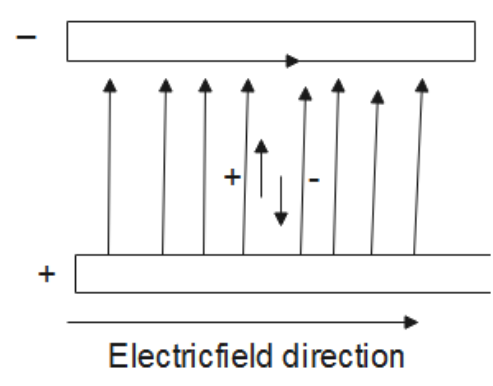
Also, the Electric field is defined as the gradient of potential (V):
$E = - gradV$
Since we know that the surface of the charged conductor has a constant potential. Therefore, there is no field along the surface of the charged conductor.
This implies that the electrostatic field at the surface of the charged conductor should be normal to the surface at every point.
Additional information:
The electric field is radially outward from a positive charge and it is radially inward to a negative point charge. S.I unit of the electric field is Newton per coulomb.
Potential (V) is defined as the amount of work needed to move one unit of electric charge from a reference point to a specific point in an electric field.
S.I unit of potential is Volts or joules per coulomb.
Note: Electric field is a vector quantity. It has both magnitude and direction.
The electric field is not negative; the negative sign shows the opposite direction of the field.
The electric field inside a conductor is zero because charges are not present inside the conductor, they are present on the surface of the conductor.
Formula used:
$E \propto \dfrac{F}{q}$
$E = - gradV$
Complete step-by-step solution:
The electric field is defined as the electric force per unit charge:
$E \propto \dfrac{F}{q}$
Here, F is the force exerted or experienced by the object and q is the charge on the object. So, if the electric field at a particular point is known and force is known we can get the charge or if the charge is known we can get the force experienced by the point charge. The direction of the field is taken to be the direction of the force it would exert on the positive test charge.
Also, the Electric field is defined as the gradient of potential (V):
$E = - gradV$
Since we know that the surface of the charged conductor has a constant potential. Therefore, there is no field along the surface of the charged conductor.
This implies that the electrostatic field at the surface of the charged conductor should be normal to the surface at every point.
Additional information:
The electric field is radially outward from a positive charge and it is radially inward to a negative point charge. S.I unit of the electric field is Newton per coulomb.
Potential (V) is defined as the amount of work needed to move one unit of electric charge from a reference point to a specific point in an electric field.
S.I unit of potential is Volts or joules per coulomb.
Note: Electric field is a vector quantity. It has both magnitude and direction.
The electric field is not negative; the negative sign shows the opposite direction of the field.
The electric field inside a conductor is zero because charges are not present inside the conductor, they are present on the surface of the conductor.
Recently Updated Pages
Master Class 12 Economics: Engaging Questions & Answers for Success

Master Class 12 Physics: Engaging Questions & Answers for Success
Master Class 12 English: Engaging Questions & Answers for Success
Master Class 12 Social Science: Engaging Questions & Answers for Success
Master Class 12 Maths: Engaging Questions & Answers for Success
Master Class 12 Business Studies: Engaging Questions & Answers for Success
Trending doubts
Which are the Top 10 Largest Countries of the World?
What are the major means of transport Explain each class 12 social science CBSE
Draw a labelled sketch of the human eye class 12 physics CBSE
Why cannot DNA pass through cell membranes class 12 biology CBSE
Differentiate between insitu conservation and exsitu class 12 biology CBSE
Draw a neat and well labeled diagram of TS of ovary class 12 biology CBSE