




Muon $({\mu ^{ - 1}})$ is negatively charged $(\left| q \right| = e)$ with a mass ${m_\mu } = {{ }}200{m_e}$, where ${m_e}$ is the mass of the electron and $e$ is the electronic charge. If ${\mu ^{ - 1}}$ is bound to a proton to form a hydrogen like atom, identify the correct statements:
(A) Radius of the muonic orbit is 200 times smaller than that of the electron.
(B) The speed of the ${\mu ^{ - 1}}$ in the ${n^{th}}$ orbit is $1/200$ times that of the electron in the ${n^{th}}$ orbit.
(C) The ionization energy of a muonic atom is $200$ times more than that of a hydrogen atom.
(D) The momentum of the muon in the ${n^{th}}$ orbit is $200$ times more than that of the electron.
1. A,B,D
2. B,D
3. C,D
4. A,C,D
Answer
 Verified
578.7k+ views
Hint: The given atomic structure is simply an atom having double positive charge in the nucleus and unit negative charge in the only orbit surrounding it. Using this fact and the formula for ionization energy, radius of an atom, momentum of an atomic particle and velocity of the electron in the ${n^{th}}$ orbit, we will be able to find the correct statements.
Formula Used: Ionization energy: ${E_n} = - \dfrac{{{m^4}_e{z^2}}}{{8{\varepsilon _0}{n^2}{h^2}}}$
Bohr’s radius of an atom: \[{r_n} = \dfrac{{{\varepsilon _0}n{h^2}}}{{\pi {m_e}z{c^2}}}\]
Velocity of the electron in the ${n^{th}}$ orbit: \[{v_n} = \dfrac{{2{\pi ^2}k{m_e}z{e^2}}}{{nh}}\]
Momentum of an atomic particle: $\rho = mv$
Where, ${E_n}$ is the ionization energy, ${r_n}$ is the radius of an atom, ${v_n}$ is the velocity of an atom, $\rho $ is the momentum of an atom, ${m_e}$ is the mass of an electron, $z$ is the atomic charge, ${\varepsilon _0}$ is the permittivity of free space, $n$ is the number of orbit, $h$ is the Planck’s constant, $k$ is a constant.
Complete step by step answer:
We have the following information about our model:
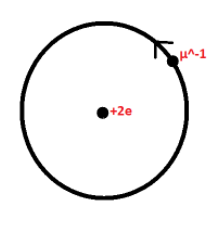
Mass of the particle contributing to the mass of the Helium like particle $m = 200{m_e}$
We know the formula for ionization energy, radius, velocity and momentum. From those we will establish a relationship between those particular quantum quantities and mass.
Formula for Bohr’s radius of an atom is \[{r_n} = \dfrac{{{\varepsilon _0}n{h^2}}}{{\pi {m_e}z{c^2}}}\]. From this we find that ${r_n} \propto \dfrac{1}{m}$.
Therefore, for our model, ${r_n} \propto \dfrac{1}{m} \propto \dfrac{1}{{200{m_e}}}$. That is radius of the muonic orbit is 200 times smaller than that of the electron.
Formula for velocity of the electron in the ${n^{th}}$ orbit is \[{v_n} = \dfrac{{2{\pi ^2}k{m_e}z{e^2}}}{{nh}}\]. From this we find that \[{v_n} \propto m\].
Therefore, for our model, \[{v_n} \propto m \propto 200{m_e}\]. That is the speed of the ${\mu ^{ - 1}}$ in the ${n^{th}}$ orbit is no $1/200$ times that of the electron in the ${n^{th}}$ orbit.
Formula for ionization energy is ${E_n} = - \dfrac{{{m^4}_e{z^2}}}{{8{\varepsilon _0}{n^2}{h^2}}}$. From this we find that \[{E_n} \propto m\].
Therefore, for our model, \[{E_n} \propto m \propto 200{m_e}\]. That is the ionization energy of muonic atom is $200$ times more than that of a hydrogen atom.
Formula for momentum of an atomic particle is $\rho = mv$. From this we find that \[\rho \propto m\].
Therefore, for our model, \[\rho \propto m \propto 200{m_e}\]. That is the momentum of the muon in the ${n^{th}}$ orbit is $200$ times more than that of the electron.
In conclusion, the correct option is 4.
Note:A muonic particle must not be confused with an electron. Electron has negligible mass and therefore, all the relationships we established are in comparison to a hydrogen atom. Therefore, every answer in terms of an electron’s mass.
Formula Used: Ionization energy: ${E_n} = - \dfrac{{{m^4}_e{z^2}}}{{8{\varepsilon _0}{n^2}{h^2}}}$
Bohr’s radius of an atom: \[{r_n} = \dfrac{{{\varepsilon _0}n{h^2}}}{{\pi {m_e}z{c^2}}}\]
Velocity of the electron in the ${n^{th}}$ orbit: \[{v_n} = \dfrac{{2{\pi ^2}k{m_e}z{e^2}}}{{nh}}\]
Momentum of an atomic particle: $\rho = mv$
Where, ${E_n}$ is the ionization energy, ${r_n}$ is the radius of an atom, ${v_n}$ is the velocity of an atom, $\rho $ is the momentum of an atom, ${m_e}$ is the mass of an electron, $z$ is the atomic charge, ${\varepsilon _0}$ is the permittivity of free space, $n$ is the number of orbit, $h$ is the Planck’s constant, $k$ is a constant.
Complete step by step answer:
We have the following information about our model:
Mass of the particle contributing to the mass of the Helium like particle $m = 200{m_e}$
We know the formula for ionization energy, radius, velocity and momentum. From those we will establish a relationship between those particular quantum quantities and mass.
Formula for Bohr’s radius of an atom is \[{r_n} = \dfrac{{{\varepsilon _0}n{h^2}}}{{\pi {m_e}z{c^2}}}\]. From this we find that ${r_n} \propto \dfrac{1}{m}$.
Therefore, for our model, ${r_n} \propto \dfrac{1}{m} \propto \dfrac{1}{{200{m_e}}}$. That is radius of the muonic orbit is 200 times smaller than that of the electron.
Formula for velocity of the electron in the ${n^{th}}$ orbit is \[{v_n} = \dfrac{{2{\pi ^2}k{m_e}z{e^2}}}{{nh}}\]. From this we find that \[{v_n} \propto m\].
Therefore, for our model, \[{v_n} \propto m \propto 200{m_e}\]. That is the speed of the ${\mu ^{ - 1}}$ in the ${n^{th}}$ orbit is no $1/200$ times that of the electron in the ${n^{th}}$ orbit.
Formula for ionization energy is ${E_n} = - \dfrac{{{m^4}_e{z^2}}}{{8{\varepsilon _0}{n^2}{h^2}}}$. From this we find that \[{E_n} \propto m\].
Therefore, for our model, \[{E_n} \propto m \propto 200{m_e}\]. That is the ionization energy of muonic atom is $200$ times more than that of a hydrogen atom.
Formula for momentum of an atomic particle is $\rho = mv$. From this we find that \[\rho \propto m\].
Therefore, for our model, \[\rho \propto m \propto 200{m_e}\]. That is the momentum of the muon in the ${n^{th}}$ orbit is $200$ times more than that of the electron.
In conclusion, the correct option is 4.
Note:A muonic particle must not be confused with an electron. Electron has negligible mass and therefore, all the relationships we established are in comparison to a hydrogen atom. Therefore, every answer in terms of an electron’s mass.
Recently Updated Pages
Master Class 12 Economics: Engaging Questions & Answers for Success

Master Class 12 Physics: Engaging Questions & Answers for Success
Master Class 12 English: Engaging Questions & Answers for Success
Master Class 12 Social Science: Engaging Questions & Answers for Success
Master Class 12 Maths: Engaging Questions & Answers for Success
Master Class 12 Business Studies: Engaging Questions & Answers for Success
Trending doubts
Which are the Top 10 Largest Countries of the World?
What are the major means of transport Explain each class 12 social science CBSE
Draw a labelled sketch of the human eye class 12 physics CBSE
Why cannot DNA pass through cell membranes class 12 biology CBSE
Differentiate between insitu conservation and exsitu class 12 biology CBSE
Draw a neat and well labeled diagram of TS of ovary class 12 biology CBSE