




How do I multiply a vector by a scalar?
Answer
 Verified
583.2k+ views
Hint: To multiply a vector by a scalar, just multiply the same or comparable parts, that is, the vector's size(magnitude) by the scalar's size. This will bring out another vector which is the product of the two given magnitudes, and which is heading in the same direction.
Complete step-by-step solution:
The terms vectors and scalars represent different types of physical quantities.
Vector, in mathematics and physics, is a quantity that has both a magnitude and a direction.
Whereas a scalar is a quantity that solely has only magnitude and has no direction.
Hence when it is necessary for them to interact, the only possible method is multiplication because adding a scalar to a vector is impossible due to their various measurements in space.
Moreover, it is possible to multiply a vector by a scalar. A scalar, be that as it may, cannot be multiplied by a vector.
To multiply a vector by a scalar, just multiply the similar components, that is, the vector’s magnitude by the scalar’s magnitude.
This will now result in a new vector that has the same direction as the vector and is the product of the two magnitudes of the quantities.
For example,
Let us consider the vector $\vec{a}$ and the scalar quantity k,
When we multiply them, we denote them as $k\vec{a}$
Pictorially, if we consider various values of k as 1,2,3, -1, -2
We get,
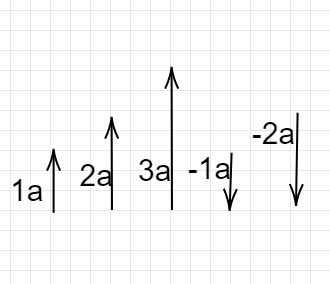
From the above-given set of vectors, we can see that the direction of the vector $\vec{a}$ ,
when the value of the scalar is positive, it remains the same whereas,
when the value of the scalar is negative, the direction becomes exactly opposite.
Note: If we have a vector of type, $\vec{a}=2\hat{i}+\hat{j}+5\hat{k}$ and the scalar quantity which we have to multiply is $3$ then,
$\Rightarrow 3\vec{a}=3\left( 2\hat{i}+\hat{j}+5\hat{k} \right)$
On opening the brackets and multiplying the contents in them we get,
$\Rightarrow 3\vec{a}=6\hat{i}+3\hat{j}+15\hat{k}$
Just multiply the coefficients or the magnitudes.
Complete step-by-step solution:
The terms vectors and scalars represent different types of physical quantities.
Vector, in mathematics and physics, is a quantity that has both a magnitude and a direction.
Whereas a scalar is a quantity that solely has only magnitude and has no direction.
Hence when it is necessary for them to interact, the only possible method is multiplication because adding a scalar to a vector is impossible due to their various measurements in space.
Moreover, it is possible to multiply a vector by a scalar. A scalar, be that as it may, cannot be multiplied by a vector.
To multiply a vector by a scalar, just multiply the similar components, that is, the vector’s magnitude by the scalar’s magnitude.
This will now result in a new vector that has the same direction as the vector and is the product of the two magnitudes of the quantities.
For example,
Let us consider the vector $\vec{a}$ and the scalar quantity k,
When we multiply them, we denote them as $k\vec{a}$
Pictorially, if we consider various values of k as 1,2,3, -1, -2
We get,
From the above-given set of vectors, we can see that the direction of the vector $\vec{a}$ ,
when the value of the scalar is positive, it remains the same whereas,
when the value of the scalar is negative, the direction becomes exactly opposite.
Note: If we have a vector of type, $\vec{a}=2\hat{i}+\hat{j}+5\hat{k}$ and the scalar quantity which we have to multiply is $3$ then,
$\Rightarrow 3\vec{a}=3\left( 2\hat{i}+\hat{j}+5\hat{k} \right)$
On opening the brackets and multiplying the contents in them we get,
$\Rightarrow 3\vec{a}=6\hat{i}+3\hat{j}+15\hat{k}$
Just multiply the coefficients or the magnitudes.
Recently Updated Pages
Master Class 12 Business Studies: Engaging Questions & Answers for Success

Master Class 12 Chemistry: Engaging Questions & Answers for Success
Master Class 12 Biology: Engaging Questions & Answers for Success
Class 12 Question and Answer - Your Ultimate Solutions Guide
Master Class 11 English: Engaging Questions & Answers for Success
Master Class 11 Social Science: Engaging Questions & Answers for Success
Trending doubts
Which are the Top 10 Largest Countries of the World?
Draw a labelled sketch of the human eye class 12 physics CBSE
Differentiate between homogeneous and heterogeneous class 12 chemistry CBSE
Why is the cell called the structural and functional class 12 biology CBSE
Draw ray diagrams each showing i myopic eye and ii class 12 physics CBSE
Which is the correct genotypic ratio of mendel dihybrid class 12 biology CBSE