




Why do most restriction enzymes cut at palindromic sequence?
Answer
 Verified
513.6k+ views
Hint: In a double-stranded DNA or RNA molecule, a palindromic sequence is a type of nucleic acid sequence in which reading in a specific direction on one strand matches the reading in the opposite direction of the complementary strand.
Complete answer:
A restriction enzyme, also known as a restriction endonuclease or restrictase, is an enzyme that polymerizes DNA into pieces at or near restriction sites which are located inside the molecules. Restriction enzymes are a subset of the larger endonuclease enzyme family.
Restriction enzymes are essential tools in recombinant DNA technology because they can be extracted from bacterial cells and utilised in the lab to modify DNA fragments, such as those containing genes with the aid of genetic engineering technology. To defend itself against bacterial viruses known as bacteriophages, or phages, a bacterium uses a type of restriction enzyme. Restriction enzymes are classified into four categories: I, II, III, and IV, with differences in structure, cleavage site, specificity, and coagulation factors.
Image showing Restriction Enzyme action:
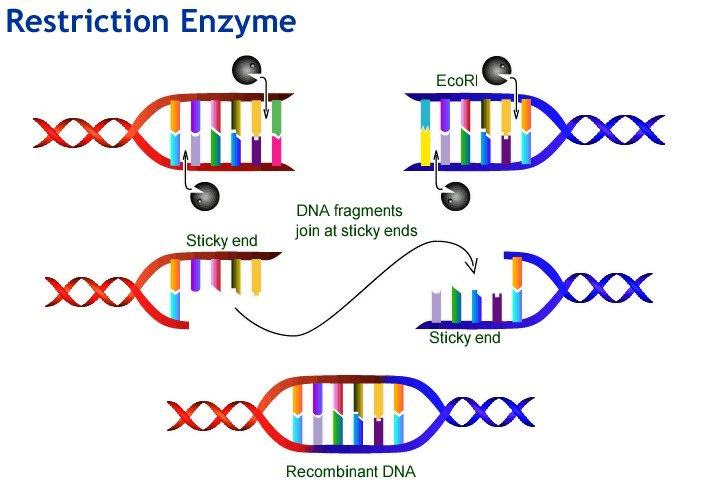
Restriction enzymes cut double-stranded DNA at specific sites based on the nucleotide pattern present there. As the palindromic sequence is recognised by the enzyme regardless of which side it approaches the DNA, hence a palindromic sequence enhances the likelihood of cutting both strands of DNA. Therefore, these restriction enzymes inevitably cut both strands at palindromic sequence since these sequences that they recognise are palindromic in nature, due to the fact that these sequences are short strings of equivalent bases on both DNA strands.
Note:
An enzyme is a protein that works as a stimulant or a catalyst in living organisms, by controlling the pace at which chemical reactions occur while the enzyme itself remains unaffected. All biological activities in living creatures involve chemical reactions, and the enzymes control the majority of them. Hydrolases, lyases, oxidoreductases, ligases, transferases, translocases and isomerases are the seven different types of enzymes. Among these different types of enzymes, the most abundant types of enzymes are oxidoreductases, transferases, and hydrolases.
Complete answer:
A restriction enzyme, also known as a restriction endonuclease or restrictase, is an enzyme that polymerizes DNA into pieces at or near restriction sites which are located inside the molecules. Restriction enzymes are a subset of the larger endonuclease enzyme family.
Restriction enzymes are essential tools in recombinant DNA technology because they can be extracted from bacterial cells and utilised in the lab to modify DNA fragments, such as those containing genes with the aid of genetic engineering technology. To defend itself against bacterial viruses known as bacteriophages, or phages, a bacterium uses a type of restriction enzyme. Restriction enzymes are classified into four categories: I, II, III, and IV, with differences in structure, cleavage site, specificity, and coagulation factors.
Image showing Restriction Enzyme action:
Restriction enzymes cut double-stranded DNA at specific sites based on the nucleotide pattern present there. As the palindromic sequence is recognised by the enzyme regardless of which side it approaches the DNA, hence a palindromic sequence enhances the likelihood of cutting both strands of DNA. Therefore, these restriction enzymes inevitably cut both strands at palindromic sequence since these sequences that they recognise are palindromic in nature, due to the fact that these sequences are short strings of equivalent bases on both DNA strands.
Note:
An enzyme is a protein that works as a stimulant or a catalyst in living organisms, by controlling the pace at which chemical reactions occur while the enzyme itself remains unaffected. All biological activities in living creatures involve chemical reactions, and the enzymes control the majority of them. Hydrolases, lyases, oxidoreductases, ligases, transferases, translocases and isomerases are the seven different types of enzymes. Among these different types of enzymes, the most abundant types of enzymes are oxidoreductases, transferases, and hydrolases.
Recently Updated Pages
Master Class 12 Economics: Engaging Questions & Answers for Success

Master Class 12 English: Engaging Questions & Answers for Success
Master Class 12 Social Science: Engaging Questions & Answers for Success
Master Class 12 Maths: Engaging Questions & Answers for Success
Master Class 12 Physics: Engaging Questions & Answers for Success
Master Class 9 General Knowledge: Engaging Questions & Answers for Success
Trending doubts
Which are the Top 10 Largest Countries of the World?
Draw a labelled sketch of the human eye class 12 physics CBSE
Differentiate between homogeneous and heterogeneous class 12 chemistry CBSE
Why is the cell called the structural and functional class 12 biology CBSE
Draw ray diagrams each showing i myopic eye and ii class 12 physics CBSE
Which is the correct genotypic ratio of mendel dihybrid class 12 biology CBSE