




Modern birds and mammals share an ancient common ancestor that was terrestrial, but penguins and whales both have limbs adapted for swimming. Which of the following terms best describes the relationship between the bones in the forelimbs of penguins and whales?
A. Homologous structures
B. Analogous structures
C. Vestigial organs
D. Convergent evolution
Answer
 Verified
643.8k+ views
Hint: Similar to structures are those structures that have various progenitors yet perform the same capacities. Appendages of penguins and whales both have adjusted for swimming. Egg-guarding conduct in the cobra, the stickleback, the octopus, and the insect is thought to have developed autonomously among those creatures, which are very removed in their natural connections.
Complete answer:
Homologous structures are those structures which have basic progenitors yet have various capacities. Present-day fowls and warm-blooded creatures share an antiquated basic predecessor that was earthly. Minimal organs are those organs which have nearly lost their unique capacity. The index in humans is a minimal organ.
Additional Information: Relationship, in science, the likeness of capacity, and shallow similarity of structures that have various roots. For instance, the wings of a fly, a moth, and a feathered creature are closely resembling in light of the fact that they grew autonomously as transformations to a typical capacity—flying. The presence of the practically equivalent structure, for this situation the wing, doesn't reflect developmental closeness among the life forms that have it. The relationship is one part of transformative science and is unmistakable from homology (q.v.), the likeness of structures because of comparable undeveloped root and improvement, thought about solid proof of basic drop.
So the correct answer is Analogous structures.
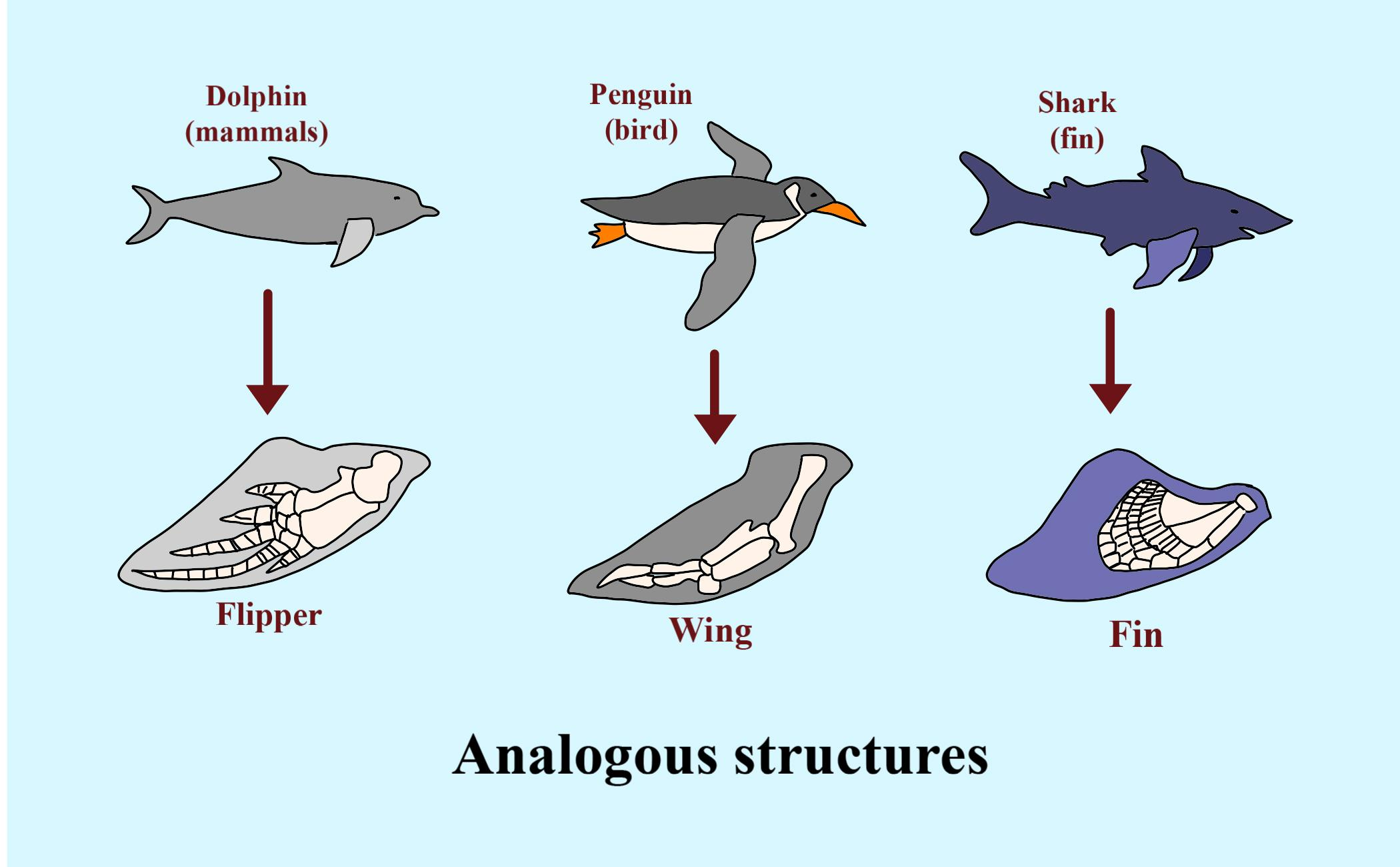
Note: By and large closely resembling structures, or analogs, will in general get comparable in appearance by a cycle named assembly. A model is the union of the smoothed out structure in the collections of squid, shark, seal, porpoise, penguin, and ichthyosaur, creatures of a different family. Physiological cycles and personal conduct standards may likewise display closely resembling assembly.
Complete answer:
Homologous structures are those structures which have basic progenitors yet have various capacities. Present-day fowls and warm-blooded creatures share an antiquated basic predecessor that was earthly. Minimal organs are those organs which have nearly lost their unique capacity. The index in humans is a minimal organ.
Additional Information: Relationship, in science, the likeness of capacity, and shallow similarity of structures that have various roots. For instance, the wings of a fly, a moth, and a feathered creature are closely resembling in light of the fact that they grew autonomously as transformations to a typical capacity—flying. The presence of the practically equivalent structure, for this situation the wing, doesn't reflect developmental closeness among the life forms that have it. The relationship is one part of transformative science and is unmistakable from homology (q.v.), the likeness of structures because of comparable undeveloped root and improvement, thought about solid proof of basic drop.
So the correct answer is Analogous structures.
Note: By and large closely resembling structures, or analogs, will in general get comparable in appearance by a cycle named assembly. A model is the union of the smoothed out structure in the collections of squid, shark, seal, porpoise, penguin, and ichthyosaur, creatures of a different family. Physiological cycles and personal conduct standards may likewise display closely resembling assembly.
Recently Updated Pages
Which will be the least stable resonating structure class 11 chemistry CBSE

How many 5 digit telephone numbers can be construc-class-11-maths-CBSE
How do you find the angle of the resultant vector class 11 physics CBSE
Draw labelled diagram of the following i Gram seed class 11 biology CBSE
1 Quintal is equal to a 110 kg b 10 kg c 100kg d 1000 class 11 physics CBSE
What is the need and importance of classification class 11 biology CBSE
Trending doubts
Find the value of the expression given below sin 30circ class 11 maths CBSE
One Metric ton is equal to kg A 10000 B 1000 C 100 class 11 physics CBSE
10 examples of friction in our daily life
Draw a diagram of a plant cell and label at least eight class 11 biology CBSE
Difference between physical and chemical change class 11 chemistry CBSE
Proton was discovered by A Thomson B Rutherford C Chadwick class 11 chemistry CBSE