




MnO is?
A. ferromagnetic
B. antiferromagnetic
C. ferrimagnetic
D. diamagnetic
Answer
 Verified
613.5k+ views
Hint: The electronic configuration of the element is responsible for the characteristics asked in the question. Manganese has the maximum number of the unpaired electrons in its excited state. It also has a half-filled configuration in its 3d subshell which decides the nature of magnetism in its oxide.
Complete step by step solution:
-After a lot of experiments, atomic structure was proposed and the probability of electrons were found to be maximum in a space known as orbital. Based on further studies, 4 quantum numbers were proposed which were able to give a complete picture of the electron location.
-Principle quantum number represents the shell of the electrons. It is represented by n. It gives a complete picture of shells and also the number of sub-shells. Value of n is always in natural numbers. First shell is denoted as K, second as L, third as M and fourth as N. Number of subshells is given by value of n and of orbitals by ${{n}^{2}}$ .
-Next is azimuthal quantum number denoted as l. It tells about the subshell and the number of orbitals. It starts from 0 and continues till (n-1). It also gives us the shape of the orbitals. The number of orbitals lie in the range from (-l to +l) as integers.
-Third quantum number is magnetic quantum number and is denoted by m. It gives us the exact orbitals. Its total value can be given as ${{n}^{2}}$ or as (2l+1) since it lies in the range (-l to +l).
-Last quantum number is spin quantum number which tells us about the spin of an electron in the orbital. It is denoted as s. It has only 2 values, +0.5 and -0.5. If the orientation is clockwise, then the spin is positive or negative.
-Spin of an atom decides its magnetic behavior. If the electrons are paired, the atom is diamagnetic else paramagnetic which is divided into ferromagnetism, ferrimagnetism and antiferromagetism.
-When the spins of electrons are parallel to the magnetic field, the atom is ferromagnetic. When spins are parallel but in opposite directions, the atom is antiferromagnetic. When the spins are antiparallel but unequal in magnitude and do not cancel each other, the atom is ferromagnetic.
-Mn has 5 electrons in the d-subshell which makes its orbital half-filled. So it has maximum magnetic moment among 3d elements and has the value of magnetic susceptibility greater than zero.
-As the magnetic susceptibility is greater in magnitude and the electrons are aligned such that they cancel the effects of each other due to opposite directions, the characteristic magnetism shown by $MnO$ is antiferromagnetism. It can be shown as
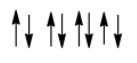
Therefore $MnO$ is antiferromagnetic and the correct option is B.
Note: The metals like $Fe$, $Co$ and $Ni$ show ferromagnetism but when they form some compounds, their magnetic behavior changes. For example, $F{{e}_{3}}{{O}_{4}}$ is ferromagnetic and not ferromagnetic as $O$ also has unpaired electrons. The orientation of the electrons of $Mn$ and $O$ in $MnO$ is such that they cancel their effects and so the compound is antiferromagnetic.
Complete step by step solution:
-After a lot of experiments, atomic structure was proposed and the probability of electrons were found to be maximum in a space known as orbital. Based on further studies, 4 quantum numbers were proposed which were able to give a complete picture of the electron location.
-Principle quantum number represents the shell of the electrons. It is represented by n. It gives a complete picture of shells and also the number of sub-shells. Value of n is always in natural numbers. First shell is denoted as K, second as L, third as M and fourth as N. Number of subshells is given by value of n and of orbitals by ${{n}^{2}}$ .
-Next is azimuthal quantum number denoted as l. It tells about the subshell and the number of orbitals. It starts from 0 and continues till (n-1). It also gives us the shape of the orbitals. The number of orbitals lie in the range from (-l to +l) as integers.
-Third quantum number is magnetic quantum number and is denoted by m. It gives us the exact orbitals. Its total value can be given as ${{n}^{2}}$ or as (2l+1) since it lies in the range (-l to +l).
-Last quantum number is spin quantum number which tells us about the spin of an electron in the orbital. It is denoted as s. It has only 2 values, +0.5 and -0.5. If the orientation is clockwise, then the spin is positive or negative.
-Spin of an atom decides its magnetic behavior. If the electrons are paired, the atom is diamagnetic else paramagnetic which is divided into ferromagnetism, ferrimagnetism and antiferromagetism.
-When the spins of electrons are parallel to the magnetic field, the atom is ferromagnetic. When spins are parallel but in opposite directions, the atom is antiferromagnetic. When the spins are antiparallel but unequal in magnitude and do not cancel each other, the atom is ferromagnetic.
-Mn has 5 electrons in the d-subshell which makes its orbital half-filled. So it has maximum magnetic moment among 3d elements and has the value of magnetic susceptibility greater than zero.
-As the magnetic susceptibility is greater in magnitude and the electrons are aligned such that they cancel the effects of each other due to opposite directions, the characteristic magnetism shown by $MnO$ is antiferromagnetism. It can be shown as
Therefore $MnO$ is antiferromagnetic and the correct option is B.
Note: The metals like $Fe$, $Co$ and $Ni$ show ferromagnetism but when they form some compounds, their magnetic behavior changes. For example, $F{{e}_{3}}{{O}_{4}}$ is ferromagnetic and not ferromagnetic as $O$ also has unpaired electrons. The orientation of the electrons of $Mn$ and $O$ in $MnO$ is such that they cancel their effects and so the compound is antiferromagnetic.
Recently Updated Pages
Master Class 12 Business Studies: Engaging Questions & Answers for Success

Master Class 12 Biology: Engaging Questions & Answers for Success
Master Class 12 Chemistry: Engaging Questions & Answers for Success
Class 12 Question and Answer - Your Ultimate Solutions Guide
Master Class 11 English: Engaging Questions & Answers for Success
Master Class 11 Social Science: Engaging Questions & Answers for Success
Trending doubts
Which are the Top 10 Largest Countries of the World?
Draw a labelled sketch of the human eye class 12 physics CBSE
Differentiate between homogeneous and heterogeneous class 12 chemistry CBSE
Why is the cell called the structural and functional class 12 biology CBSE
Draw ray diagrams each showing i myopic eye and ii class 12 physics CBSE
Which is the correct genotypic ratio of mendel dihybrid class 12 biology CBSE