




Mitosis can be studied in
(a) Onion root tip
(b) Garlic root tip
(c) Tendril tip
(d) All of the above
Answer
 Verified
651.3k+ views
Hint: Mitosis is also known as equational division. It can be best studied in the cells that are in a continuous phase of division resulting in a new set of cells. They retain the power of division.
Complete answer:
Mitosis is a type of division where a cell is divided in such a manner that the daughter cells receive the exact number of chromosomes as the parent cell. The tips of any plant consist of meristematic cells that are actively dividing cells and produce new cells by mitosis. Thus, root tips of onion and garlic are used as a sample for studying mitosis in the laboratory. Tendrils are modified shoots and thus its tips also contain actively dividing meristems.
Additional Information: -Meristematic cells are thin-walled cells with rich cytoplasm and a big nucleus. They are special in terms of their eternal dividing abilities which are otherwise lost in the permanent tissue.
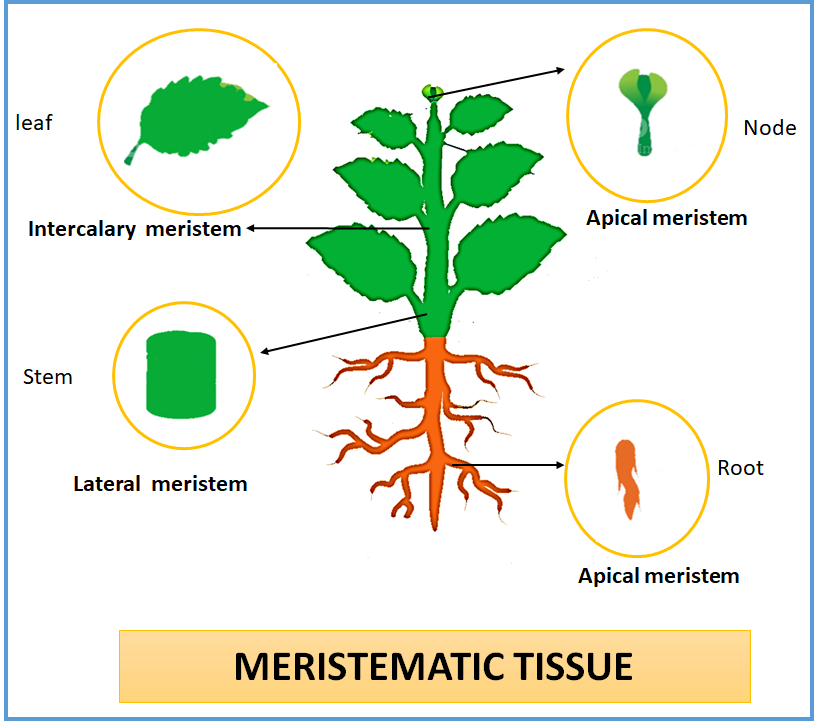
-Meristems are of two types- primary and secondary meristems, based on their origin. Primary meristems develop directly from the embryo tissues. Secondary meristems develop from the permanent tissue which has acquired the power of division. Based on the location, meristems are classified into - apical meristem, intercalary meristem, and lateral meristems.
-Monocots like onion and garlic are usually used for the study of mitosis is due to their larger chromosomes which their movement and changes can be easily witnessed and analyzed. Also, they both have eight pairs of chromosomes, making it easier for the study of mitosis.
-The best stage to view mitosis is the metaphase stage when all the chromosomes are arranged on the equatorial plane or metaphase plate, with the centromeres attached to the spindle fibers in preparation for separation.
So, the correct answer is ‘All of these.’
Note: -Any cell which loses the capacity to divide and acquire a permanent function, shape, and size, they are known as permanent tissues.
-Meiosis is another type of cell division that is different from mitosis in the sense that the daughter cells receive half the number of chromosomes as their parents.
Complete answer:
Mitosis is a type of division where a cell is divided in such a manner that the daughter cells receive the exact number of chromosomes as the parent cell. The tips of any plant consist of meristematic cells that are actively dividing cells and produce new cells by mitosis. Thus, root tips of onion and garlic are used as a sample for studying mitosis in the laboratory. Tendrils are modified shoots and thus its tips also contain actively dividing meristems.
Additional Information: -Meristematic cells are thin-walled cells with rich cytoplasm and a big nucleus. They are special in terms of their eternal dividing abilities which are otherwise lost in the permanent tissue.
-Meristems are of two types- primary and secondary meristems, based on their origin. Primary meristems develop directly from the embryo tissues. Secondary meristems develop from the permanent tissue which has acquired the power of division. Based on the location, meristems are classified into - apical meristem, intercalary meristem, and lateral meristems.
-Monocots like onion and garlic are usually used for the study of mitosis is due to their larger chromosomes which their movement and changes can be easily witnessed and analyzed. Also, they both have eight pairs of chromosomes, making it easier for the study of mitosis.
-The best stage to view mitosis is the metaphase stage when all the chromosomes are arranged on the equatorial plane or metaphase plate, with the centromeres attached to the spindle fibers in preparation for separation.
So, the correct answer is ‘All of these.’
Note: -Any cell which loses the capacity to divide and acquire a permanent function, shape, and size, they are known as permanent tissues.
-Meiosis is another type of cell division that is different from mitosis in the sense that the daughter cells receive half the number of chromosomes as their parents.
Recently Updated Pages
Which will be the least stable resonating structure class 11 chemistry CBSE

How many 5 digit telephone numbers can be construc-class-11-maths-CBSE
How do you find the angle of the resultant vector class 11 physics CBSE
Draw labelled diagram of the following i Gram seed class 11 biology CBSE
1 Quintal is equal to a 110 kg b 10 kg c 100kg d 1000 class 11 physics CBSE
What is the need and importance of classification class 11 biology CBSE
Trending doubts
Find the value of the expression given below sin 30circ class 11 maths CBSE
One Metric ton is equal to kg A 10000 B 1000 C 100 class 11 physics CBSE
10 examples of friction in our daily life
Draw a diagram of a plant cell and label at least eight class 11 biology CBSE
Difference between physical and chemical change class 11 chemistry CBSE
Proton was discovered by A Thomson B Rutherford C Chadwick class 11 chemistry CBSE