




What is the minimum thickness of a soap film needed for constructive interference in reflected light, if the light incident on the film is $750\,nm$ ? Assume that the refractive index for the film is $\mu = 1.33$ .
Answer
 Verified
599.1k+ views
Hint: Use the formula of the thickness of the soap film, substitute all the necessary parameters in this formula. Calculate the wavelength from the formula given and substitute it in it. The simplification of the result, provides minimum thickness.
Useful formula:
(1) The formula of the thickness of the soap film is given by
$2t = \left( {m + \dfrac{1}{2}} \right){\lambda'}$
Where $t$ is the thickness of the soap film, ${\lambda'}$ is the new wavelength in a medium.
(2) The new wavelength in a medium can be obtained as
${\lambda'} = \dfrac{\lambda }{\mu }$
Where $\lambda $ is the wavelength of the light that incident on the soap film and $\mu $ is the refractive index of the film.
Complete step by step solution:
It is given that the
Wavelength of the light that falls on the soap film, $\lambda = 750\,nm$
The refractive index of the film, $\mu = 1.33$
Using the formula of the thickness of the soap film.
$2t = \left( {m + \dfrac{1}{2}} \right){\lambda'}$
Since the minimum thickness is to be calculated, the value of the $m$ is assumed to be $0$. Hence substituting the known values in the above equation, we get
$t = \dfrac{{{\lambda'}}}{4}$ -------(1)
In order to find the wavelength of the new medium, the formula (2) is used.
${\lambda'} = \dfrac{\lambda }{\mu }$
Substituting the values,
${\lambda'} = \dfrac{{750 \times {{10}^{ - 9}}}}{{1.33}}$ -------(2)
Substituting (2) in (1)
$t = \dfrac{{750 \times {{10}^{ - 9}}}}{{1.33 \times 4}}$
$t = 141\,nm$
Hence the minimum thickness of the soap film is obtained as $141\,nm$ .
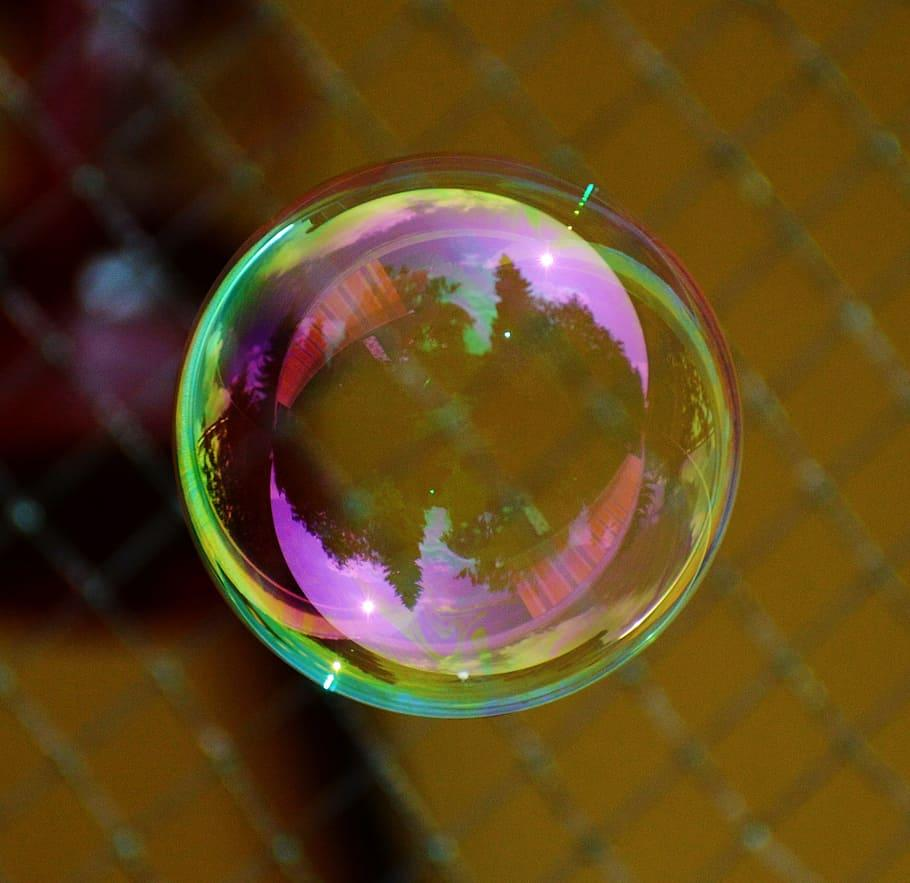
Note: The soap water forms the soap bubble by the two layers of soap separated and surrounded by the air. This is formed mainly due to the surface tension of the water, the water has the ability to reduce its surface area as much as it can.
Useful formula:
(1) The formula of the thickness of the soap film is given by
$2t = \left( {m + \dfrac{1}{2}} \right){\lambda'}$
Where $t$ is the thickness of the soap film, ${\lambda'}$ is the new wavelength in a medium.
(2) The new wavelength in a medium can be obtained as
${\lambda'} = \dfrac{\lambda }{\mu }$
Where $\lambda $ is the wavelength of the light that incident on the soap film and $\mu $ is the refractive index of the film.
Complete step by step solution:
It is given that the
Wavelength of the light that falls on the soap film, $\lambda = 750\,nm$
The refractive index of the film, $\mu = 1.33$
Using the formula of the thickness of the soap film.
$2t = \left( {m + \dfrac{1}{2}} \right){\lambda'}$
Since the minimum thickness is to be calculated, the value of the $m$ is assumed to be $0$. Hence substituting the known values in the above equation, we get
$t = \dfrac{{{\lambda'}}}{4}$ -------(1)
In order to find the wavelength of the new medium, the formula (2) is used.
${\lambda'} = \dfrac{\lambda }{\mu }$
Substituting the values,
${\lambda'} = \dfrac{{750 \times {{10}^{ - 9}}}}{{1.33}}$ -------(2)
Substituting (2) in (1)
$t = \dfrac{{750 \times {{10}^{ - 9}}}}{{1.33 \times 4}}$
$t = 141\,nm$
Hence the minimum thickness of the soap film is obtained as $141\,nm$ .
Note: The soap water forms the soap bubble by the two layers of soap separated and surrounded by the air. This is formed mainly due to the surface tension of the water, the water has the ability to reduce its surface area as much as it can.
Recently Updated Pages
Master Class 12 Business Studies: Engaging Questions & Answers for Success

Master Class 12 Biology: Engaging Questions & Answers for Success
Master Class 12 Chemistry: Engaging Questions & Answers for Success
Class 12 Question and Answer - Your Ultimate Solutions Guide
Master Class 11 Social Science: Engaging Questions & Answers for Success
Master Class 11 English: Engaging Questions & Answers for Success
Trending doubts
Which are the Top 10 Largest Countries of the World?
Draw a labelled sketch of the human eye class 12 physics CBSE
Differentiate between homogeneous and heterogeneous class 12 chemistry CBSE
Sulphuric acid is known as the king of acids State class 12 chemistry CBSE
Why is the cell called the structural and functional class 12 biology CBSE
Which is the correct genotypic ratio of mendel dihybrid class 12 biology CBSE