




Why is the microscope important to the study of biology?
Answer
 Verified
524.1k+ views
Hint: Biology is the study of life. It is the science of the study of life and its processes. It contains various fields like the study of medicines, bones, cells, organs, poison, blood, nerves, etc. Microscopes are instruments, which have opened up a whole new dimension in science. Through microscopes, scientists were able to discover the existence of microorganisms and view the smallest parts of animals, fungi, and plants.
Complete answer:
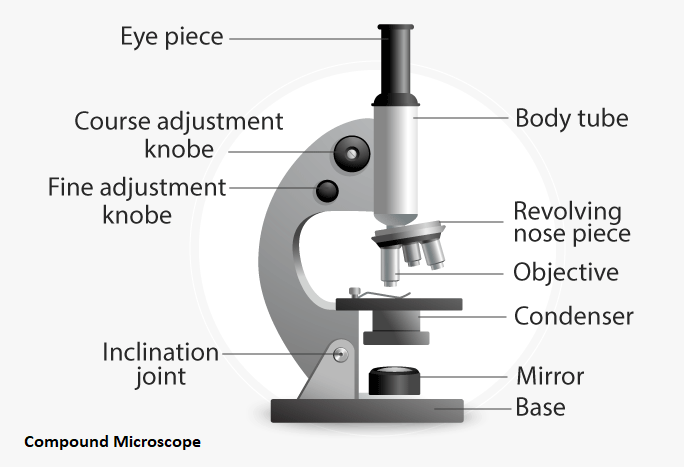
Fig.: Parts of a Compound Microscope
Biology involves the study of organisms, mainly humans, which is inclusive of cells and smaller parts of the body, which are invisible to the naked eye. So, microscopes are used in the study of biology. They help scientists to view microscopic organisms or objects or anything they want to see.
The microscope is important to the study of biology because biology predominantly deals with the study of genes, cells, contents of cells, and all organisms. Some organisms are so tiny that they can’t be viewed through the naked eye.
For viewing, magnification of x 2000- x 2500 is needed, which can be attained only by microscope, as the cells are too small to be viewed by eye.
Genetics deals with the study of variations from one generation to subsequent generations and genetic engineering needs the mixing of genes. As genes are even smaller than cells, microscopes are indispensable to genetics. Thus, without the microscope, biology would not have developed this much and various diseases would not have obtained the cure.
Note:
Though some organisms are huge in this world, many are so tiny that they can’t be viewed by normal eyes. In that case, a microscope comes into play and aids in viewing things clearly. It is used to analyze things in detail through their greater magnifications and they aid in zooming the minute structures. It is essential to monitor the activities of bacteria and view the inner plant structures like stomata and vascular bundle.
Complete answer:
Fig.: Parts of a Compound Microscope
Biology involves the study of organisms, mainly humans, which is inclusive of cells and smaller parts of the body, which are invisible to the naked eye. So, microscopes are used in the study of biology. They help scientists to view microscopic organisms or objects or anything they want to see.
The microscope is important to the study of biology because biology predominantly deals with the study of genes, cells, contents of cells, and all organisms. Some organisms are so tiny that they can’t be viewed through the naked eye.
For viewing, magnification of x 2000- x 2500 is needed, which can be attained only by microscope, as the cells are too small to be viewed by eye.
Genetics deals with the study of variations from one generation to subsequent generations and genetic engineering needs the mixing of genes. As genes are even smaller than cells, microscopes are indispensable to genetics. Thus, without the microscope, biology would not have developed this much and various diseases would not have obtained the cure.
Note:
Though some organisms are huge in this world, many are so tiny that they can’t be viewed by normal eyes. In that case, a microscope comes into play and aids in viewing things clearly. It is used to analyze things in detail through their greater magnifications and they aid in zooming the minute structures. It is essential to monitor the activities of bacteria and view the inner plant structures like stomata and vascular bundle.
Recently Updated Pages
Master Class 12 Business Studies: Engaging Questions & Answers for Success

Master Class 12 Chemistry: Engaging Questions & Answers for Success
Master Class 12 Biology: Engaging Questions & Answers for Success
Class 12 Question and Answer - Your Ultimate Solutions Guide
Master Class 11 English: Engaging Questions & Answers for Success
Master Class 11 Social Science: Engaging Questions & Answers for Success
Trending doubts
Which are the Top 10 Largest Countries of the World?
Draw a labelled sketch of the human eye class 12 physics CBSE
Differentiate between homogeneous and heterogeneous class 12 chemistry CBSE
In order to find out the different types of gametes class 12 biology NEET_UG
Why is the cell called the structural and functional class 12 biology CBSE
Draw ray diagrams each showing i myopic eye and ii class 12 physics CBSE