




Methylamine, $C{H_3}N{H_2}$has very similar chemical properties to ammonia, $N{H_3}$ Methylamine reacts with hydrogen chloride to form a white crystalline salt, methylammonium chloride.
$C{H_3}N{H_2} + HCl \to C{H_3}N{H_3}^ + C{l^ - }$
A sample of methylammonium chloride is heated with aqueous sodium hydroxide.
What are products?
A.Ammonia, sodium chloride and water
B.Ammonia, sodium hydrogen carbonate and sodium chloride
C.Methylamine, hydrogen chloride and water
D.Methylamine, sodium chloride and water
Answer
 Verified
608.7k+ views
Hint: The formula of methylamine is $C{H_3}N{H_2}$, it is an organic compound. It is the derivative of ammonia in which the methyl group replaces the hydrogen atom. It is a very important organic compound for the synthesis of the different commercial products.
Complete step by step answer:
The preparation of the methylamine takes place as follows:
$N{H_3} + C{H_3}OH \to C{H_3}N{H_2} + {H_2}O$
Ammonia reacts with methanol or ethyl alcohol to form the methylamine and water as the by product in the reaction. The structure of methylamine is given below:
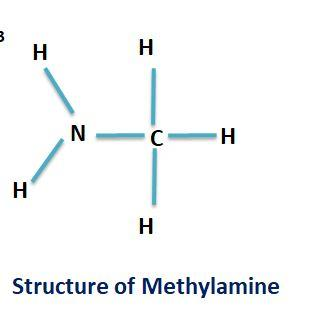
Therefore when methylamine ($C{H_3}N{H_2}$) reacts with sodium hydroxide ($NaOH$) Methylamine ($C{H_3}N{H_2}$), sodium chloride ($NaCl$) and water (${H_2}O$) are formed in the reaction. Thus option D is the correct answer
$C{H_3}N{H_3}^ + C{l^ - } + NaOH \to C{H_3}N{H_2} + NaCl + {H_2}O$
In the above reaction, dimethylamine and trimethylamine are also formed along with the methylamine but the amount of the reactants taken i.e; their ratio, reaction kinetics determines the most favoured product during the reaction.
Another product formed during the reaction is sodium chloride and the chemical name of the compound is known as the common salt which is used by us in our day to day life and it is an electrolyte which has many biological roles in our body it maintains the amount of water and salts balance in our body and also plays a vital role in the nerve impulse conduction.
But the overdose of this compound can lead to vomiting, stomach cramps, uneven heart rate, and weakness, swelling in the hands or feet. The feeling of restlessness is also a symptom.
So therefore option D is the correct answer.
Note:
Methylamine is an unhindered amine and thus it acts as a good nucleophile. It is considered as a weak base it is exclusively used for the preparation of methyl isocyanide as a reactant with the phosgene gas since its properties are analogous to ammonia.
Complete step by step answer:
The preparation of the methylamine takes place as follows:
$N{H_3} + C{H_3}OH \to C{H_3}N{H_2} + {H_2}O$
Ammonia reacts with methanol or ethyl alcohol to form the methylamine and water as the by product in the reaction. The structure of methylamine is given below:
Therefore when methylamine ($C{H_3}N{H_2}$) reacts with sodium hydroxide ($NaOH$) Methylamine ($C{H_3}N{H_2}$), sodium chloride ($NaCl$) and water (${H_2}O$) are formed in the reaction. Thus option D is the correct answer
$C{H_3}N{H_3}^ + C{l^ - } + NaOH \to C{H_3}N{H_2} + NaCl + {H_2}O$
In the above reaction, dimethylamine and trimethylamine are also formed along with the methylamine but the amount of the reactants taken i.e; their ratio, reaction kinetics determines the most favoured product during the reaction.
Another product formed during the reaction is sodium chloride and the chemical name of the compound is known as the common salt which is used by us in our day to day life and it is an electrolyte which has many biological roles in our body it maintains the amount of water and salts balance in our body and also plays a vital role in the nerve impulse conduction.
But the overdose of this compound can lead to vomiting, stomach cramps, uneven heart rate, and weakness, swelling in the hands or feet. The feeling of restlessness is also a symptom.
So therefore option D is the correct answer.
Note:
Methylamine is an unhindered amine and thus it acts as a good nucleophile. It is considered as a weak base it is exclusively used for the preparation of methyl isocyanide as a reactant with the phosgene gas since its properties are analogous to ammonia.
Recently Updated Pages
Master Class 12 Business Studies: Engaging Questions & Answers for Success

Master Class 12 Chemistry: Engaging Questions & Answers for Success
Master Class 12 Biology: Engaging Questions & Answers for Success
Class 12 Question and Answer - Your Ultimate Solutions Guide
Master Class 11 English: Engaging Questions & Answers for Success
Master Class 11 Maths: Engaging Questions & Answers for Success
Trending doubts
Which is more stable and why class 12 chemistry CBSE
Which are the Top 10 Largest Countries of the World?
Draw a labelled sketch of the human eye class 12 physics CBSE
Differentiate between homogeneous and heterogeneous class 12 chemistry CBSE
What are the major means of transport Explain each class 12 social science CBSE
Sulphuric acid is known as the king of acids State class 12 chemistry CBSE