




Meselson and Stahl's Experiment proved
A.Transduction
B.Transformation
C.DNA is the genetic material
D.Disruptive DNA replication
Answer
 Verified
616.8k+ views
Hint: Meselson and Stahl refined microbes in an N 15 medium to get the DNA of hefty thickness. At that point, microscopic organisms were moved to an N 14 medium, DNA of replication cycles 0, 1, and 2 was secluded.
Complete answer:
The DNA was all of the transitional thickness after one replication cycle and precluded the moderate replication model, which predicts that both substantial thickness DNA and light thickness DNA will be available. This outcome demonstrated the semi-moderate replication model, as indicated by which all DNA particles will comprise one N 15- named DNA strand and one N 14 - marked DNA strand. The after-effect of the second replication cycle was likewise predictable with the semi-moderate replication model; three theories had been recently proposed for the strategy for replication of DNA.
Additional Information: Meselson–Stahl explores is a test by Matthew Meselson and Franklin Stahl in 1958 which upheld Watson and Crick's speculation that DNA replication was semiconservative. In semiconservative replication, when the twofold abandoned DNA helix is recreated, every one of the two new twofold abandoned DNA helices consists of one strand from the first helix and one recently incorporated. It has been designated "the most lovely investigation in biology."Meselson and Stahl chose the most ideal approach to label the parent DNA is to transform one of the iotas in the parent DNA atom. Since nitrogen is found in the nitrogenous bases of every nucleotide, they chose to utilize an isotope of nitrogen to recognize parent and recently duplicated DNA. The isotope of nitrogen had an additional neutron in the core, which made it heavier.
So, the correct answer is ‘Disruptive DNA replication’.
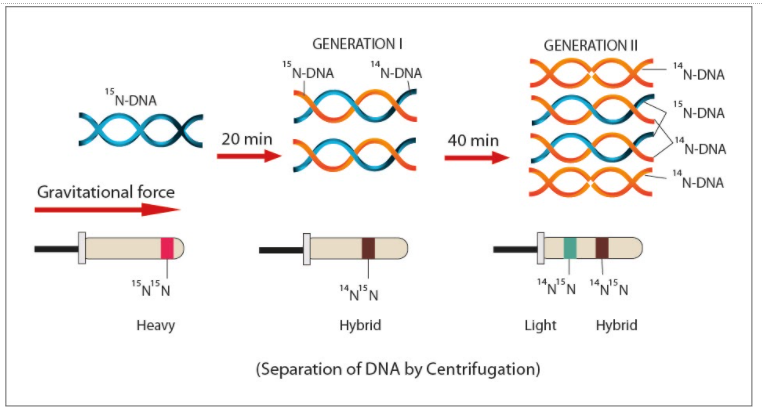
Note: In the semi-conservative theory, proposed by Watson and Crick, the two strands of a DNA particle separate during replication. Each strand at that point goes about as a format for the union of another strand. The moderate speculation recommended that the whole DNA particle went about as a format for the union of an altogether new one. As indicated by this model, histone proteins tie to the DNA, spinning the strand and uncovering the nucleotide bases (which typically line the inside) for hydrogen bonding.
Complete answer:
The DNA was all of the transitional thickness after one replication cycle and precluded the moderate replication model, which predicts that both substantial thickness DNA and light thickness DNA will be available. This outcome demonstrated the semi-moderate replication model, as indicated by which all DNA particles will comprise one N 15- named DNA strand and one N 14 - marked DNA strand. The after-effect of the second replication cycle was likewise predictable with the semi-moderate replication model; three theories had been recently proposed for the strategy for replication of DNA.
Additional Information: Meselson–Stahl explores is a test by Matthew Meselson and Franklin Stahl in 1958 which upheld Watson and Crick's speculation that DNA replication was semiconservative. In semiconservative replication, when the twofold abandoned DNA helix is recreated, every one of the two new twofold abandoned DNA helices consists of one strand from the first helix and one recently incorporated. It has been designated "the most lovely investigation in biology."Meselson and Stahl chose the most ideal approach to label the parent DNA is to transform one of the iotas in the parent DNA atom. Since nitrogen is found in the nitrogenous bases of every nucleotide, they chose to utilize an isotope of nitrogen to recognize parent and recently duplicated DNA. The isotope of nitrogen had an additional neutron in the core, which made it heavier.
So, the correct answer is ‘Disruptive DNA replication’.
Note: In the semi-conservative theory, proposed by Watson and Crick, the two strands of a DNA particle separate during replication. Each strand at that point goes about as a format for the union of another strand. The moderate speculation recommended that the whole DNA particle went about as a format for the union of an altogether new one. As indicated by this model, histone proteins tie to the DNA, spinning the strand and uncovering the nucleotide bases (which typically line the inside) for hydrogen bonding.
Recently Updated Pages
Master Class 12 Economics: Engaging Questions & Answers for Success

Master Class 12 Biology: Engaging Questions & Answers for Success
Master Class 11 English: Engaging Questions & Answers for Success
Master Class 11 Physics: Engaging Questions & Answers for Success
Master Class 11 Computer Science: Engaging Questions & Answers for Success
Master Class 11 Chemistry: Engaging Questions & Answers for Success
Trending doubts
Draw a labelled sketch of the human eye class 12 physics CBSE
Why is the cell called the structural and functional class 12 biology CBSE
Draw ray diagrams each showing i myopic eye and ii class 12 physics CBSE
Which are the Top 10 Largest Countries of the World?
Differentiate between homogeneous and heterogeneous class 12 chemistry CBSE
Which is the correct genotypic ratio of mendel dihybrid class 12 biology CBSE