




Meroblastic cleavage occurs in the egg.
(a) Isolecithal
(b) Microlecithal
(c) Telolecithal
(d) All of the above
Answer
 Verified
604.8k+ views
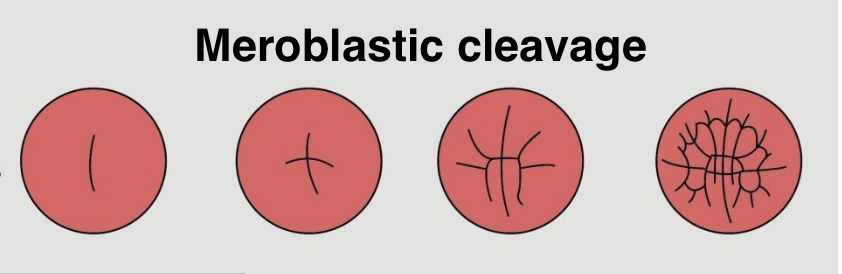
Hint: Meroblastic cleavage is a type of cleavage that occurs in very yolky eggs like birds in which the egg cytoplasm and not the yolk divides (incomplete division) . Here only a portion of the egg divides. This is due to the presence of a large amount of yolk in the egg cell that the cleavage furrows do not penetrate the yolk.
Complete step by step answer:
The definition of cleavage is the rapid cell division that leads to the formation of a multicellular embryo. The meaning of 'cleave' is to slice or split something, so it makes sense that cleavage is the splitting of cells. The zygote then travels down the fallopian tube and spends the next few days there. As it travels, it divides by mitosis several times to form a ball of cells called a morula. The cell divisions, which are called cleavage, increase the number of cells but not their overall size. We know that yolk is very dense in their consistency, so it makes sense that the more yolk present, the more difficult it is to cleave or split a cell all the way through. In this case, there is an incomplete cleavage, which we call meroblastic cleavage. If the yolk is dense and concentrated at one end of the cell we call these telolecithal cells ('telos' means 'end' - think of the two poles on Earth as being the different 'ends') .
So, the correct answer is,’Telolecithal.’.
Additional information:
1) There are two different patterns of meroblastic cleavage for telolecithal cells. The first, bilateral cleavage, is when cleavage activity is the same on both sides. What this cleavage pattern does is creates left and right halves that are mirror images of each other. The other meroblastic pattern for telolecithal cells is discoidal cleavage, which is when cleavage creates a disc of cells called a blastodisc.
2) The blastodisc forms at the animal pole, and because cleavage doesn't penetrate the yolk, the inner cells of this disc are continuous with the vegetal pole (instead of separated) .
3) We see meroblastic bilateral cleavage in animals called cephalopod molluscs, which are animals like octopi, squid, and cuttlefish.
4) A slow rate of division can be seen in mammals that are between 12 and 24 hours. These cellular divisions are asynchronous. The transcription in Zygotes starts at the 2- celled, 4- celled, or 8-celled stage. Cleavage is holoblastic and rotational.
Note: The eggs have a very small amount of yolk in the case of the placental mammals (including humans). In those cases, nourishment is provided by the mother's body, and those eggs undergo holoblastic cleavage. Other species like birds, with a lot of yolk in the egg to nourish the embryo during development, undergo meroblastic cleavage.
Complete step by step answer:
The definition of cleavage is the rapid cell division that leads to the formation of a multicellular embryo. The meaning of 'cleave' is to slice or split something, so it makes sense that cleavage is the splitting of cells. The zygote then travels down the fallopian tube and spends the next few days there. As it travels, it divides by mitosis several times to form a ball of cells called a morula. The cell divisions, which are called cleavage, increase the number of cells but not their overall size. We know that yolk is very dense in their consistency, so it makes sense that the more yolk present, the more difficult it is to cleave or split a cell all the way through. In this case, there is an incomplete cleavage, which we call meroblastic cleavage. If the yolk is dense and concentrated at one end of the cell we call these telolecithal cells ('telos' means 'end' - think of the two poles on Earth as being the different 'ends') .
So, the correct answer is,’Telolecithal.’.
Additional information:
1) There are two different patterns of meroblastic cleavage for telolecithal cells. The first, bilateral cleavage, is when cleavage activity is the same on both sides. What this cleavage pattern does is creates left and right halves that are mirror images of each other. The other meroblastic pattern for telolecithal cells is discoidal cleavage, which is when cleavage creates a disc of cells called a blastodisc.
2) The blastodisc forms at the animal pole, and because cleavage doesn't penetrate the yolk, the inner cells of this disc are continuous with the vegetal pole (instead of separated) .
3) We see meroblastic bilateral cleavage in animals called cephalopod molluscs, which are animals like octopi, squid, and cuttlefish.
4) A slow rate of division can be seen in mammals that are between 12 and 24 hours. These cellular divisions are asynchronous. The transcription in Zygotes starts at the 2- celled, 4- celled, or 8-celled stage. Cleavage is holoblastic and rotational.
Note: The eggs have a very small amount of yolk in the case of the placental mammals (including humans). In those cases, nourishment is provided by the mother's body, and those eggs undergo holoblastic cleavage. Other species like birds, with a lot of yolk in the egg to nourish the embryo during development, undergo meroblastic cleavage.
Recently Updated Pages
Master Class 10 Computer Science: Engaging Questions & Answers for Success

Master Class 10 General Knowledge: Engaging Questions & Answers for Success
Master Class 10 English: Engaging Questions & Answers for Success
Master Class 10 Social Science: Engaging Questions & Answers for Success
Master Class 10 Maths: Engaging Questions & Answers for Success
Master Class 10 Science: Engaging Questions & Answers for Success
Trending doubts
Which is more stable and why class 12 chemistry CBSE
Which are the Top 10 Largest Countries of the World?
Draw a labelled sketch of the human eye class 12 physics CBSE
Differentiate between homogeneous and heterogeneous class 12 chemistry CBSE
What are the major means of transport Explain each class 12 social science CBSE
Sulphuric acid is known as the king of acids State class 12 chemistry CBSE