




Mendel’s law of independent assortment holds good for genus situated on the
(a) Non- Homologous chromosomes
(b) Homologous chromosomes
(c) Extranuclear genetic element
(d) Same chromosomes
Answer
 Verified
610.8k+ views
Hint: Mendel indicated that on chromosomes, genes are placed. During cell division, the chromosomes split. Then, collectively, these chromosomes become part of different gametes. Within a diploid organism carrying the same genes, two pieces of DNA, one from each parental source, is good for the independent assortment law of Mendel.
Complete answer:
The independent assortment rule of Mendel is good for the genus located on the homologous chromosome. In each of their cells, diploid species, including humans, hold two copies of the genome. It helps increase both the diversity and stability of a population by providing two copies of each chromosome, called homologous chromosomes.
Mendel's Independent Assortment Rule states that the alleles of two (or more) different genes are sorted into gametes independently of each other. In other words, the allele a gamete receives for one gene does not affect the allele that another gene receives.
Additional Information: Mendel’s experiment for the law of independent assortment:
Mendel selected round-yellow seeds and wrinkled green seeds in the dihybrid cross and crossed them. In the F1 generation, he obtained only round yellow seeds. Later, in the F2 generation, the self-pollination of F1 progeny produced four separate seed combinations. The phenotypic ratio was 9:3:3:1 for round-yellow, wrinkled-yellow, round-green, and wrinkled-green seeds.
The phenotypic yellow 3:1 ratio: green color and circular 3:1 ratio: wrinkled seed form was also preserved in the dihybrid cross during the monohybrid cross. Thus, he argued that characters are separately distributed and separately inherited. He established his third law based on this observation: The Law of Independent Assortment.
This rule is demonstrated by the dihybrid crosses between the parental genotype RRYY (round yellow seeds) and rryy (green wrinkled seeds). The odds of gametes forming with the R gene and the r gene are 50:50 here. The likelihood of gametes forming with the Y gene and the y gene is also 50:50. Thus, either R or r and Y or y should be present in each gamete.
The Rule of Separate Assortment states that R and r segregation is separate from Y and y segregation. This results in four kinds of RY, Ry, RY, and Ry gametes. These allele combinations vary from the mixture of their parents (RR, YY, rr, and yy).
So, the answer is, “Homologous chromosomes.”
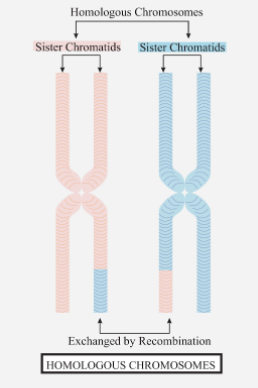
Note: - Homologous chromosomes are involved during the development of gametes in a process known as homologous recombination. This process is also known as "crossing over" because when they come into near contact, pieces of the homologous chromosomes are exchanged. The chromosomes contain the same genes, which are the same length and size in general.
- During the meiosis process, an independent assortment takes place. The chromosomes are halved in this process and are known as haploids.
Complete answer:
The independent assortment rule of Mendel is good for the genus located on the homologous chromosome. In each of their cells, diploid species, including humans, hold two copies of the genome. It helps increase both the diversity and stability of a population by providing two copies of each chromosome, called homologous chromosomes.
Mendel's Independent Assortment Rule states that the alleles of two (or more) different genes are sorted into gametes independently of each other. In other words, the allele a gamete receives for one gene does not affect the allele that another gene receives.
Additional Information: Mendel’s experiment for the law of independent assortment:
Mendel selected round-yellow seeds and wrinkled green seeds in the dihybrid cross and crossed them. In the F1 generation, he obtained only round yellow seeds. Later, in the F2 generation, the self-pollination of F1 progeny produced four separate seed combinations. The phenotypic ratio was 9:3:3:1 for round-yellow, wrinkled-yellow, round-green, and wrinkled-green seeds.
The phenotypic yellow 3:1 ratio: green color and circular 3:1 ratio: wrinkled seed form was also preserved in the dihybrid cross during the monohybrid cross. Thus, he argued that characters are separately distributed and separately inherited. He established his third law based on this observation: The Law of Independent Assortment.
This rule is demonstrated by the dihybrid crosses between the parental genotype RRYY (round yellow seeds) and rryy (green wrinkled seeds). The odds of gametes forming with the R gene and the r gene are 50:50 here. The likelihood of gametes forming with the Y gene and the y gene is also 50:50. Thus, either R or r and Y or y should be present in each gamete.
The Rule of Separate Assortment states that R and r segregation is separate from Y and y segregation. This results in four kinds of RY, Ry, RY, and Ry gametes. These allele combinations vary from the mixture of their parents (RR, YY, rr, and yy).
So, the answer is, “Homologous chromosomes.”
Note: - Homologous chromosomes are involved during the development of gametes in a process known as homologous recombination. This process is also known as "crossing over" because when they come into near contact, pieces of the homologous chromosomes are exchanged. The chromosomes contain the same genes, which are the same length and size in general.
- During the meiosis process, an independent assortment takes place. The chromosomes are halved in this process and are known as haploids.
Recently Updated Pages
Master Class 12 Economics: Engaging Questions & Answers for Success

Master Class 12 English: Engaging Questions & Answers for Success
Master Class 12 Social Science: Engaging Questions & Answers for Success
Master Class 12 Maths: Engaging Questions & Answers for Success
Master Class 12 Physics: Engaging Questions & Answers for Success
Master Class 9 General Knowledge: Engaging Questions & Answers for Success
Trending doubts
Which are the Top 10 Largest Countries of the World?
Draw a labelled sketch of the human eye class 12 physics CBSE
Differentiate between homogeneous and heterogeneous class 12 chemistry CBSE
Sulphuric acid is known as the king of acids State class 12 chemistry CBSE
Why is the cell called the structural and functional class 12 biology CBSE
Draw ray diagrams each showing i myopic eye and ii class 12 physics CBSE