




Meiosis occurs in
(a)Shoot apex
(b)Reproductive parts
(c)Root apex
(d)Leaf bud
Answer
 Verified
594.3k+ views
Hint: Meiosis is known as reductional division because the chromosome number becomes half after this division whereas mitosis is known as equational division because the chromosome number remains the same even after the division.
Complete answer:
Meiosis occurs in the reproductive parts of the plant where there is gamete formation. This is because gametes have half the number of chromosomes as compared to the parent plant. And meiosis is the type of cell division in which chromosome number becomes half. Thus, meiosis occurs in the reproductive organs of all sexually reproducing organisms.
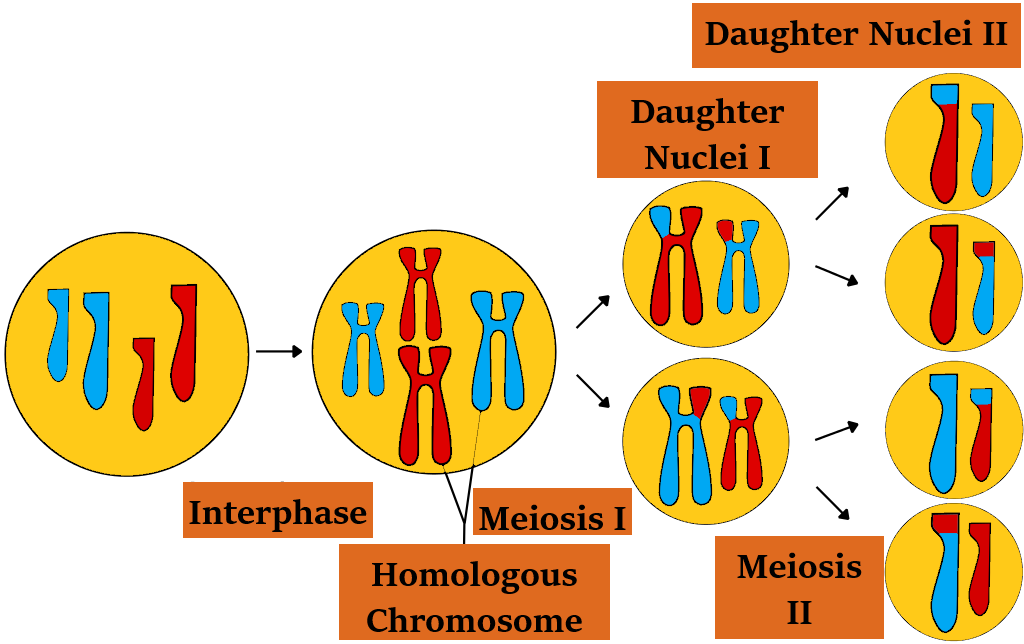
In meiosis, the cell undergoes two rounds of cell division known as meiosis-I and meiosis-II. In meiosis-I, the chromosome number is halved and meiosis-II is just normal mitotic cell division.
The gametes that fuse during fertilization to restore the chromosome number (diploidy) in the organism again.
Additional Information: Let us look at the process of meiosis in detail. It is divided into
Meiosis-I: This is further divided into
(a)Prophase-I: It consists of 5 phases known as leptotene, zygotene, pachytene, diplotene, and diakinesis. In this phase crossing over and recombination of homologous chromosomes occurs.
(b)Metaphase-I: In this phase homologous chromosomes are aligned along the equator known as the metaphase plate.
(c)Anaphase-I: In this phase, homologous chromosomes are separated due to the contraction of spindle fibers.
(d)Telophase-I: Karyokinesis occurs in this phase followed by cytokinesis resulting in 2 cells with half the number of chromosomes.
Meiosis-II: This is further divided into:
(a)Prophase-II: There is a disappearance of the nuclear membrane and condensation of the genetic material.
(b)Metaphase-II: Chromosomes are aligned on the equator again.
(c)Anaphase-II: This time instead of homologous chromosomes, chromatids are separated.
(d)Telophase-II: Karyokinesis takes place followed by cytokinesis.
So, the correct option is ‘Reproductive parts’.
Note: -Mitosis occurs to increase the cell number and thus it will occur in meristematic tissues such as shoot apex, root apex, and leaf bud.
-Crossing over which leads to recombination takes place in the pachytene stage of prophase-I.
-After crossing over, there are some parts where the homologous chromosomes are still joined which are known as chiasmata.
Complete answer:
Meiosis occurs in the reproductive parts of the plant where there is gamete formation. This is because gametes have half the number of chromosomes as compared to the parent plant. And meiosis is the type of cell division in which chromosome number becomes half. Thus, meiosis occurs in the reproductive organs of all sexually reproducing organisms.
In meiosis, the cell undergoes two rounds of cell division known as meiosis-I and meiosis-II. In meiosis-I, the chromosome number is halved and meiosis-II is just normal mitotic cell division.
The gametes that fuse during fertilization to restore the chromosome number (diploidy) in the organism again.
Additional Information: Let us look at the process of meiosis in detail. It is divided into
Meiosis-I: This is further divided into
(a)Prophase-I: It consists of 5 phases known as leptotene, zygotene, pachytene, diplotene, and diakinesis. In this phase crossing over and recombination of homologous chromosomes occurs.
(b)Metaphase-I: In this phase homologous chromosomes are aligned along the equator known as the metaphase plate.
(c)Anaphase-I: In this phase, homologous chromosomes are separated due to the contraction of spindle fibers.
(d)Telophase-I: Karyokinesis occurs in this phase followed by cytokinesis resulting in 2 cells with half the number of chromosomes.
Meiosis-II: This is further divided into:
(a)Prophase-II: There is a disappearance of the nuclear membrane and condensation of the genetic material.
(b)Metaphase-II: Chromosomes are aligned on the equator again.
(c)Anaphase-II: This time instead of homologous chromosomes, chromatids are separated.
(d)Telophase-II: Karyokinesis takes place followed by cytokinesis.
So, the correct option is ‘Reproductive parts’.
Note: -Mitosis occurs to increase the cell number and thus it will occur in meristematic tissues such as shoot apex, root apex, and leaf bud.
-Crossing over which leads to recombination takes place in the pachytene stage of prophase-I.
-After crossing over, there are some parts where the homologous chromosomes are still joined which are known as chiasmata.
Recently Updated Pages
Master Class 11 Social Science: Engaging Questions & Answers for Success

Master Class 11 English: Engaging Questions & Answers for Success
Master Class 11 Maths: Engaging Questions & Answers for Success
Master Class 11 Chemistry: Engaging Questions & Answers for Success
Master Class 11 Biology: Engaging Questions & Answers for Success
Master Class 11 Physics: Engaging Questions & Answers for Success
Trending doubts
Differentiate between an exothermic and an endothermic class 11 chemistry CBSE
One Metric ton is equal to kg A 10000 B 1000 C 100 class 11 physics CBSE
Difference Between Prokaryotic Cells and Eukaryotic Cells
There are 720 permutations of the digits 1 2 3 4 5 class 11 maths CBSE
Draw a diagram of a plant cell and label at least eight class 11 biology CBSE
Two of the body parts which do not appear in MRI are class 11 biology CBSE