




What is meant by polarization angle ? Find angle between reflected and refracted rays whenever light rays incident on polarization angle. Draw a suitable ray diagram.
Answer
 Verified
613.8k+ views
Hint: Polarization angle is an angle of incidence at which light with a particular polarization is perfectly transmitted through a transparent dielectric surface, with no reflection.
Complete step by step solution:
The phenomenon of light being polarized by reflection from a surface at a particular angle was first observed by Louis Malus in 1808.
Malus attempted to relate the polarizing angle to the refractive index of the material, but was frustrated with the quality of glasses available at that time.
In 1815, Brewster experimented with higher – quality materials and showed that this angle was a function of the refractive index, and thus given Brewster’s law. Thus polarization angle is also known as Brewster’s angle.
Polarization angle is an angle of incidence at which light with a particular polarization is perfectly transmitted through a transparent dielectric surface, with no reflection.
When unpolarized light is incident at this angle, the light that is reflected from the surface is therefore perfectly polarized.
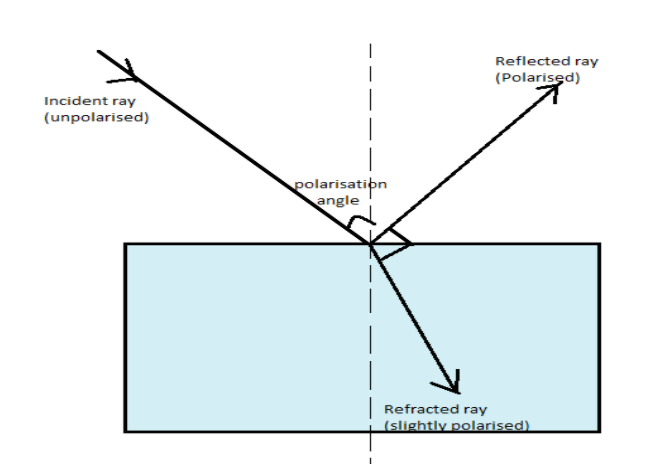
When light encounters a boundary between two media with different refractive indices, some of it is usually reflected as shown in figure.
The fraction that is reflected and the fraction that is refracted have a relation such that the angle between them is \[{90^\circ }\].
Note: Polarization angle is also known as Brewster angle. This special angle of incidence is named after the Scottish physicist Sir David Brewster. Polarized sunglasses use the principle of Brewster’s angle, to reduce the glare from the sun reflecting off horizontal surfaces such as water on the road. Polaroid sheets are used in Polarizing glasses to block horizontally – polarized light, preferentially blocking reflections from horizontal surfaces. Brewster windows are also made keeping the concept of polarization of light.
Complete step by step solution:
The phenomenon of light being polarized by reflection from a surface at a particular angle was first observed by Louis Malus in 1808.
Malus attempted to relate the polarizing angle to the refractive index of the material, but was frustrated with the quality of glasses available at that time.
In 1815, Brewster experimented with higher – quality materials and showed that this angle was a function of the refractive index, and thus given Brewster’s law. Thus polarization angle is also known as Brewster’s angle.
Polarization angle is an angle of incidence at which light with a particular polarization is perfectly transmitted through a transparent dielectric surface, with no reflection.
When unpolarized light is incident at this angle, the light that is reflected from the surface is therefore perfectly polarized.
When light encounters a boundary between two media with different refractive indices, some of it is usually reflected as shown in figure.
The fraction that is reflected and the fraction that is refracted have a relation such that the angle between them is \[{90^\circ }\].
Note: Polarization angle is also known as Brewster angle. This special angle of incidence is named after the Scottish physicist Sir David Brewster. Polarized sunglasses use the principle of Brewster’s angle, to reduce the glare from the sun reflecting off horizontal surfaces such as water on the road. Polaroid sheets are used in Polarizing glasses to block horizontally – polarized light, preferentially blocking reflections from horizontal surfaces. Brewster windows are also made keeping the concept of polarization of light.
Recently Updated Pages
Master Class 12 Economics: Engaging Questions & Answers for Success

Master Class 12 English: Engaging Questions & Answers for Success
Master Class 12 Social Science: Engaging Questions & Answers for Success
Master Class 12 Maths: Engaging Questions & Answers for Success
Master Class 12 Physics: Engaging Questions & Answers for Success
Master Class 12 Business Studies: Engaging Questions & Answers for Success
Trending doubts
Which are the Top 10 Largest Countries of the World?
Draw a labelled sketch of the human eye class 12 physics CBSE
Differentiate between homogeneous and heterogeneous class 12 chemistry CBSE
Why is the cell called the structural and functional class 12 biology CBSE
Draw ray diagrams each showing i myopic eye and ii class 12 physics CBSE
Which is the correct genotypic ratio of mendel dihybrid class 12 biology CBSE