




What is meant by dispersive power of a transparent material?
Answer
 Verified
665.4k+ views
Hint: Dispersion is known as the phenomenon of splitting of white light into its constituent colours. The band of colours is called a spectrum. Dispersive power of a transparent medium is the separation of different colours of light by refraction.
Complete step by step answer:
The dispersion was initially observed through a glass prism. It takes place because the refractive index of the material of the medium is different for different colours. By the word colours, it means the wavelengths. The dispersive power for any transparent medium is measured by the ratio of difference in refractive index of two different wavelengths to the refractive index at some specified intermediate wavelength.
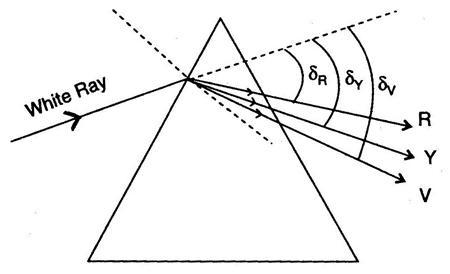
Let us consider a glass prism as an example, the refractive index of a prism is given by the relation
$\mu =\dfrac { \sin { \dfrac { A+D }{ 2 } } }{ \sin { \dfrac { A }{ 2 } } }$
Where, A is the angle of prism and
D is the angle of minimum deviation
If A is the refracting angle of a small angled prism and δ is the angle of deviation. The prism formula becomes,
$\mu =\dfrac { \sin { \dfrac { A+\delta }{ 2 } } }{ \sin { \dfrac { A }{ 2 } } }$
As we are considering small angled prism, $\sin { \dfrac { A+\delta }{ 2 } } =\dfrac { A+\delta }{ 2 }$ and $\sin { \dfrac { A }{ 2 } } =\dfrac { A }{ 2 }$
$\mu =\dfrac { \dfrac { A+\delta }{ 2 } }{ \dfrac { A }{ 2 } }$
$\mu A=A+\delta$
Therefore, $\delta =\left( \mu -1 \right) A$
If δv and δr are the deviations of violet and red rays, the corresponding wavelengths are given as μv and μr . So, the angular dispersion is given as
${ \delta }_{ v }-{ \delta }_{ r }=\left( { \mu }_{ v }-{ \mu }_{ r } \right) A$
The angular dispersion is known as the difference in deviation between extreme colours.
If δy and μy are the deviation and refractive index of an intermediate wavelength yellow,
${ \delta }_{ y }=\left( { \mu }_{ y }-1 \right) A$
On dividing both equations, we get
$\dfrac { { \delta }_{ v }-{ \delta }_{ r } }{ { \delta }_{ y } } =\dfrac { { \mu }_{ v }-{ \mu }_{ r } }{ { \mu }_{ y } }$
The expression $\dfrac { { \delta }_{ v }-{ \delta }_{ r } }{ { \delta }_{ y } }$ is known as dispersive power of the material of the prism and is denoted by ω
$\omega =\dfrac{{{\mu }_{v}}-{{\mu }_{r}}}{{{\mu }_{y}}}$
The dispersive power of the material of a prism is defined as the ratio of angular dispersion for any two wavelengths to the deviation of mean wavelength.
Note: The deviation and the refractive index is more for violet rays than red rays. Therefore, the violet rays travel with a smaller velocity in glass medium than red rays. The refractive index and deviation of yellow rays are taken as mean values.
Complete step by step answer:
The dispersion was initially observed through a glass prism. It takes place because the refractive index of the material of the medium is different for different colours. By the word colours, it means the wavelengths. The dispersive power for any transparent medium is measured by the ratio of difference in refractive index of two different wavelengths to the refractive index at some specified intermediate wavelength.
Let us consider a glass prism as an example, the refractive index of a prism is given by the relation
$\mu =\dfrac { \sin { \dfrac { A+D }{ 2 } } }{ \sin { \dfrac { A }{ 2 } } }$
Where, A is the angle of prism and
D is the angle of minimum deviation
If A is the refracting angle of a small angled prism and δ is the angle of deviation. The prism formula becomes,
$\mu =\dfrac { \sin { \dfrac { A+\delta }{ 2 } } }{ \sin { \dfrac { A }{ 2 } } }$
As we are considering small angled prism, $\sin { \dfrac { A+\delta }{ 2 } } =\dfrac { A+\delta }{ 2 }$ and $\sin { \dfrac { A }{ 2 } } =\dfrac { A }{ 2 }$
$\mu =\dfrac { \dfrac { A+\delta }{ 2 } }{ \dfrac { A }{ 2 } }$
$\mu A=A+\delta$
Therefore, $\delta =\left( \mu -1 \right) A$
If δv and δr are the deviations of violet and red rays, the corresponding wavelengths are given as μv and μr . So, the angular dispersion is given as
${ \delta }_{ v }-{ \delta }_{ r }=\left( { \mu }_{ v }-{ \mu }_{ r } \right) A$
The angular dispersion is known as the difference in deviation between extreme colours.
If δy and μy are the deviation and refractive index of an intermediate wavelength yellow,
${ \delta }_{ y }=\left( { \mu }_{ y }-1 \right) A$
On dividing both equations, we get
$\dfrac { { \delta }_{ v }-{ \delta }_{ r } }{ { \delta }_{ y } } =\dfrac { { \mu }_{ v }-{ \mu }_{ r } }{ { \mu }_{ y } }$
The expression $\dfrac { { \delta }_{ v }-{ \delta }_{ r } }{ { \delta }_{ y } }$ is known as dispersive power of the material of the prism and is denoted by ω
$\omega =\dfrac{{{\mu }_{v}}-{{\mu }_{r}}}{{{\mu }_{y}}}$
The dispersive power of the material of a prism is defined as the ratio of angular dispersion for any two wavelengths to the deviation of mean wavelength.
Note: The deviation and the refractive index is more for violet rays than red rays. Therefore, the violet rays travel with a smaller velocity in glass medium than red rays. The refractive index and deviation of yellow rays are taken as mean values.
Recently Updated Pages
Which of the following graphs shows the variation of class 12 physics CBSE

Draw a labelled diagram of the human male reproductive class 12 biology CBSE
Describe the experiment to compare the emf of two cells class 12 physics CBSE
What is standard hydrogen electrode
What is conventional current and electric current class 12 physics CBSE
2Bromopentane is treated with an alcoholic KOH solution class 12 chemistry CBSE
Trending doubts
Draw a labelled sketch of the human eye class 12 physics CBSE
Which are the Top 10 Largest Countries of the World?
Differentiate between homogeneous and heterogeneous class 12 chemistry CBSE
Draw ray diagrams each showing i myopic eye and ii class 12 physics CBSE
Which is the correct genotypic ratio of mendel dihybrid class 12 biology CBSE
What is the Full Form of PVC, PET, HDPE, LDPE, PP and PS ?