




Mature anther contains?
A) 1 wall layer, 2 microsporangia.
B) 2 wall layer , 1 microsporangium
C) 4 wall layer , 4 microsporangia
D) 2 wall layer , 4 microsporangia
Answer
 Verified
538.2k+ views
Hint: Anther is the male reproductive part of the flower which contains male gametes. Through the process of microsporogenesis, the sporogenous tissue undergoes meiotic division to form microspore tetrad while the anther is developed.
Complete answer:
We already know that stamen is the male reproductive part of the flower and consists of anther and filament. To tackle this question, we must know about anther.
An anther is a bilobed structure with each lobe containing two pollen sacs. So, in total there are four pollen sacs in which pollen grains are produced. Each pollen sac contains several pollen grains. The anther wall comprises four layers. The pollen grains that are developing consume the products of middle layers and tapetum.
Each pollen sac is called a microsporangium and is consumed with huge cells known as sporogenous cells. The sporogenous cells are actually the microspore mother cell or the microsporocyte. The cells of sporogenous tissue undergo few mitotic divisions alternatively to add up to their number before entering meiosis. Each MMC has two sets of chromosomes and so you know that it is diploid. Each meiosis gives rise to four haploid microspores, through a single meiotic division. Initially, all four spores remain enclosed in a common wall made of callous. This four-celled organization is called a tetrad.
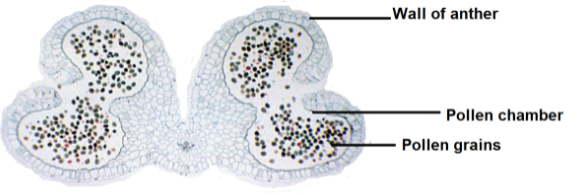
So, from the above discussion, it is quite clear that a mature anther contains a four-wall layer, as well as 4 microsporangia in it and options (C), becomes our correct answer.
Note:
- A mature microspore is called a pollen grain.
- The pollen grains are dispersed through external agents in the case of cross-pollinated plants.
- The exine of the pollen grain is made up of sporopollenin, making it resistant to chemical and biological decomposition.
Complete answer:
We already know that stamen is the male reproductive part of the flower and consists of anther and filament. To tackle this question, we must know about anther.
An anther is a bilobed structure with each lobe containing two pollen sacs. So, in total there are four pollen sacs in which pollen grains are produced. Each pollen sac contains several pollen grains. The anther wall comprises four layers. The pollen grains that are developing consume the products of middle layers and tapetum.
Each pollen sac is called a microsporangium and is consumed with huge cells known as sporogenous cells. The sporogenous cells are actually the microspore mother cell or the microsporocyte. The cells of sporogenous tissue undergo few mitotic divisions alternatively to add up to their number before entering meiosis. Each MMC has two sets of chromosomes and so you know that it is diploid. Each meiosis gives rise to four haploid microspores, through a single meiotic division. Initially, all four spores remain enclosed in a common wall made of callous. This four-celled organization is called a tetrad.
So, from the above discussion, it is quite clear that a mature anther contains a four-wall layer, as well as 4 microsporangia in it and options (C), becomes our correct answer.
Note:
- A mature microspore is called a pollen grain.
- The pollen grains are dispersed through external agents in the case of cross-pollinated plants.
- The exine of the pollen grain is made up of sporopollenin, making it resistant to chemical and biological decomposition.
Recently Updated Pages
Master Class 12 Economics: Engaging Questions & Answers for Success

Master Class 12 English: Engaging Questions & Answers for Success
Master Class 12 Social Science: Engaging Questions & Answers for Success
Master Class 12 Maths: Engaging Questions & Answers for Success
Master Class 12 Physics: Engaging Questions & Answers for Success
Master Class 12 Business Studies: Engaging Questions & Answers for Success
Trending doubts
Which are the Top 10 Largest Countries of the World?
Draw a labelled sketch of the human eye class 12 physics CBSE
Differentiate between homogeneous and heterogeneous class 12 chemistry CBSE
Sulphuric acid is known as the king of acids State class 12 chemistry CBSE
Why is the cell called the structural and functional class 12 biology CBSE
Draw ray diagrams each showing i myopic eye and ii class 12 physics CBSE