




Mark (a) if both A and R are correct and R is the correct explanation for A.
Mark (b) if both A and R are correct R is not the correct explanation for A.
Mark (c) if A is true but R is false
Mark (d) if A is false but R is true
A: The circle \[{{x}^{2}}+{{y}^{2}}+2ax+c=0,{{x}^{2}}+{{y}^{2}}+2by+c=0\] touch if \[\dfrac{1}{{{a}^{2}}}+\dfrac{1}{{{b}^{2}}}=\dfrac{1}{c}\].
R: Two circles with centers \[{{C}_{1}},{{C}_{2}}\] and radii \[{{r}_{1}},{{r}_{2}}\] touch each other if \[{{r}_{1}}\pm {{r}_{2}}={{C}_{1}}{{C}_{2}}\]
Answer
 Verified
619.8k+ views
Hint: To choose the correct option, first of all, we will check whether statement R is true or not. If statement R is found true, then we have to check which of the option (a), (b), and (d) satisfies the condition and if R is false then the possible correct option is (c).
Complete step-by-step answer:
In this question, we have to check whether A and R are true or not, and if they are true, then we need to check if they have any relation between them. The statement R states that two circles with the centers \[{{C}_{1}}\] and \[{{C}_{2}}\] and radii \[{{r}_{1}}\] and \[{{r}_{2}}\] touch each other if \[{{r}_{1}}\pm {{r}_{2}}={{C}_{1}}{{C}_{2}}\]. Now, we will consider both the cases of two circles touching each other internally and externally.
When circles touch internally
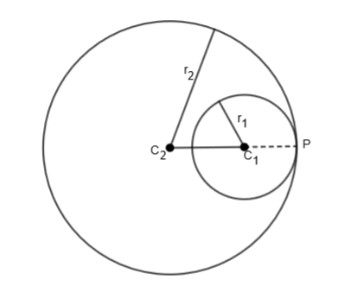
Here, we can see that \[{{C}_{2}}P={{r}_{2}}\] is the radius of the circle with the center \[{{C}_{2}}\] and \[{{C}_{1}}P={{r}_{1}}\] is the radius of the circle with the center \[{{C}_{1}}\] and from the figure, we can see that,
\[{{C}_{2}}P-{{C}_{1}}P={{C}_{1}}{{C}_{2}}\]
\[{{r}_{2}}-{{r}_{1}}={{C}_{1}}{{C}_{2}}.....\left( i \right)\]
When circle touches externally
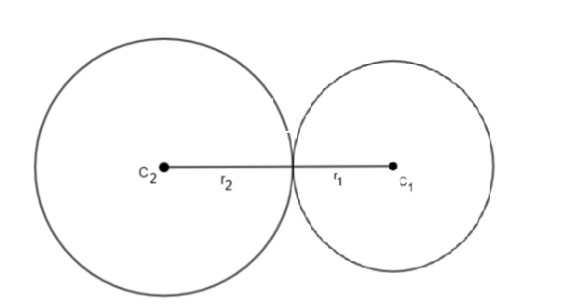
Here also, we can see that \[{{C}_{2}}P={{r}_{2}}\] and \[{{C}_{1}}P={{r}_{1}}\] are radii of the circle with center \[{{C}_{2}}\] and \[{{C}_{1}}\] respectively and from the figure, we can say that
\[{{C}_{2}}P+{{C}_{1}}P={{C}_{1}}{{C}_{2}}\]
\[{{r}_{2}}+{{r}_{1}}={{C}_{1}}{{C}_{2}}....\left( ii \right)\]
From equation (i) and (ii), we can conclude that if \[{{C}_{1}}{{C}_{2}}={{r}_{1}}\pm {{r}_{2}}\], then two circles with centers \[{{C}_{1}}\] and \[{{C}_{2}}\] and radii \[{{r}_{1}}\] and \[{{r}_{2}}\] touches each other.
Hence, R is a true statement. So, option (c) cannot be the correct answer.
Now, we will try to derive A using R to see which option is correct. We have been given a condition that \[{{x}^{2}}+{{y}^{2}}+2ax+c=0\] and \[{{x}^{2}}+{{y}^{2}}+2by+c=0\] touches if \[\dfrac{1}{{{a}^{2}}}+\dfrac{1}{{{b}^{2}}}=\dfrac{1}{c}\]. So, if we prove that if the circle touches each other, then \[\dfrac{1}{{{a}^{2}}}+\dfrac{1}{{{b}^{2}}}=\dfrac{1}{c}\], then we will get our required result.
As we have proved that if the circles touch each other, then \[{{C}_{1}}{{C}_{2}}={{r}_{1}}\pm {{r}_{2}}\]. So, let us consider circle 1 as \[{{x}^{2}}+{{y}^{2}}+2ax+c=0\] and circle 2 as \[{{x}^{2}}+{{y}^{2}}+2by+c=0\]. We know that the center of a circle of the equation \[{{x}^{2}}+{{y}^{2}}+2gx+2fy+c=0\] is given by (– g, – f) and radius as \[\sqrt{{{g}^{2}}+{{f}^{2}}-c}\].
So, we can write the center of circle 1 as \[{{C}_{1}}\left( -a,0 \right)\] and of circle 2 as \[{{C}_{2}}\left( 0,-b \right)\]. Also, we can write the radius of circle 1 as \[{{r}_{1}}=\sqrt{{{a}^{2}}-c}\] and radius of circle 2 as \[{{r}_{2}}=\sqrt{{{b}^{2}}-c}\].
So, we can write the distance between the center \[{{C}_{1}}\] and \[{{C}_{2}}\] as \[\sqrt{{{\left( 0-\left( -a \right) \right)}^{2}}+{{\left( -b-0 \right)}^{2}}}=\sqrt{{{a}^{2}}+{{b}^{2}}}\]
Now, we will put the value of \[{{C}_{1}}{{C}_{2}}\], \[{{r}_{1}}\] and \[{{r}_{2}}\] in the relation of the statement R. So, we get,
\[\sqrt{{{a}^{2}}+{{b}^{2}}}=\sqrt{{{a}^{2}}-c}\pm \sqrt{{{b}^{2}}-c}\]
Now, we will square both sides of the equation. So, we will get,
\[{{a}^{2}}+{{b}^{2}}={{\left( \sqrt{{{a}^{2}}-c} \right)}^{2}}+{{\left( \sqrt{{{b}^{2}}-c} \right)}^{2}}\pm 2\left( \sqrt{{{a}^{2}}-c} \right)\left( \sqrt{{{b}^{2}}-c} \right)\]
\[{{a}^{2}}+{{b}^{2}}={{a}^{2}}-c+{{b}^{2}}-c\pm 2\left( \sqrt{{{a}^{2}}-c} \right)\left( \sqrt{{{b}^{2}}-c} \right)\]
\[2c=\pm 2\left( \sqrt{{{a}^{2}}-c} \right)\left( \sqrt{{{b}^{2}}-c} \right)\]
\[c=\pm \left( \sqrt{{{a}^{2}}-c} \right)\left( \sqrt{{{b}^{2}}-c} \right)\]
Now, again we will square both sides of the equation. So, we will get,
\[{{c}^{2}}={{\left[ \left( \sqrt{{{a}^{2}}-c} \right)\left( \sqrt{{{b}^{2}}-c} \right) \right]}^{2}}\]
\[{{c}^{2}}=\left( {{a}^{2}}-c \right)\left( {{b}^{2}}-c \right)\]
\[{{c}^{2}}={{a}^{2}}{{b}^{2}}-{{b}^{2}}c-{{a}^{2}}c+{{c}^{2}}\]
\[{{a}^{2}}c+{{b}^{2}}c={{a}^{2}}{{b}^{2}}\]
Now, we will divide the whole equation by \[{{a}^{2}}{{b}^{2}}c\]. So, we will get,
\[\dfrac{{{a}^{2}}c}{{{a}^{2}}{{b}^{2}}c}+\dfrac{{{b}^{2}}c}{{{a}^{2}}{{b}^{2}}c}=\dfrac{{{a}^{2}}{{b}^{2}}}{{{a}^{2}}{{b}^{2}}c}\]
\[\dfrac{1}{{{b}^{2}}}+\dfrac{1}{{{a}^{2}}}=\dfrac{1}{c}\]
\[\dfrac{1}{{{a}^{2}}}+\dfrac{1}{{{b}^{2}}}=\dfrac{1}{c}\]
Here, we have proved that if the circles \[{{x}^{2}}+{{y}^{2}}+2ax+c=0\], \[{{x}^{2}}+{{y}^{2}}+2by+c=0\] touches each other then \[\dfrac{1}{{{a}^{2}}}+\dfrac{1}{{{b}^{2}}}=\dfrac{1}{c}\] which is the same as statement A.
Therefore, we can say that statement A and statement R are true and so we have derived statement A using statement R. So, we can say statement R is the correct explanation of statement A.
Hence, option (a) is the correct answer.
Note: In this question, one might choose any of the options - (a), (b) or (d) as the correct answer randomly without verifying statement A, by just after verifying the statement R as a true statement to either save time or reduce efforts which is not a correct way to solve a question. A better way to solve this is by patiently verifying statement A first by using statement R if satisfied then we will choose option (a) as correct otherwise we will look for another option and then choose the correct answer.Students should remember the center of a circle of the equation \[{{x}^{2}}+{{y}^{2}}+2gx+2fy+c=0\] is given by $(– g, – f)$ and radius as \[\sqrt{{{g}^{2}}+{{f}^{2}}-c}\] and also distance between two points formula i.e \[\sqrt{(y_2-y_1)^2+(x_2-x_1)^2}\] for solving these types of questions.
Complete step-by-step answer:
In this question, we have to check whether A and R are true or not, and if they are true, then we need to check if they have any relation between them. The statement R states that two circles with the centers \[{{C}_{1}}\] and \[{{C}_{2}}\] and radii \[{{r}_{1}}\] and \[{{r}_{2}}\] touch each other if \[{{r}_{1}}\pm {{r}_{2}}={{C}_{1}}{{C}_{2}}\]. Now, we will consider both the cases of two circles touching each other internally and externally.
When circles touch internally
Here, we can see that \[{{C}_{2}}P={{r}_{2}}\] is the radius of the circle with the center \[{{C}_{2}}\] and \[{{C}_{1}}P={{r}_{1}}\] is the radius of the circle with the center \[{{C}_{1}}\] and from the figure, we can see that,
\[{{C}_{2}}P-{{C}_{1}}P={{C}_{1}}{{C}_{2}}\]
\[{{r}_{2}}-{{r}_{1}}={{C}_{1}}{{C}_{2}}.....\left( i \right)\]
When circle touches externally
Here also, we can see that \[{{C}_{2}}P={{r}_{2}}\] and \[{{C}_{1}}P={{r}_{1}}\] are radii of the circle with center \[{{C}_{2}}\] and \[{{C}_{1}}\] respectively and from the figure, we can say that
\[{{C}_{2}}P+{{C}_{1}}P={{C}_{1}}{{C}_{2}}\]
\[{{r}_{2}}+{{r}_{1}}={{C}_{1}}{{C}_{2}}....\left( ii \right)\]
From equation (i) and (ii), we can conclude that if \[{{C}_{1}}{{C}_{2}}={{r}_{1}}\pm {{r}_{2}}\], then two circles with centers \[{{C}_{1}}\] and \[{{C}_{2}}\] and radii \[{{r}_{1}}\] and \[{{r}_{2}}\] touches each other.
Hence, R is a true statement. So, option (c) cannot be the correct answer.
Now, we will try to derive A using R to see which option is correct. We have been given a condition that \[{{x}^{2}}+{{y}^{2}}+2ax+c=0\] and \[{{x}^{2}}+{{y}^{2}}+2by+c=0\] touches if \[\dfrac{1}{{{a}^{2}}}+\dfrac{1}{{{b}^{2}}}=\dfrac{1}{c}\]. So, if we prove that if the circle touches each other, then \[\dfrac{1}{{{a}^{2}}}+\dfrac{1}{{{b}^{2}}}=\dfrac{1}{c}\], then we will get our required result.
As we have proved that if the circles touch each other, then \[{{C}_{1}}{{C}_{2}}={{r}_{1}}\pm {{r}_{2}}\]. So, let us consider circle 1 as \[{{x}^{2}}+{{y}^{2}}+2ax+c=0\] and circle 2 as \[{{x}^{2}}+{{y}^{2}}+2by+c=0\]. We know that the center of a circle of the equation \[{{x}^{2}}+{{y}^{2}}+2gx+2fy+c=0\] is given by (– g, – f) and radius as \[\sqrt{{{g}^{2}}+{{f}^{2}}-c}\].
So, we can write the center of circle 1 as \[{{C}_{1}}\left( -a,0 \right)\] and of circle 2 as \[{{C}_{2}}\left( 0,-b \right)\]. Also, we can write the radius of circle 1 as \[{{r}_{1}}=\sqrt{{{a}^{2}}-c}\] and radius of circle 2 as \[{{r}_{2}}=\sqrt{{{b}^{2}}-c}\].
So, we can write the distance between the center \[{{C}_{1}}\] and \[{{C}_{2}}\] as \[\sqrt{{{\left( 0-\left( -a \right) \right)}^{2}}+{{\left( -b-0 \right)}^{2}}}=\sqrt{{{a}^{2}}+{{b}^{2}}}\]
Now, we will put the value of \[{{C}_{1}}{{C}_{2}}\], \[{{r}_{1}}\] and \[{{r}_{2}}\] in the relation of the statement R. So, we get,
\[\sqrt{{{a}^{2}}+{{b}^{2}}}=\sqrt{{{a}^{2}}-c}\pm \sqrt{{{b}^{2}}-c}\]
Now, we will square both sides of the equation. So, we will get,
\[{{a}^{2}}+{{b}^{2}}={{\left( \sqrt{{{a}^{2}}-c} \right)}^{2}}+{{\left( \sqrt{{{b}^{2}}-c} \right)}^{2}}\pm 2\left( \sqrt{{{a}^{2}}-c} \right)\left( \sqrt{{{b}^{2}}-c} \right)\]
\[{{a}^{2}}+{{b}^{2}}={{a}^{2}}-c+{{b}^{2}}-c\pm 2\left( \sqrt{{{a}^{2}}-c} \right)\left( \sqrt{{{b}^{2}}-c} \right)\]
\[2c=\pm 2\left( \sqrt{{{a}^{2}}-c} \right)\left( \sqrt{{{b}^{2}}-c} \right)\]
\[c=\pm \left( \sqrt{{{a}^{2}}-c} \right)\left( \sqrt{{{b}^{2}}-c} \right)\]
Now, again we will square both sides of the equation. So, we will get,
\[{{c}^{2}}={{\left[ \left( \sqrt{{{a}^{2}}-c} \right)\left( \sqrt{{{b}^{2}}-c} \right) \right]}^{2}}\]
\[{{c}^{2}}=\left( {{a}^{2}}-c \right)\left( {{b}^{2}}-c \right)\]
\[{{c}^{2}}={{a}^{2}}{{b}^{2}}-{{b}^{2}}c-{{a}^{2}}c+{{c}^{2}}\]
\[{{a}^{2}}c+{{b}^{2}}c={{a}^{2}}{{b}^{2}}\]
Now, we will divide the whole equation by \[{{a}^{2}}{{b}^{2}}c\]. So, we will get,
\[\dfrac{{{a}^{2}}c}{{{a}^{2}}{{b}^{2}}c}+\dfrac{{{b}^{2}}c}{{{a}^{2}}{{b}^{2}}c}=\dfrac{{{a}^{2}}{{b}^{2}}}{{{a}^{2}}{{b}^{2}}c}\]
\[\dfrac{1}{{{b}^{2}}}+\dfrac{1}{{{a}^{2}}}=\dfrac{1}{c}\]
\[\dfrac{1}{{{a}^{2}}}+\dfrac{1}{{{b}^{2}}}=\dfrac{1}{c}\]
Here, we have proved that if the circles \[{{x}^{2}}+{{y}^{2}}+2ax+c=0\], \[{{x}^{2}}+{{y}^{2}}+2by+c=0\] touches each other then \[\dfrac{1}{{{a}^{2}}}+\dfrac{1}{{{b}^{2}}}=\dfrac{1}{c}\] which is the same as statement A.
Therefore, we can say that statement A and statement R are true and so we have derived statement A using statement R. So, we can say statement R is the correct explanation of statement A.
Hence, option (a) is the correct answer.
Note: In this question, one might choose any of the options - (a), (b) or (d) as the correct answer randomly without verifying statement A, by just after verifying the statement R as a true statement to either save time or reduce efforts which is not a correct way to solve a question. A better way to solve this is by patiently verifying statement A first by using statement R if satisfied then we will choose option (a) as correct otherwise we will look for another option and then choose the correct answer.Students should remember the center of a circle of the equation \[{{x}^{2}}+{{y}^{2}}+2gx+2fy+c=0\] is given by $(– g, – f)$ and radius as \[\sqrt{{{g}^{2}}+{{f}^{2}}-c}\] and also distance between two points formula i.e \[\sqrt{(y_2-y_1)^2+(x_2-x_1)^2}\] for solving these types of questions.
Recently Updated Pages
Basicity of sulphurous acid and sulphuric acid are

Master Class 12 English: Engaging Questions & Answers for Success
Master Class 12 Social Science: Engaging Questions & Answers for Success
Master Class 12 Maths: Engaging Questions & Answers for Success
Master Class 12 Economics: Engaging Questions & Answers for Success
Master Class 12 Physics: Engaging Questions & Answers for Success
Trending doubts
Which are the Top 10 Largest Countries of the World?
Draw a labelled sketch of the human eye class 12 physics CBSE
Which state in the country is at the forefront in controlling class 12 social science CBSE
Mention the role of cyanobacteria as a biofertiliz class 12 biology ICSE
Where is the largest hydroelectric power station located class 12 biology CBSE
Which country did Danny Casey play for class 12 english CBSE