




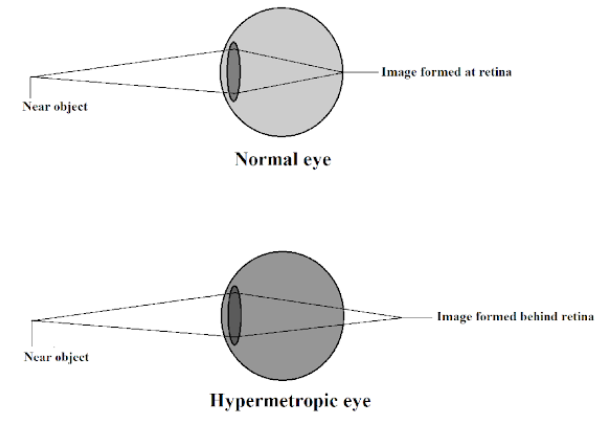
Make a diagram to show how hypermetropia is corrected. The near point of the hypermetropic eye is $1m$. What is the power of the lens required to correct this defect? Assume that the near point of eye is $25cm$.
Answer
 Verified
615.9k+ views
Hint: In case of hypermetropia, the image of the object placed at normal near point is formed at the back of the retina. For correcting hypermetropia, the lens which can converge the light rays at the retina of the human eye will be considered. For finding the power of the lens used, we need to find the focal length of the lens used.
Formula used:
For finding the focal length of lens, $\dfrac{1}{f}=\dfrac{1}{v}-\dfrac{1}{u}$
For finding the power of lens, $P=\dfrac{1}{f}$
Complete step-by-step answer:
Hypermetropia is also known as farsightedness. A person with hypermetropia can see distant objects clearly but cannot see the near objects distinctly.
This effect can be corrected by using a convex lens of appropriate power. The convex lens converges the incident light rays so that the final image of the object from the human eye lens is formed at the retina of the eye.
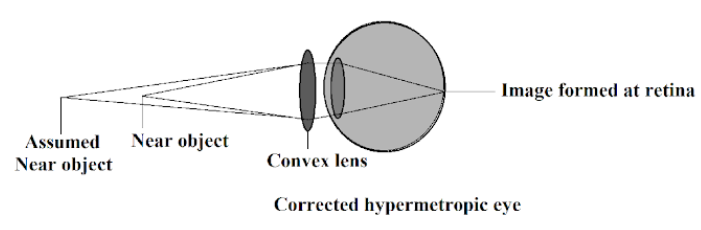
The object placed at $25cm$ from the correcting lens must produce a virtual image at $1m$ or $100cm$.
Object distance, $u=-25cm$
Virtual image distance, $v=-100cm$
Using lens formula,
$\dfrac{1}{f}=\dfrac{1}{v}-\dfrac{1}{u}$
Putting the values, we get,
$\begin{align}
& \dfrac{1}{f}=\dfrac{1}{-100}-\dfrac{1}{-25} \\
& =\dfrac{1}{-100}+\dfrac{1}{25} \\
& =+\dfrac{3}{100}
\end{align}$
Therefore,
$\begin{align}
& f=+\dfrac{100}{3}cm \\
& f=+\dfrac{1}{3}m \\
\end{align}$
Therefore, power of lens is,
$\begin{align}
& P=\dfrac{1}{f}=+3 \\
& P=+3D \\
\end{align}$
Hence, the power of the lens required to correct the defect is $+3D$.
Note: While calculating the power of the lens in Dioptres, focal length must be taken in metres only. For correcting hypermetropia, convex lens is used and focal length of convex lens is considered as positive. Therefore, the power of the lens used for correcting hypermetropia is positive.
Formula used:
For finding the focal length of lens, $\dfrac{1}{f}=\dfrac{1}{v}-\dfrac{1}{u}$
For finding the power of lens, $P=\dfrac{1}{f}$
Complete step-by-step answer:
Hypermetropia is also known as farsightedness. A person with hypermetropia can see distant objects clearly but cannot see the near objects distinctly.
This effect can be corrected by using a convex lens of appropriate power. The convex lens converges the incident light rays so that the final image of the object from the human eye lens is formed at the retina of the eye.
The object placed at $25cm$ from the correcting lens must produce a virtual image at $1m$ or $100cm$.
Object distance, $u=-25cm$
Virtual image distance, $v=-100cm$
Using lens formula,
$\dfrac{1}{f}=\dfrac{1}{v}-\dfrac{1}{u}$
Putting the values, we get,
$\begin{align}
& \dfrac{1}{f}=\dfrac{1}{-100}-\dfrac{1}{-25} \\
& =\dfrac{1}{-100}+\dfrac{1}{25} \\
& =+\dfrac{3}{100}
\end{align}$
Therefore,
$\begin{align}
& f=+\dfrac{100}{3}cm \\
& f=+\dfrac{1}{3}m \\
\end{align}$
Therefore, power of lens is,
$\begin{align}
& P=\dfrac{1}{f}=+3 \\
& P=+3D \\
\end{align}$
Hence, the power of the lens required to correct the defect is $+3D$.
Note: While calculating the power of the lens in Dioptres, focal length must be taken in metres only. For correcting hypermetropia, convex lens is used and focal length of convex lens is considered as positive. Therefore, the power of the lens used for correcting hypermetropia is positive.
Recently Updated Pages
Three beakers labelled as A B and C each containing 25 mL of water were taken A small amount of NaOH anhydrous CuSO4 and NaCl were added to the beakers A B and C respectively It was observed that there was an increase in the temperature of the solutions contained in beakers A and B whereas in case of beaker C the temperature of the solution falls Which one of the following statements isarecorrect i In beakers A and B exothermic process has occurred ii In beakers A and B endothermic process has occurred iii In beaker C exothermic process has occurred iv In beaker C endothermic process has occurred

Master Class 12 Social Science: Engaging Questions & Answers for Success
Master Class 12 Physics: Engaging Questions & Answers for Success
Master Class 12 Maths: Engaging Questions & Answers for Success
Master Class 12 Economics: Engaging Questions & Answers for Success
Master Class 12 Chemistry: Engaging Questions & Answers for Success
Three beakers labelled as A B and C each containing 25 mL of water were taken A small amount of NaOH anhydrous CuSO4 and NaCl were added to the beakers A B and C respectively It was observed that there was an increase in the temperature of the solutions contained in beakers A and B whereas in case of beaker C the temperature of the solution falls Which one of the following statements isarecorrect i In beakers A and B exothermic process has occurred ii In beakers A and B endothermic process has occurred iii In beaker C exothermic process has occurred iv In beaker C endothermic process has occurred
Master Class 12 Social Science: Engaging Questions & Answers for Success
Master Class 12 Physics: Engaging Questions & Answers for Success
Trending doubts
Which are the Top 10 Largest Countries of the World?
Draw a labelled sketch of the human eye class 12 physics CBSE
Differentiate between homogeneous and heterogeneous class 12 chemistry CBSE
What are the major means of transport Explain each class 12 social science CBSE
Sulphuric acid is known as the king of acids State class 12 chemistry CBSE
Why should a magnesium ribbon be cleaned before burning class 12 chemistry CBSE