




Magnetic line of force originates from ____
Answer
 Verified
574.5k+ views
Hint: Magnetic lines of force are imaginary lines representing the direction of magnetic field. The tangent at any point on the magnetic field lines represents the direction of the field vector at that point. When a small magnet is placed in between these field lines it aligns itself in the direction of these magnetic field lines.
Complete answer:
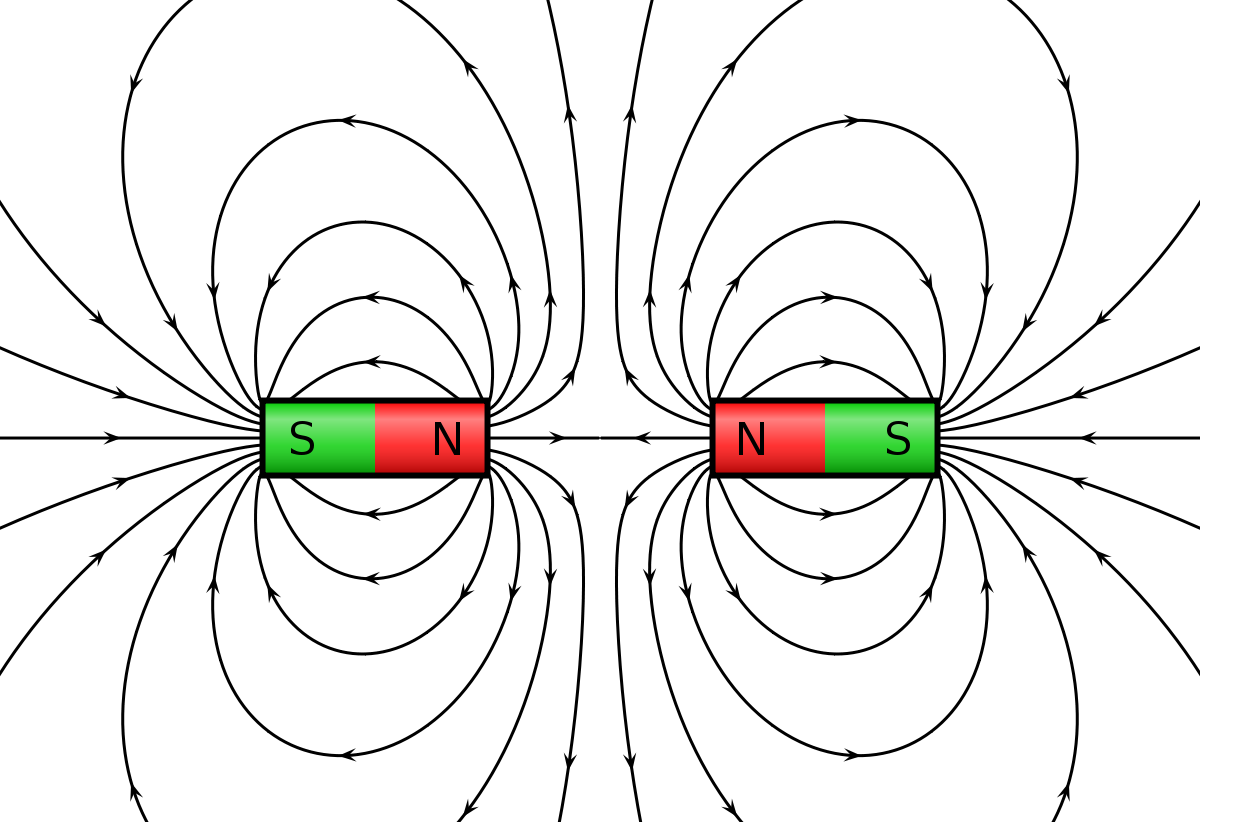
Magnetic field lines of force always emerge from the North Pole and terminate to the South Pole. The lines travel from south to north pole inside the magnet and outside they travel from south to north pole.
The lines are not real, they are imaginary. Magnetic field lines follow a curvilinear path while moving from north to south pole outside the magnet and south to north inside it. This can be seen in the following image:
They have a unique property that they never intersect though curved. Their tangents are always parallel but not intersecting. Also, they never have an end point, or a start point.
Magnetic flux is the number of magnetic field lines passing through a specific area. Magnetic induction is the number of lines passing through a unit area.
When we perform an experiment to get these imaginary magnetic field lines, we need to place a bar magnet on a sheet which has sprinkled iron fillings. They get arranged as circular lines representing magnetic field lines.
Note:
In magnets unlike charges, we get both pairs of north and south poles together at two ends. So, whenever the above experiment is performed, we could see fillings of iron arranged in such a way as if lines emerge from one end of the magnet bar and terminate to another end. Whereas in charges we could see electric lines either emerging or terminating, since they have a single charge present at a time.
Complete answer:
Magnetic field lines of force always emerge from the North Pole and terminate to the South Pole. The lines travel from south to north pole inside the magnet and outside they travel from south to north pole.
The lines are not real, they are imaginary. Magnetic field lines follow a curvilinear path while moving from north to south pole outside the magnet and south to north inside it. This can be seen in the following image:
They have a unique property that they never intersect though curved. Their tangents are always parallel but not intersecting. Also, they never have an end point, or a start point.
Magnetic flux is the number of magnetic field lines passing through a specific area. Magnetic induction is the number of lines passing through a unit area.
When we perform an experiment to get these imaginary magnetic field lines, we need to place a bar magnet on a sheet which has sprinkled iron fillings. They get arranged as circular lines representing magnetic field lines.
Note:
In magnets unlike charges, we get both pairs of north and south poles together at two ends. So, whenever the above experiment is performed, we could see fillings of iron arranged in such a way as if lines emerge from one end of the magnet bar and terminate to another end. Whereas in charges we could see electric lines either emerging or terminating, since they have a single charge present at a time.
Recently Updated Pages
Explain the structure of megasporangium class 12 biology CBSE

Why is chloroform kept in dark coloured bottles class 12 chemistry CBSE
Derive the balancing condition of a Wheatstone bri class 12 physics CBSE
Draw VI characteristics of a pn junction diode Explain class 12 physics CBSE
Is it possible to carry pride in ones language too class 12 english CBSE
In a population at Hardy Weinberg equilibrium the allele class 12 biology CBSE
Trending doubts
Draw a labelled sketch of the human eye class 12 physics CBSE
Which are the Top 10 Largest Countries of the World?
Draw ray diagrams each showing i myopic eye and ii class 12 physics CBSE
One megawatt is equal to how many units of electri class 12 physics CBSE
Which is the correct genotypic ratio of mendel dihybrid class 12 biology CBSE
Give 10 examples of unisexual and bisexual flowers