




What is Lucas reagent? Distinguish primary, secondary and tertiary alcohols using Lucas reagent.
Answer
 Verified
672k+ views
Hint: Lucas reagent is a solution of a transition metal chloride in an inorganic acid. Lucas reagent will give a unimolecular nucleophilic substitution reaction with alcohols in which the different types of alcohols will react differently.
Complete step by step solution:
- Solution of anhydrous Zinc chloride in concentrated hydrochloric acid is known as Lucas reagent.
- Lucas reagent simply substitutes –Cl group in place of –OH group. It is a kind of \[{S_N}1\] reaction. So, carbocation is formed during the reaction. Let’s see how all types of alcohols react with Lucas reagent.
- Below is the reaction of primary alcohol Propan-1-ol with Lucas reagent. Here, primary cation is formed as hydroxyl group leaves after getting protonated by acid in the form of water. It does not give a\[{S_N}1\] reaction at room temperature. So, the solution remains the same and it is clear.

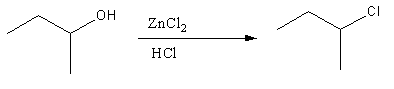
- Secondary alcohol forms secondary cation after the hydroxyl group is removed, it takes some minutes to react with chloride ions present in the solution to give \[{S_N}1\] reaction. It is shown in the reaction. As the reaction occurs, Chloroalkane is the product and we can see the solution becoming hazy.
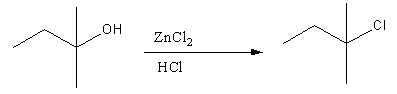
- Tertiary alcohols form tertiary cation by the reaction with Lucas reagent and as tertiary cations are most stable, it gives substitution reaction immediately and gives chloroalkane. Formation of products makes solutions hazy.
- So, we can conclude that tertiary alcohols immediately react with Lucas reagent, secondary alcohols take some minutes to react and primary alcohols do not react with Lucas reagent at room temperatures.
Additional Information:
- Lucas reagent can only distinguish small chain alcohols.
- Mixture of anhydrous Zinc chloride and concentrated hydrochloric acid is taken in equimolar proportions as Lucas reagent .
Note:
Note that here \[{S_N}1\] reaction occurs. Considering it as \[{S_N}2\] reaction will lead to wrong conclusions. In Lucas reagent, we cannot use any other acid. We need to use hydrochloric acid only.
Complete step by step solution:
- Solution of anhydrous Zinc chloride in concentrated hydrochloric acid is known as Lucas reagent.
- Lucas reagent simply substitutes –Cl group in place of –OH group. It is a kind of \[{S_N}1\] reaction. So, carbocation is formed during the reaction. Let’s see how all types of alcohols react with Lucas reagent.
- Below is the reaction of primary alcohol Propan-1-ol with Lucas reagent. Here, primary cation is formed as hydroxyl group leaves after getting protonated by acid in the form of water. It does not give a\[{S_N}1\] reaction at room temperature. So, the solution remains the same and it is clear.
- Secondary alcohol forms secondary cation after the hydroxyl group is removed, it takes some minutes to react with chloride ions present in the solution to give \[{S_N}1\] reaction. It is shown in the reaction. As the reaction occurs, Chloroalkane is the product and we can see the solution becoming hazy.
- Tertiary alcohols form tertiary cation by the reaction with Lucas reagent and as tertiary cations are most stable, it gives substitution reaction immediately and gives chloroalkane. Formation of products makes solutions hazy.
- So, we can conclude that tertiary alcohols immediately react with Lucas reagent, secondary alcohols take some minutes to react and primary alcohols do not react with Lucas reagent at room temperatures.
Additional Information:
- Lucas reagent can only distinguish small chain alcohols.
- Mixture of anhydrous Zinc chloride and concentrated hydrochloric acid is taken in equimolar proportions as Lucas reagent .
Note:
Note that here \[{S_N}1\] reaction occurs. Considering it as \[{S_N}2\] reaction will lead to wrong conclusions. In Lucas reagent, we cannot use any other acid. We need to use hydrochloric acid only.
Recently Updated Pages
Explain the structure of megasporangium class 12 biology CBSE

Why is chloroform kept in dark coloured bottles class 12 chemistry CBSE
Derive the balancing condition of a Wheatstone bri class 12 physics CBSE
Draw VI characteristics of a pn junction diode Explain class 12 physics CBSE
Is it possible to carry pride in ones language too class 12 english CBSE
In a population at Hardy Weinberg equilibrium the allele class 12 biology CBSE
Trending doubts
Draw a labelled sketch of the human eye class 12 physics CBSE
Which are the Top 10 Largest Countries of the World?
Draw ray diagrams each showing i myopic eye and ii class 12 physics CBSE
One megawatt is equal to how many units of electri class 12 physics CBSE
Which is the correct genotypic ratio of mendel dihybrid class 12 biology CBSE
Give 10 examples of unisexual and bisexual flowers